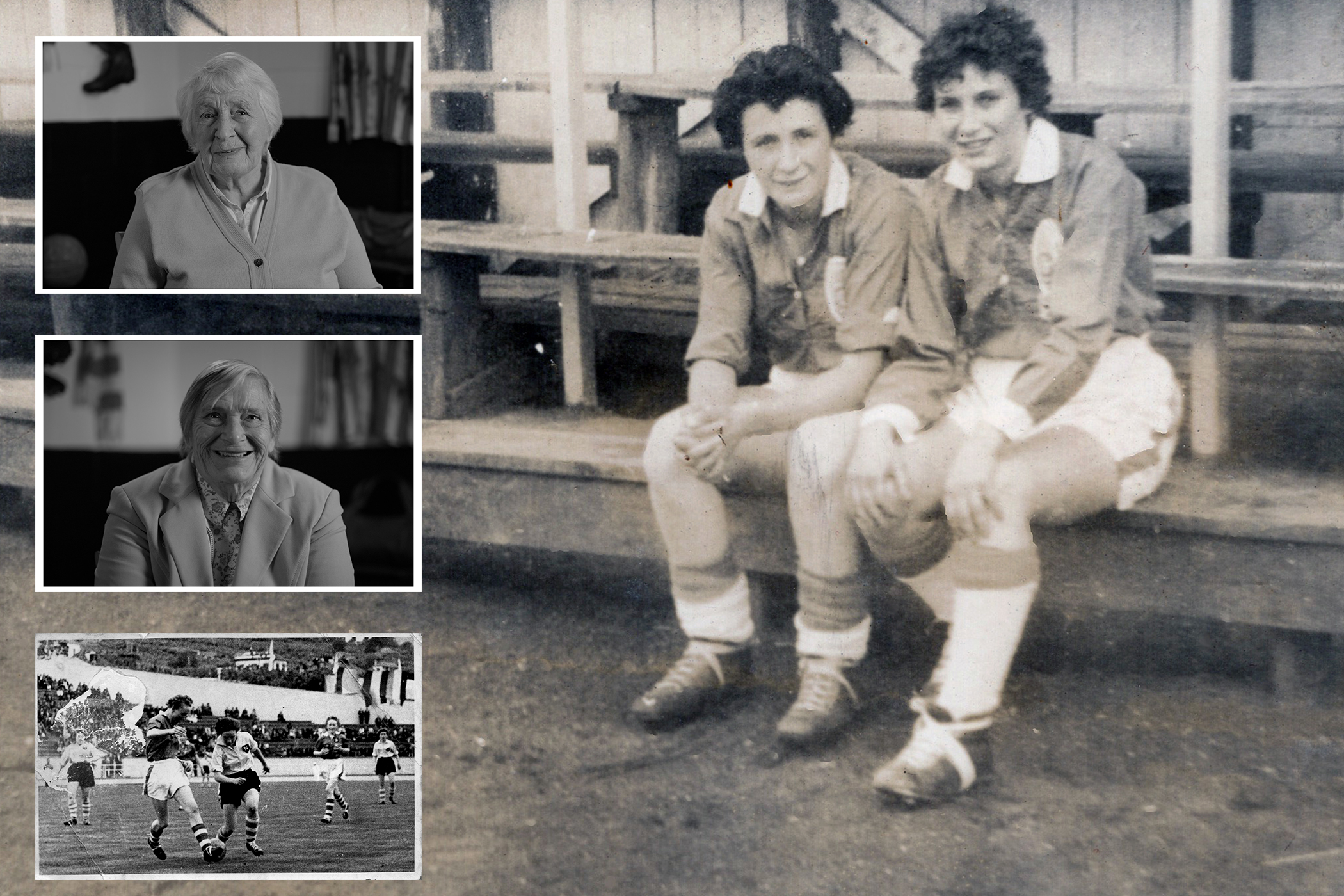


You might have spotted them around Manchester, 10 wise women, faces rich with experience, looking down at the city on 30 billboards from the Printworks to Piccadilly.
If not there, perhaps on BBC Breakfast, North West Tonight, Granada, Radio Manchester or the World Service. Or belting out a club song at arts centre HOME, at the premiere of the new film made to celebrate their lives, The Corinthians, We Were The Champions. After 50 years, it’s about time they were heard.
Myra Lypnyckyj, Anne Grimes. Pauline Hulme, Marlene Cook, Freda Ashton, Monica Curran, Margaret “Whit” Whitworth, Jean Wilson, Jan Lyons, and Margaret “Tiny” Shepherd were all members of the Corinthians FC, a globe-trotting, rule-breaking, English women’s football club based in Manchester, at their zenith during the half a century that the FA banned, and tried to bury, women’s football, describing it as“quite unsuitable for females” and “not to be encouraged”.
The game duly shrank from its post-World War One height, as the FA had hoped, but it didn’t die. Among the believers was Percy Ashley, a scout for Bolton Wanderers, who formed the Corinthians in 1949, so that his talented daughter Doris, who was deaf, would have a team to play with. They trained and played at Fog Lane Park in Didsbury, and from this muddy field grew an unstoppable, slide-tackling, taboo-breaking team.
The FA may have been able to stop them kicking a ball on FA-affiliated pitches, but it couldn’t stop them winning. They were so good that Ashley had to form a second team, The Nomads. Nor could the FA stop them touring the world, sponsored by the Red Cross. Off they went to Germany, encouraged by Manchester City goalkeeper Bert Trautmann, and won the unofficial European Cup in 1957. They flew to Portugal, and played at Sporting Lisbon’s ground. In 1960, they jetted to South America, on a trip that was supposed to take three weeks but took three months, such was the desire to watch them play. Then triumphed over Juventus to bag another European Cup in 1970, before the FA finally relented in 1971. In between they limbo danced, sunbathed naked and downed rum and cokes. And signed autographs, lots of autographs.
‘People didn’t take women playing any game serious in my class’
‘People didn’t take women playing any game serious in my class’
Monica Curran, former player
The filmmaker, Helen Tither, first read about their story in the Manchester Evening News in 2022. She arranged a meeting with the surviving players at the Football Museum, and they arrived with bags full of scrapbooks, trophies and enthusiasm. She learnt that “no one was really interested”, in their achievements and knew immediately that she had a story.
She thought it would be an easy sell. It wasn’t. “Too northern,” she was told. “Too niche, too old … no one wants to watch women’s football.” So, in the spirit of the Corinthians, she set up her own company, Films Not Words, to make the film and, with the help of crowdfunders, raised the money to make it possible.
It is a lovely piece of documentary making – 90 minutes (no extra time) of no-nonsense, very funny talking heads, threaded together with archive footage, comic-book style animations and visits back to Fog Lane. You hear the women, now aged between 70 and 90, describe the absolute joy that came from being able to play with other women, the sacrifices made and the transformative effect it had on their lives.
The personal stories were filmed in the dressing room of local club, West Didsbury and Chorlton. “You don’t see many women talking about their sporting careers,” says Tither. “So I didn’t want it to be setting them up on a sofa with a cup of tea. I wanted them to be seen as footballers.”
And they are: penalty-saving, defender-stalking, goal-heading champions. Brutal, too. “If you can’t stop ’em,” says Ashton in the film, “drop ’em.”
Newsletters
Choose the newsletters you want to receive
View more
For information about how The Observer protects your data, read our Privacy Policy
Curran played at left wing. She left school in Oldham at 15 and worked in a variety of factories, on conveyor belts and making bicycle chains. She is now just completed a Phd, aged 80. She says she was shy back then – she isn’t now. “I’d probably never been out of Oldham,” she says, “and when I went to Italy with the football it blew my mind. I couldn’t believe it: the smells, the clothes, the culture, how they were. Lovely thin pizzas, we didn‘t know about pizzas; meat-and-potato pie that’s what we had.
“It was the makings of me … gave me an education. It was like a scene in my head, I didn’t just want to go to Oldham market and have an Oxo drink … it’s like you go from a black-and-white world to this colour world, that’s how it felt. And soon after that I left home to pursue a different way of life. There’s nothing wrong with Oldham and I’m proud of where I come from, but you were restricted, especially as a girl.
“It was all down to Percy, he respected you, took you serious, people didn’t take women playing any game serious in my class.”
Andy Burnham, the mayor of Greater Manchester, was at the sold-out first public screening on Thursday, and promised a statue for the Corinthians in Manchester – though his suggestion of Ashley was quickly tweaked by Tither to be Percy and Doris – and to press for an apology from the FA. “This city is a football city to its core,” he said. “Who are we if we are not going to tell their story.”
The Corinthians. Footballers. Rule breakers. Rebels. Seen at last.
The Corinthians, We Were The Champions is being shown at HOME, Manchester on 2, 12 and 28 April.