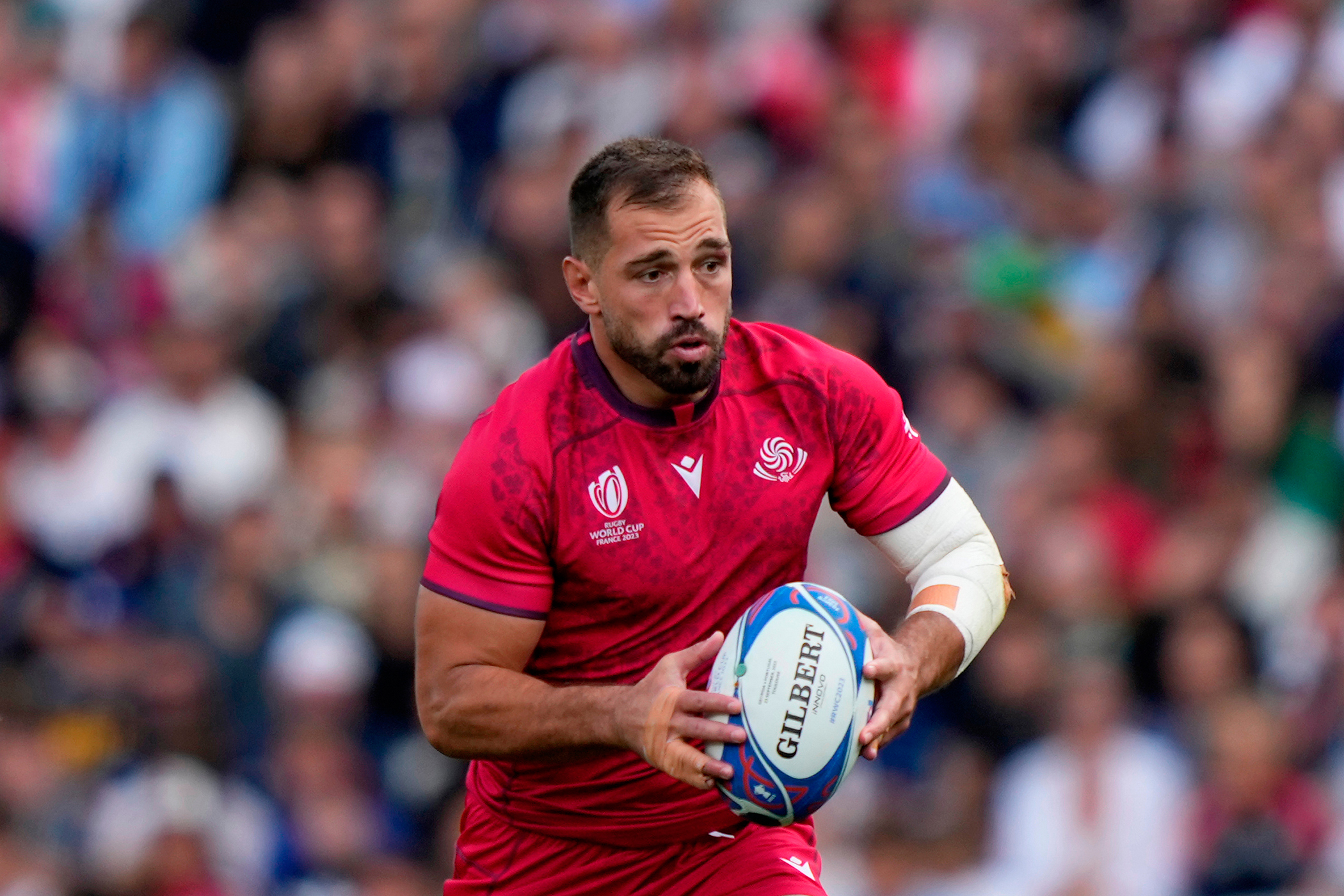
Look, it is not all bad news. Congratulations to those involved in what has been described as rugby’s biggest-ever doping investigation for successfully landing the plane. Handing out almost 36 years’ worth of bans to six Georgian players – and one doctor – after a process that has lasted four years must feel satisfying.
Operation Obsidian – as in, the volcanic rock – was a joint investigation between World Rugby and the World Anti Doping Agency, triggered by the findings of irregularities in urine samples provided by the players involved over an extended period of time.
World Rugby’s operating hypothesis was that the urine swaps were done to intentionally conceal the use of performance-enhancing substances, although no evidence has turned up to support this theory.
However, the investigation did uncover credible evidence that the use of cannabis and tramadol – the latter is a strong painkiller – had been concealed by the swapped urine samples.
The doctor, Nutsa Shamatava, asked either over text message or in person for Merab Sharikadze, the former Georgia captain, to provide clean urine that the other players could use for their samples.
On top of that, the doctor would send messages to group chats containing up to 26 Georgian players, giving them up to 24 hours’ notice of which players would be tested and on which days. Given that a core part of drug testing is no advance notice, to avoid any subterfuge, Shamatava’s actions are extraordinary. She was banned for nine years. Sharikadze, for his part in supplying the urine to the three players, was suspended for 11 years.
Giorgi Chkoidze, who returned two urine samples which did not match his DNA – the first all the way back in 2019 – was banned for six years. Lasha Khmaladze, who supplied one of Chkoidze’s fake samples, received three years, as did Miriani Modebadze and Otar Lashkhi after the DNA match for their samples was revealed to belong to Sharikadze. Lasha Lomidze received the shortest suspension at nine months. Part of the sanction includes a misconduct charge against the Georgian Rugby Union (GRU) and a financial penalty, while an independent enquiry into the GRU was also commissioned.
Even if no evidence was found that the urine sample swaps were carried out to conceal the use of performance-enhancing drugs, this is still a terrible look for the Georgian Rugby Union. The coercion between medical staff and senior players, the repetitive nature of the offences, and the orchestration by the team doctor to alert players of imminent tests through WhatsApp groups about when their tests were coming up – or, to put it another way, give the players a timeframe to get themselves organised – raises an obvious question around whether more players could have been involved.
Now begins years of work to convince doubters the discrepancy was a one-off
Now begins years of work to convince doubters the discrepancy was a one-off
There is a twinge of sadness about the whole thing. For years there have been campaigns to add Georgia into the Six Nations, with the Lelos stretching clear of the rest of the pack in the second tier, winning 14 out of the last 16 Rugby Europe Championships (they were stunned in the final game this year by champions Portugal). Their success and the struggles of Italy, and more recently Wales, created a discussion not without merit around whether a door should be opened at the bottom of the Six Nations to allow Georgia to swap trips to Madrid and Mons for Paris and Twickenham.
When Georgia won in Cardiff in 2022, defeating a good Wales side by a point, the drumbeat for their inclusion in the Six Nations only grew louder. Imagine if Georgia had been invited into the country club, replacing another side or as a seventh team, and then this investigation had been revealed. The column inches it would be taking up. The outrage that would ensue. Or if a Tier One side had been discovered to be operating a similar alert system between team doctor and players, swapping samples to try and beat the drug testers. There would have been utter condemnation.
Newsletters
Choose the newsletters you want to receive
View more
For information about how The Observer protects your data, read our Privacy Policy
The price for Georgia, beyond whatever financial penalty has been dished out, is the reputational fractures this will cause even if no performance-enhancing drugs have been found to be used at any point during the investigation. Regardless of their innocence in that respect, opponents and governing bodies and supporters will now raise an eyebrow when it comes to Georgia. There will be suspicion. And when you are a second-tier side trying to break into the room where the game’s global elite sit, an incident such as this makes the prospect of you being welcomed and accepted immensely more difficult.
Your standards have to be whiter than white. A number of players and staff wilfully failing to comply with their anti-doping obligations, bringing the game into disrepute under Regulation 18.5, does not exactly fit that bill. And now likely begins what will be years of hard work to convince doubters that this discrepancy was a one-off blot, not a sign of systemic failure. That the punishments will act as a precedent.
Remarkably, the Georgia revelation was not even the only drug-testing punishment handed out by World Rugby this week. Asenathi Ntlabakanye, a prop capped by South Africa, has been banned for 18 months. His case is more complex; he tested positive for anastrozole, prescribed by a professional rugby doctor, which does not warrant a mandatory suspension.
However he also self-declared taking a prohibited anabolic steroid, DHEA. Given that Ntlabakanye acted in good faith by declaring the use of a steroid, a potential four-year ban was cut to 18 months. Ntlabakanye will miss next year’s Rugby World Cup, a high price for a mistake signed off by a medical professional, but can still revive his career afterwards.
For most of those banned Georgian players, there will be no comeback. Only extra scrutiny on a country with a superstar in Davit Niniashvili and a proud rugby history who seemed like the best bet to join rugby’s elite, but now feel miles away from doing so.
Photograph by Lewis Joly/AP