Jesse Campbell calls himself an addict. One of New Zealand’s great modern three-day event riders, he manages to be 6’6 without looking lanky or imposing, in part through an enveloping warmth and vulnerability. “I love [eventing],” he explains. “It’s my life, and it’s a beautiful lifestyle.” But as he talks, your eyes wander to a purple lapel pin.
When Campbell first met Georgie Strang in 2017, he knew he was going to marry her. Born in Devon, Strang was already also an elite eventer, and became Georgie Campbell in an understated Covid wedding just over three years later; they had no interest in waiting. The two ran a stables together until May 2024, when Georgie, in her purple cross country colours, suffered a rotational fall - when a horse clips a solid jump and flips over, often landing on their rider - while competing at Bicton Horse Trials. Campbell was watching a live stream, and sprinted across the grounds to his wife. Last week, an inquest concluded that her death was “a terrible, tragic accident, involving a much-loved woman who died participating in the sport she loved.” Even now, Campbell rarely confronts his sport’s inherent risks. “If I did, I would probably be second guessing myself. You can’t ride like that. You have to be very committed.” Not long after Georgie died, Jesse walked away from a similar fall.
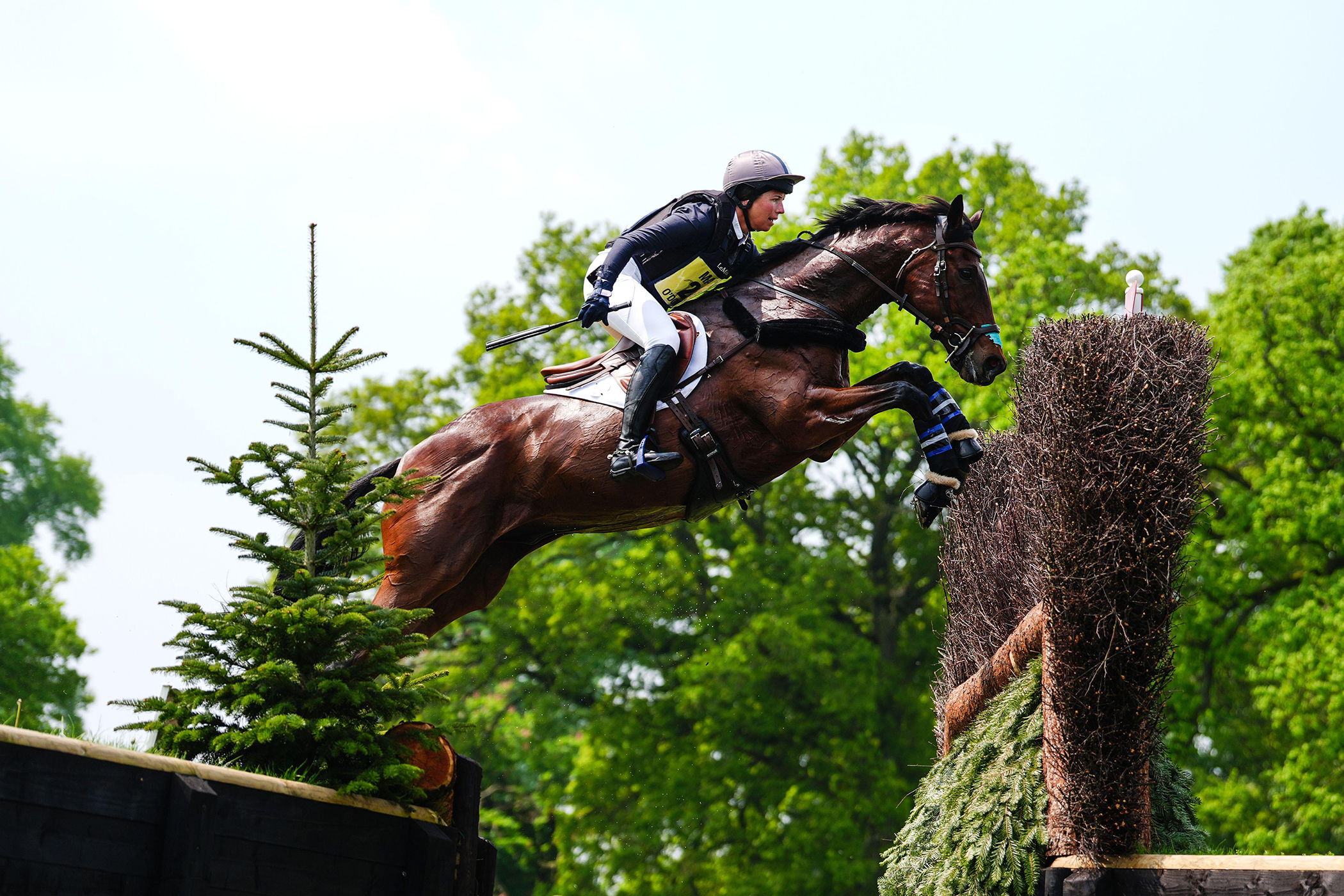
Each May, two worlds converge in the bucolic shadow of Badminton House: the furs and feathers of an often-overlooked rural Britain, and an extreme sport so all-demanding and soul-consuming you never really escape. Badminton Horse Trials is the Wimbledon of eventing, founded by the 10th Duke of Beaufort to remedy Team GB’s “poor showing” on horseback at the 1948 Olympics. It runs over four days - Thursday and Friday for dressage (horse dancing, although any improvisation from the horses is thoroughly frowned upon), Saturday for cross country (6.4km of jumps taller and wider than many people, often into water, to be covered in 11 ½ minutes - the most dangerous element). Sunday is showjumping, all impossible contortions and miniscule margins. These are three largely opposing skills, each requiring a technical mastery basically incomprehensible to all but the few capable of achieving it. Horses have to be suited to the tailcoated control of dressage, the untethered brutality of cross country and the spring-loaded speed of showjumping.
Cross-country Saturday will be the second-most attended day of British sport this year - a sell out of over 100,000, with 80,000 more across the other three days - only topped by Sunday at Silverstone. A common quip is that Badminton has become a festival of shopping with a horse trials attached, with over 250 trade stands, many bearing taglines like “truly, madly, British”. The “Back British Farming” tent is replete with Union Jack welcome mats, a King and Country patriotism littered throughout, literalised by Camilla’s arrival on Friday triggering the world’s politest scrum. Clare Balding’s here, as are a range of Made In Chelsea cast, past and future. Getting there entails trailing mud-spattered Range Rovers through Jilly Cooper country - Gloucester, Frocester, Stanley Downton, Cockadilly - all knee-high sandstone walls and spiteful potholes.
Most stalls assume that everyone has a garden, and that those gardens have an acute lack of hand-whittled wooden animals. You can buy chutneys and safaris and cartoon toilet seats, just past the last shop in Britain displaying polo shirts with the collars pre-popped, whispering to passing young farmers like a cold pint on a hot day. Dubarry of Ireland hands out prosecco while you wait (“any time you want a free drink, go and sit in THAT CHAIR,” a tweed suit announced to anyone who would listen), children roaming free-range. Jade Holland Cooper, daughter of a farmer and fashion designer, who founded the modern home of countryside fashion - Holland Cooper - calls Badminton “a runway”. This is true for maybe half the attendees, a technicolor smorgasbord of petticoats and hats, the uniform of the equestrian aesthetic, while the other half look like they think hairbrushes are only for using on horses. The stands betray this world’s differing approaches to horses and humans - everything related to horse health is preventative, endless supplements and vitamins, while the few related to human health have names like “beat back pain now”.
World No 1 Harry Meade (whose foot was caught in his stirrup during a fall in 2020, meaning he was repeatedly kicked in the head by his horse while hanging upside down, having broken both elbows in 2013), son of Team GB’s most successful equestrian Olympian, says: “This is what I love doing. I feel I was born to do this, and there are certain bits I find sort of easy, so it would be a waste not to. It’s not an option not to.” Painkiller addiction is close to an occupational hazard. It is an open secret that one rider is competing at Badminton seriously injured, three weeks after finishing all three phases at another major event despite surgical pins being dislodged midway through.
Sam Ecroyd also believes his relationship with eventing is “obsession, addiction”. This is his first Badminton, five years on from a rotational fall which broke his skull and face in 57 places. Now 29, he believes not remembering the accident helped him return to riding, although there was never any real debate over whether he would. One in four rotational falls ends in either death or permanent disability for the rider. “I don’t think there’s a rider here in the top 10 in the world who hasn’t had some pretty big smashes,” Ecroyd explains. “It’s something I try not to dwell on. There have been people very close to me that were less lucky.”
One of the most promising event riders of her generation, Saffron Cresswell started eventing at 13, and by 16 committed her life to it. With a skill for developing horses, she competed at junior European Championships and finished 8th at the 2022 U25 National Championship at Bramham, then 21, aspiring to Olympic qualification. And then at Bramham in 2024, three fences from the end of her cross country, she suffered a rotational fall, a T4 complete spinal injury paralysing her from the chest down.
“I still very much love the sport,” she explains. “I was surrounded by people in a spinal ward that had literally fallen off the sofa and broken their neck and couldn’t move anything. My mindset is a little bit like ‘whatever’s going to happen to you will happen to you’.” This fatalism, the sense we all have a rotational fall with our name on it, comes up time and again.
Cresswell now mixes coaching with presenting for equestrian TV and radio channels - although she plans on expanding to other sports - and is working towards Paralympic para-canoe. Integrating eventing into her new life has been key, something many struggle with. In April 2022 Caroline March was paralysed from the waist down in a fall at Burnham Market. Just under two years later, aged 31, she ended her life at an assisted dying clinic, writing that “the entire impossibility to do anything and everything that I love” was “not an existence I want”.
Newsletters
Choose the newsletters you want to receive
View more
For information about how The Observer protects your data, read our Privacy Policy
At which point you have to ask, why do people still do this? What are they addicted to? Is it adrenaline, competition, the extremes of life and death? “Man and horse, we’ve been looking after each other for 3,500 years,” Ecroyd says. “To be a part of that, to show off what they can achieve, intrinsically draws me to it. Competing and trying to win every week doesn’t drive me really. It’s more of a desire to be better every day and work with the horse.” Cresswell says the horse/rider relationship is what she misses most, “less so even riding, just having that opportunity to be around them in the stables, build that bond”. The trust these riders have in their horses, and vice versa, is extreme. Ros Canter, the favourite having won Badminton twice before, competed at Burghley while five months pregnant last year, and is here having given birth three months ago.
For all the class stereotypes around equestrian sport, this is not about money. Badminton is the sport’s most lucrative event, £125,000 to the winner, and yet only a quarter of the 80 starters will earn any prize money. 20th gets £2500, not enough to cover travel and accommodation expenses. Few riders own their horses, certainly not outright, with most reliant on sponsorship and external owners, whose effective philanthropy gives the sport a false air of financial sustainability. A “made” 5* horse can cost well into six figures, so almost all riders take them on at four or five and educate them, relationships which can last decades. “Plenty of riders have gone hungry to make sure their horses have an extra physio session,” Campbell explains, a fact given away by the extraordinary array of jutting cheekbones and jawlines.
The Georgie Campbell Foundation, established by Jesse and Georgie’s sister, works to “support and progress cross country safety”, a genuinely contentious topic. Traditionalists maintain that danger is integral to the sport, that making it safer loses something.
The greatest development in cross country safety of the past 30 years was the development of frangible pins, which allow fences to fall down, but 88% of rotational falls stil happen on fixed fences. Badminton course designer Eric Winter - an affable gent in orange trousers who seems to know everyone we drive past - relays a debate with one of the great British riders over a difficult fence being made with frangible pins. Knocking one down incurs 11 penalties, and the rider said he’d rather take his chances, despite an accident once putting him in a coma. As Winter puts it: “In what world can you think it’s better that you’d sprawl across the middle of the water with your horse and hope to survive than collect 11 penalties?” Even then, only 13 of the 32 fences are collapsible, although Winter reckons this is the highest of any 5* event.
One fence, an enormous hand-carved wooden fish with a brush mohawk, drops two metres into a lake on the other side, and yet Meade is almost dismissive of the course, saying “would there be many 5* questions out there? Maybe not.” They want this to be hard, want it to hurt, want it to push and pull and prod their minds and bodies. You gradually realise that no-one here could stop, even if they wanted to; at once addiction, and love, and life.
Photograph by PA Images