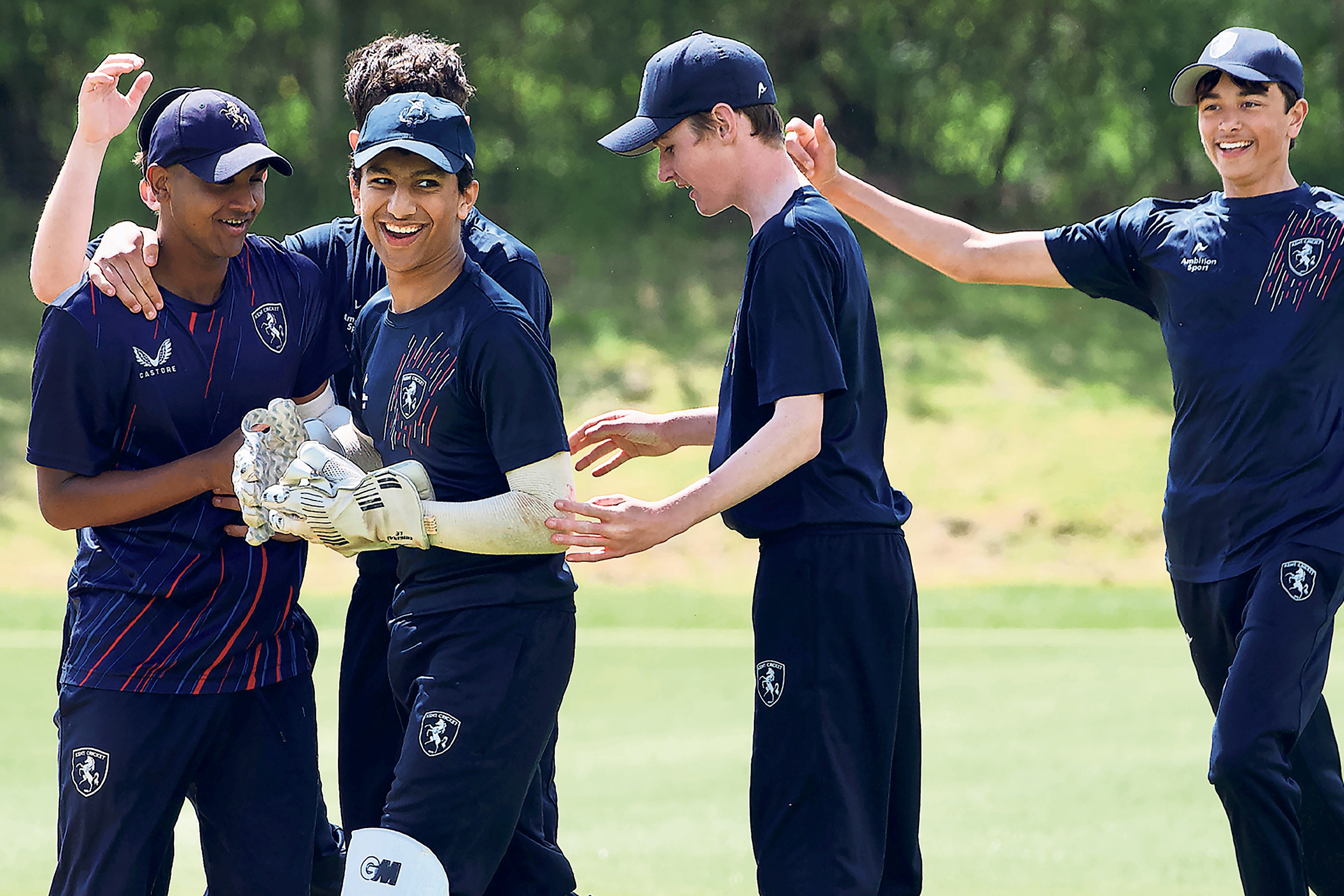



The problem with cricket in the UK is that too few schools account for too many of the professional players.
Take Canterbury Academy in Kent, Park View School in County Durham and Brighton Aldridge Community Academy. And between just these three schools, there were eight professional cricketers in action across the 2025 season, and a ninth played in the recent T20 World Cup for Namibia.
The unexpected difference is that all three of these schools are comprehensives amid a sporting landscape where private schools dominate. According to the Sutton Trust, 59% of male professional cricketers are educated in the independent sector, making it the third most privately educated profession in the country behind the high-ranking armed forces officers (63%) and senior judges (62%). Or to put it another way, the three poshest props in the United Kingdom are a gun, a wig, and a bat. In 2014, the figure stood at 33%.
But while cricket has a private school problem, it also has a state school opportunity. “Trusts are the solution,” says Luke Sparkes, the chief executive of Dixons Academies Trust, a network of schools that teach more than 20,000 children across Bradford, Leeds, Liverpool and Greater Manchester.
Sparkes has just appointed a head of cricket, former England and Wales Cricket Board and Yorkshire employee Maroof Khan, whose task is to install cricket across the trust’s network of schools over the coming years.
Dixons, as an academy trust, has more autonomy over its curriculum than a local authority-run comprehensive. And that is important. Academy schools, first introduced by Tony Blair’s Labour government, now account for 83% of secondary schools across England. The landscape of schooling in this country is entirely different from what it was 20 years ago. For cricket, it represents a change that can be used to its advantage.
Sparkes, for instance, cites the already existing Dixons Cup as a competition that could be replicated nationwide. “All of our schools compete against each other anyway,” says Sparkes. “So we can have cricket competitions just within our trust to get more kids playing cricket. If we want to solve this, we’ve got to get the big trusts to do what we’re doing.”
Sparkes’ work is taking place against a backdrop of change already happening across the country. The Knight-Stokes Cup, a state school competition run by the MCC, has had more than 1,000 entrants in its first year, with the finals to be played at Lord’s.
But in the MCC’s own words, the competition is the “icing on the cake” for a school with an existing, or nascent, cricket programme to channel its efforts. It will do no harm, and will undoubtedly do some good, but it is not in itself a solution for the game.
‘We know that if you can get them [playing] beyond 16 [years old], you’ve got them for life’
‘We know that if you can get them [playing] beyond 16 [years old], you’ve got them for life’
Richard Thompson, ECB chair
An alternative approach to engaging schools is the Surrey Academic Cricket Scholars (SACS) Programme, which has been a revelation since its inception in 2023. The brainchild of Judy Wallis, herself from cricketing royalty as the daughter of Surrey legend Mickey Stewart and the sister of England great Alec Stewart, she is described by colleagues as a “force of nature” in what she has created.
Already in 12 schools across the county, the programme boasts 170 “scholars” who receive four hours of specialist training from Surrey coaches each week. The programme is focused on sixth formers because the age of 16 is identified by the ECB as a major drop-off point. “We know that if you can get them beyond 16,” said ECB chair Richard Thompson last year, “the statistics go through the roof that you’ve got them for life.”
The programme’s goal is for no child to be more than 45 minutes from a school offering a cricket programme. Training is provided at school, but students are encouraged to play for their clubs on Saturdays, build their relationship there and challenge themselves against adults.
“The biggest thing,” says Wallis, “and this is what Alec says, is that Saturday school fixtures are a slight on the development of young players. They would rather have players go back to club cricket and grow their talent within that environment.”
The programme is now expanding to Kent, where it will be launched in three schools next year, while Wallis is also in conversation with Worcestershire, Gloucestershire and Berkshire who wish to replicate the system. “This is a proven model,” says Wallis. “This is working, and this could so easily work nationwide.”
The truth is that cricket is too small a sport for efforts, however limited, not to have a tangible impact. The challenge of rejuvenating state school cricket is often deemed too insurmountable a task. But up and down the country, both now and historically, initiatives have worked. And when they have stopped, their absence has been felt.
A notable example is Haringey College, a local sixth form centre in Tottenham that between 1984 and 1997 produced 25 first-class cricketers, almost all of whom were of Afro-Caribbean heritage. The programme ended through a lack of funding. Twenty-three years later, in 2020, a Sport England survey found Black participation in cricket to be so low as to be “statistically irrelevant”.
State schools account for 93% of the nation’s education. Which means if cricket isn’t in state schools, it isn’t in schools full stop. Fortunately, throughout the nation, people are having variants of the same good idea. Networks of schools, coming together to create infrastructure rather than one-offs. In short, wherever cricket is played, professionals follow. Fingers crossed, the tide is turning.
Photograph by Kent Cricket Club
Newsletters
Choose the newsletters you want to receive
View more
For information about how The Observer protects your data, read our Privacy Policy