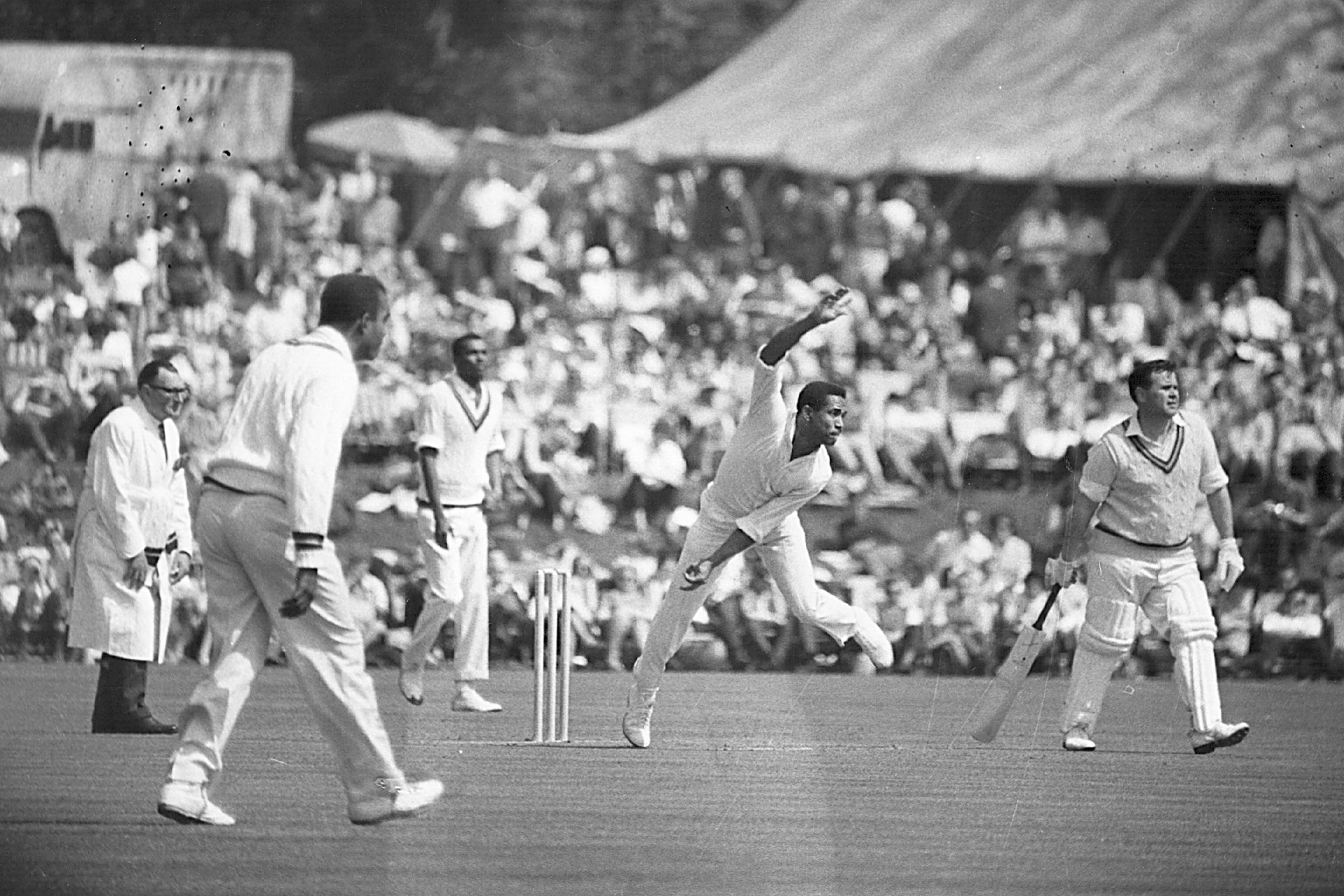


Measuring Garfield Sobers’ cricket career by its numbers is like analysing the Sistine Chapel ceiling by counting the total of hunks and honeys painted by Michelangelo. The statistics fail to capture the overall magnificence and broader influence. But they are still phenomenally, historically impressive.
Sobers’s numbers are astonishing. In his peak 50 Tests with the bat, from 1958 to 1968, his batting average was 74. Only Don Bradman, Steve Smith and Ricky Ponting have ever exceeded that number over a 50-Test sequence. In his most productive 50-match sequence with the ball (1960-1971), Sobers took 171 wickets, 22% of the wickets taken by West Indies’ bowlers. (Jacques Kallis, the great South African whose overall statistics are similar to those of Sobers, took 127 in his most wicket-laden 50-Test run, 15% of his team’s wickets.) Sobers achieved the treble of 400 runs, 15 wickets and 10 catches in a series three times – more than all other Test cricketers combined.
His individual feats, across his career, and in his greatest series and innings, are among the sport’s most brilliant performances. The true significance of Sobers in cricket’s history, however, is revealed by the context in which he performed his extravagant range of all-round skills with such technical mastery, aesthetic magnificence, and competitive charisma.
Test Cricket was, broadly, sinking into a pit of seemingly inescapable negativity. Sobers and the West Indies were the exception. From the start of the 1960-61 season, when he made two dazzling centuries in the classic tied-Test series in Australia, to the end of 1966-67, when West Indies beat India for their fifth consecutive series victory, West Indies played 28 Tests, of which they won sixteen, lost five, tied one and drew only six (21%). In that same period, in the 93 Tests not involving West Indies, 55 were drawn (59%). Only one of the six other Test teams drew fewer than half of their games – Australia, who drew 49% (22 of 45).
Sobers played in all 28 of West Indies’ matches. He averaged 60 with the bat, 29 with the ball, and two catches per match in the field. He scored at around 55 runs per 100 balls (ball-by-ball data is incomplete) – relatively unspectacular by modern standards, but scintillating for his time. All other players in that period collectively scored at around 40 per 100 balls.
Every cricket lover today, and every professional player, owes Sobers a debt of gratitude, not only for his own achievements and the rare kind of transcendent brilliance that can take sports to a higher dimension, but for playing a critical role in cricket surviving as a popular spectator sport through a period when it often seemed intent on its own demise.
Photograph by Jim Gray/Keystone/Getty Images
Newsletters
Choose the newsletters you want to receive
View more
For information about how The Observer protects your data, read our Privacy Policy