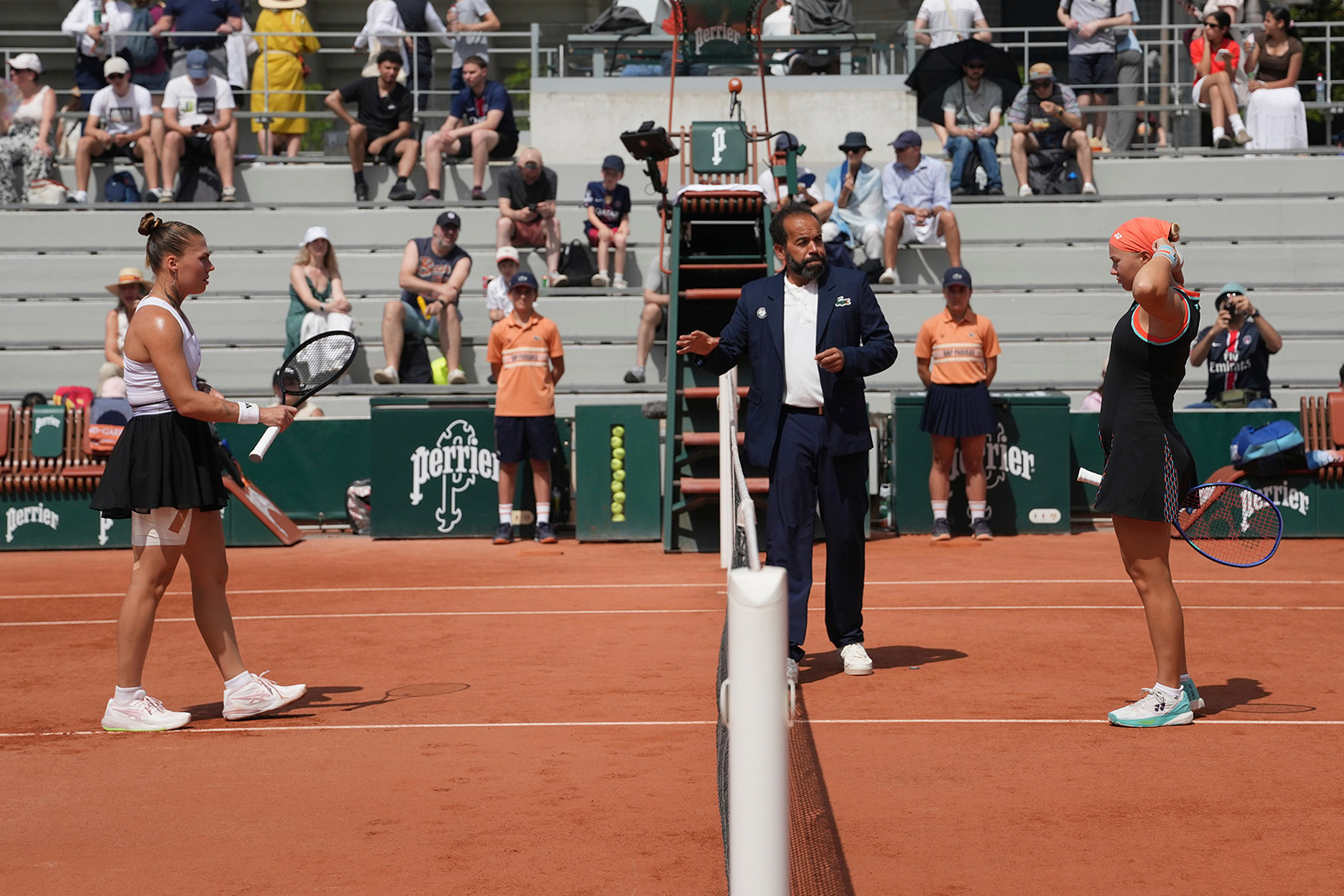

When Ukraine’s Oleksandra Oliynykova and Russia’s Diana Shnaider took to the court at Roland Garros, ten security personnel were positioned around the stands. The irony of these safety measures was not lost on Oliynykova, considering she has lived through far more dangerous experiences. “I feel like nobody is talking about the fact that when I will come back home [to Kyiv], I will be attacked with drones and rockets,” she said. “For me, this contrast, I feel really strange about it.”
The bolstered security in Paris was precautionary, as this third round encounter had more potential to boil over than most. Shnaider is one of the players who Oliynykova accused of supporting Vladimir Putin’s war effort, including by participating in an exhibition tournament in St Petersburg, which was sponsored by Russian state energy company Gazprom. “Gazprom is a company that finances war crimes,” Oliynykova, whose father and boyfriend are serving in Ukraine’s army, said ahead of their match. “I think it’s like playing in Nazi Germany for the Gestapo… for me there is no difference.”
Ukrainian players have been performing a balancing act for more than four years now, since the full-scale Russian invasion began in February 2022. One minute they are reading news of destruction in their home country, and the next they need to bring their A-game on court. Remarkably, amid the terror of war, Oliynykova and her compatriots are thriving on the court.
No less than seven Ukrainian women currently reside inside the top 100, putting them ahead of three Grand Slam nations. At Roland Garros, four reached the third round, equalling the country’s all-time record at a major tournament. They are led by world No. 7 Elina Svitolina, who won the Italian Open two weeks ago, and Marta Kostyuk, who is on a 15-match winning streak after lifting titles in Madrid and Rouen.
Both are through to the last-16 in Paris, but on day one of Roland Garros, Kostyuk woke up to the news that her family home in Kyiv had barely survived a Russian missile attack overnight. Somehow, she mustered the strength to win her match later that morning. “Most of the morning I felt sick,” she told journalists. “If it was 100 metres closer, I probably wouldn’t have a mum and sister today.”
There is no handbook on how to support a player through such unprecedented circumstances, as Kostyuk’s coach of three years Sandra Zaniewska (who is from Poland) knows all too well. “I don’t know how it feels going to bed every night thinking your family is somewhere that a war is happening,” Zaniewska says.
“I just cannot relate so I’m not going to pretend I can. I can just be there for her. We spoke about it before the [first] match, how the French Open is starting and she’s had a great season but it doesn’t matter at all. It’s completely irrelevant to what she was going through.”
This barrage of bad news from home is juxtaposed with regular on-court meetings with opponents from Russia and Belarus (who are not permitted to play under their own flags). Ukrainian players refuse to shake hands with them and many openly question their right to play. World No. 66 Oliynykova relentlessly uses her newfound platform to speak on the war and claims the WTA “threatened [her] with fines of tens of thousands of dollars” as a result.
On Saturday she targeted the organisation in a 200-word speech delivered during her press conference: “I know that some people disagree with my actions. I know that some people would prefer that I stay silent. But what I do is not about politics, it’s about humanity. When people are being killed, while children are dying, when violence is justified or celebrated, we cannot pretend that nothing is happening. We cannot look away. We cannot protect those who support or excuse such actions. Our organisation was not built by pioneers like Billie Jean King so that money and luxury could become the only values in women’s tennis.” She added that “there should be some mechanism in our tour to stop” players who spread “propaganda”.
She said: “If I will not try to do everything to help Ukraine to win this war, my life would be destroyed. The people I love, they would be killed. I will be killed. I don’t see any other option for me.”
Newsletters
Choose the newsletters you want to receive
View more
For information about how The Observer protects your data, read our Privacy Policy
A WTA statement said they “remain unequivocal in condemning Russia’s war on Ukraine” and have “consistently supported” Ukrainian athletes. It added: “All WTA athletes have the right to express themselves. At the same time, the WTA is committed to maintaining a professional and respectful environment for all athletes, regardless of nationality or country of origin.”
Igor Grachev – the only Ukrainian member of the press at Roland Garros – believes that, if not for Kostyuk’s experience last weekend and Oliynykova’s punchy press conferences, the war would hardly be on the agenda. “It’s very, very in the shadow,” he told The Observer. “It’s hard for us as journalists. For me, I try to cover clearly all the situations – war and tennis. Tennis is a good platform to say the war is going on. There’s no pause for the war.”
Nevertheless, Ukraine’s women battle on in Paris.
For Svitolina, who is an aide to President Volodymyr Zelensky, her country’s plight remains front of mind, even as she navigates a major tournament as one of the favourites. “For me it’s a part of my life, from the beginning of the war and always will be. You cannot escape that.”
Photograph by Tibault Camus/AP