
A substantial portion of the blame belongs to Pep Guardiola, and a smaller slice of it to Jürgen Klopp. Part of it can probably be put down to social media, to the algorithms and the alchemy of their overlords, their gift for transforming base outrage into gold. But some of it is good old-fashioned yearning, too.
Swirled and blended and folded together, they have combined to create the reality that Arsenal’s players, staff and fans must endure: one in which the entrails of every performance are examined for auspices, every result is treated as a referendum on their ambitions, and they are condemned to win or lose the Premier League title every week.
That English football is a frenzied, irrational environment is nothing new, obviously. The sheer amount of coverage dedicated to the Premier League incentivises over-reaction; shouting loudest and hitting hardest has always been the best way of attracting attention.
The timbre of the debate around Arsenal this season, though, has felt particularly manic. This is a team, after all, who have lost just twice all season. Mikel Arteta’s side went top of the Premier League at the start of October. They have the best defence in the division by some distance. They have only lost twice. For good measure, they have been flawless in the Champions League and the Carabao Cup, too.
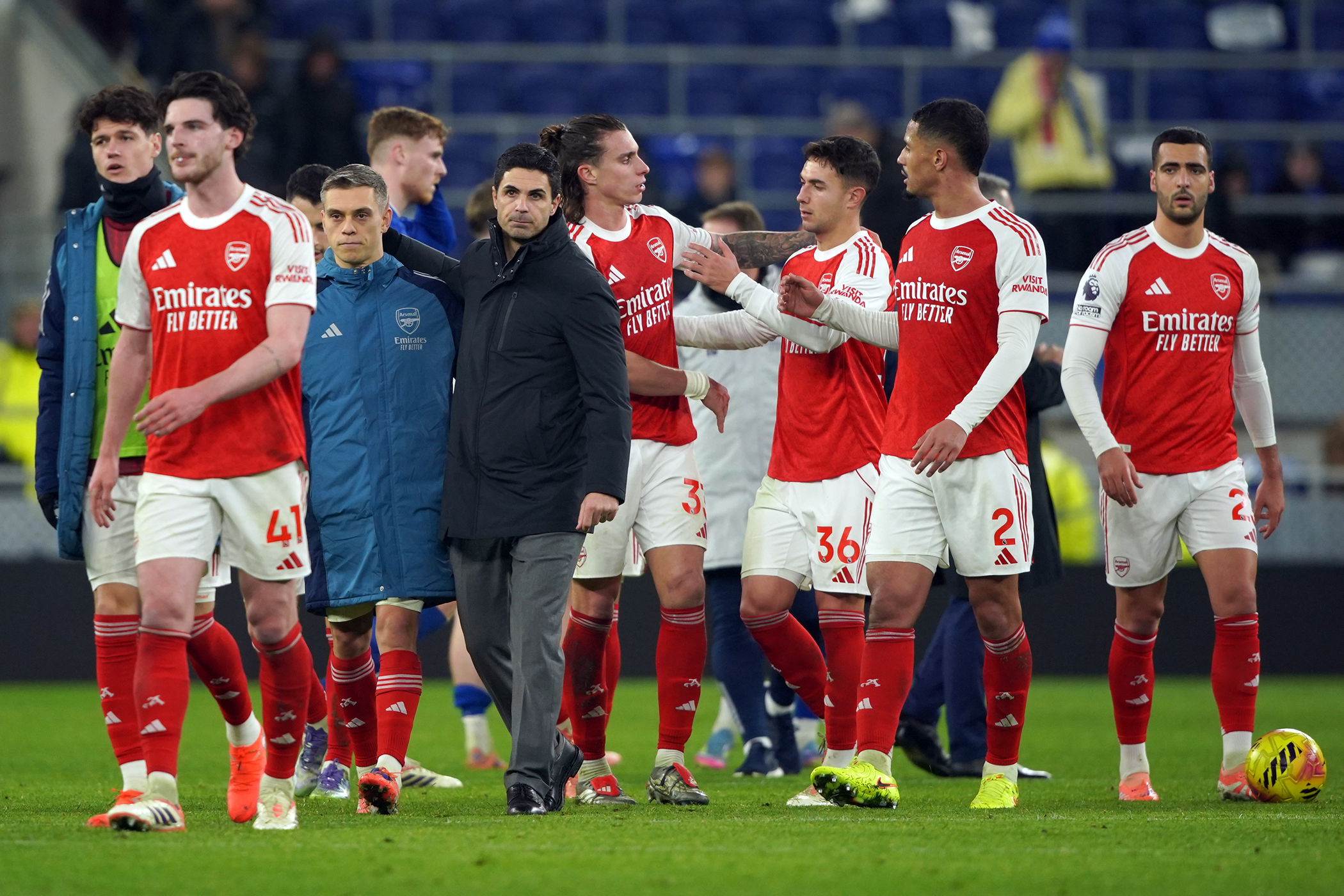
Despite all that, their draws against Sunderland and Chelsea were greeted as harbingers of imminent decline. So, too, last week’s game against Wolves, despite the inconvenient fact that they won. The same may well be said of a gnarled, grizzled sort of a victory against Everton. Winning, if not achieved in a specific manner, does not appear to be enough to quell the doubts.
Any explanation of why that might be has to start, really, with Guardiola. The Catalan has, in the last week or two, started the latest round in what is by now an annual feature of the Premier League calendar: dancing around the subject of whether he will be in charge at Manchester City next year.
His opening gambit is always basically the same. Nobody knows, he says. Things change. Contracts are a guideline, not a rule. But whenever he does depart, the Catalan will leave English football markedly different in innumerable ways, the most relevant of which here is the extent to which he has shifted our understanding of what it takes to win a title. Aided and abetted by Klopp, Guardiola has established a new watermark not just for how many points a champion requires – Guardiola’s “centurions” set the bar in 2018; the three highest totals in Premier League history were all recorded by City and Liverpool between 2018 and 2020 – but for what champions feel like.
Just as the abiding cultural memory of Sir Alex Ferguson’s serially victorious Manchester United teams are last-gasp interventions in what became known as “Fergie Time”, the collective imagination recalls City sweeping opponents aside, scoring three or four or five in the first half, so imperious that they were essentially untouchable. Compared with that idealised version of City, watching Arsenal grind out a win – albeit one in which they hit the post twice – against an Everton team shorn of two of their three best players is hardly awe-inspiring. Liverpool suffered the same affliction last season; Arne Slot’s team were deemed to lack the appropriate swagger.
But that disregards not only the fact that there were times that City had to scrap and claw for three points – champions have never been uniformly breathtaking – but that the league itself has changed. Nobody will require 100 points to win the Premier League this season. Perfection, or something close to it, is no longer necessary.
Retaining that sort of perspective, sadly, is no longer really viable in what was once a marketplace of ideas but now resembles the middle aisle of Lidl: a colossal amount of stuff that you do not really need but that it is impossible not to find inexplicably alluring.That phenomenon, of course, was not invented by social media; newspapers and radio phone-ins and rolling 24-hour news channels were always perfectly adept at taking the smallest possible flaw and turning it into an endlessly fertile talking point.
Newsletters
Choose the newsletters you want to receive
View more
For information about how The Observer protects your data, read our Privacy Policy
The shouting match quality of sport has become more pronounced and more extreme, though, as the platforms on which those conversations – for want of a better word – take place have, in the terminology of the time, maximised for engagement.
The operating principle, more than anything, is that we cannot help ourselves. That is true of all fans. It is particularly true of Arsenal at this moment in time. From the outside, it does not feel like it can be 22 years since the club last won the title. To Arsenal, though, it represents an eternity. A generation of fans who grew up watching their club trawl for trophies – reinventing the English game no less impressively than Guardiola’s City as they did so – have been starved of major honours for two decades. A few FA Cups no longer quite cut it.
They have been close for the last three years; their hunger has now taken on an urgent quality, something that at times looks quite close to panic. They know the signs are good. They know Arteta has built a serious force. They are just desperate to know, now, how it ends.
Photograph by Ian Hodgson/AP