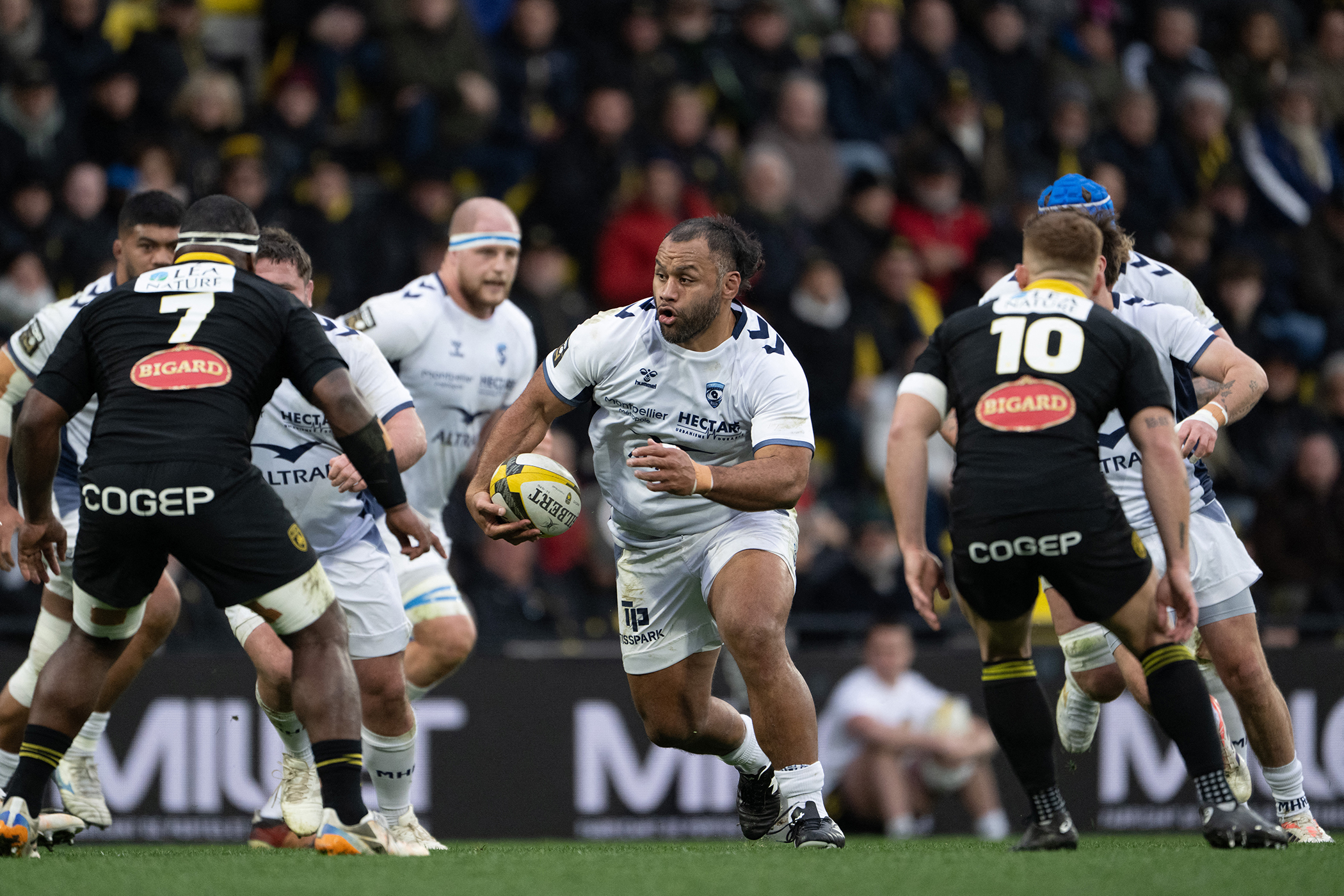
Life for Billy Vunipola at Montpellier is going pretty well. Next week the former England No 8 will receive a player of the season award from the French publication Midi Olympique. Vunipola turns 34 later this year but is currently playing like a younger man, one of the top ball-carriers in France, with Montpellier firmly in the mix for the playoffs and through to the Challenge Cup final against Ulster.
It has been a successful union, extended until the end of the 2026-27 season, between two parties who, as Vunipola sees it, needed each other. Montpellier given their perilous position, clinging on to a berth in France’s top flight after winning a relegation playoff shortly before he arrived. And for Vunipola after the high-profile way his time at Saracens came to a close after 11 years.
“I was probably at the same stage personally as they were as a club. Down, but not out,” he tells The Observer. His success this season deserves to be appreciated. Players from overseas do not always settle as well as Vunipola has in the Top 14.
Vunipola is more than playing his part in a monster pack, punishing teams with their maul and close-range carries. Montpellier recently defeated Bordeaux-Bégles, the reigning European champions now through to another Champions Cup final, on their own patch. Vunipola’s fellow back-rows include Yacouba Camara, a phenomenal athlete, while Lenni Nouchi, only 22, broke through into France’s squad during the Six Nations.
“We managed to go to [UBB’s] place, to a sold-out crowd, and just play our rugby. And it was ugly, but I think the only people that cared were the people that came and paid to watch. No one in the changing rooms did afterwards. I know that for a fact,” he adds with a smile.
“When I was looking at signing for Montpellier, I definitely knew that the strength of this team would be within the forward pack and hopefully I could add to that. And like you said, there are some big bodies within our team, but also we’ve got some agile players within that as well.”
Earlier this year, in an interview with Midi Olympique, Vunipola was asked what was motivating him to play at such a high level. He responded that he felt appreciated by the coaches before adding, “that’s new for me”. I ask him to elaborate.
“When I was at Saracens, my role was more in the shadows, more within the team camaraderie,” Vunipola explains. “And maybe they thought because I was always up to no good, I guess you see all the news of what happened in Mallorca and what have you. I guess they probably thought that was who I was, that I never thought about rugby with as much depth as other players such as your Owen Farrells. And I mean, I don’t blame them. I never gave [the coaches at Saracens] the opportunity to think that.
“Also, I never wanted that responsibility because, you know, we had such great players like Owen Farrell, Neil de Kock, Richard Wigglesworth, who is now the England coach, Charlie Hodgson, Brad Barritt, my brother, Mako. There were loads.
“I never really ever had to play that role thinking about what the team needs in a rugby sense. My role was to get us going forward, stop the other team from going forward and keep the vibes high. And I could do that because there were others around me that were doing the unseen stuff in terms of preparing the team along with the coaches.”
Newsletters
Choose the newsletters you want to receive
View more
For information about how The Observer protects your data, read our Privacy Policy
Montpellier, understandably, have been eager to tap into Vunipola’s wealth of experience after playing for a club that “dominated Europe for the best part of eight years”, which in turn has led to a new mentoring role. He is appreciated, as he was at Saracens, except now in a different way.
Vunipola, it is also worth stressing, still goes on nights out. “That is still a rugby value to me. To be close with a 20-year-old or 25-year-old that you would rely on, you are going to need. For me, the human side is always going to trump the rugby side. I just do it in a different way now, you know?”
The details of that end-of-season incident in Mallorca are well documented. The “accumulation” of factors that led to a shirtless Vunipola being tasered and arrested at half four in the morning, and the changes that have come after, are something he has not previously discussed in depth, noting that players often “hold a lot of stuff in” and talk about those moments when their careers are over.
The previous year’s Rugby World Cup had not gone as Vunipola hoped, limited to cameos off the bench. The reason was a knee injury he suffered playing against La Rochelle in April, then reinjured it during rehab, and could have accepted that the World Cup was not meant to be. Instead he did “something crazy” and opted to have his meniscus removed. “Which, I’m now paying for,” he adds.
You won’t see Vunipola in the photos of the squad departing for the World Cup because the night before they were due to head to France, his knee picked up an infection. Another sign. With hindsight and maturity, Vunipola admits he should have “been big enough to be like, ‘look Steve, I’m nowhere near 75 per cent. You’ve got [Tom] Curry, Courtney [Lawes], Ben Earl, Lewis [Ludlam], [Jack] Willis, I think you guys will be all right.’ If the same thing happened now, I’d be mature enough to say that, but I didn’t know at the time. I was just like, ‘I’m gonna make it work’. And it didn’t.” He admits he felt like a fraud. Vunipola’s knock-on was the final act of England’s semi-final defeat to South Africa, and that haunted him.
“Whether I like it or not, I was the one who dropped the ball against South Africa, and that sits with you,” he explains. “You know, people think ‘yeah, he doesn’t care’. But some people hide it in different ways and that’s what I did. I hid it by trying to be stoic, but deep down it was eating away at me.”
He was not selected for the following Six Nations, and his starting spot at Saracens went to Tom Willis. Saracens won at Bath with Vunipola coming off the bench, flew to Mallorca the same night for a team social and, as Vunipola puts it, “it all kind of just kicked off. With no one else but myself. All the emotions that I had held inside for a good period just all came out.”
The fallout made him reset. “A refining moment” is how he describes it, leaning into his faith “as I always do when I fall over”.
The difference this time was the change of environment. Vunipola has grown a lot, speaks with maturity. He seems lighter both mentally and physically, weighing in at his lowest since he went on the 2017 Lions tour. “Now that I’m older, I wish that I’d had the same discipline I do now with my diet and recovery and whatnot when I was younger. But then I wouldn’t be where I am right now, you know?”
He is engaging on a number of other topics, be it his brother Mako’s imminent return to the PREM with Leicester Tigers - “He’s not just a prop, he’s a very, very smart rugby player. He thinks a lot about the game.” - to how the pressure of relegation makes you perform in France, and also initially being “as shocked as everyone else” by Tom Willis’s decision to leave Saracens, and therefore his chances of England selection, to return to France to join Bordeaux-Bégles. Then Vunipola began to understand it.
“Think about the stage of his career where he’s at, where he’s 27. No one’s guaranteed their lifespan within the international stage, guaranteed their selection with England. And you’ve got to look after yourself.”
There was a final topic to dig into. Reports at the end of last year suggested that Vunipola could look to switch his international allegiances to Tonga, following the culmination of his three-year stand-down period from Test rugby having won the last of his 75 England caps in 2023. His father, Fe’ao, played for Tonga, creating an emotional pull.
Vunipola met with the Tonga head coach, Tevita Tuʻifua, to discuss switching sides this November, as many other players with Pacific Island heritage have done since the regulation was introduced. Ultimately, Vunipola decided against it.
“I’m 33 now and I’m Tongan. I’m proud to be Tongan. I’m proud to represent Tongan people when I play for England. But I’m also proud to have represented England, and to represent a country that has given me everything I have with the opportunities that it gave me. And I’m proud to say to people that I’m English.
“It might sound silly because I don’t look like your typical Englishman, but some people are afraid to say they’re English. I’m not. I’m Tongan and English. And I’m proud to say that I represented England.”
It also goes beyond himself, feeling as though he has a “duty of care… to advocate for more players to play for Tonga”. Romantic as it might be for him to follow in his father’s footsteps by playing for ʻIkale Tahi, does it carry the same weight if he blocks a young Tongan player from having the chance to go to a World Cup, to then make a name for themselves and potentially settle in England or Wales or France, as his father once did? The answer, Vunipola believes, is no.
His hope is that local Tongan players will represent their country and “put themselves in the shop window, where they get the opportunities that I’ve been lucky to have. Because that’s how I’m sitting right here in front of you.”
He continues: “To think about going back and potentially blocking a young Tongan kid who wants to give his family the same opportunity that I’ve had, I think would be… pretty greedy, you know? That’s the way I would put it.”
Not that he is eyeing up a return to play for England. He was like every other supporter in the Six Nations, willing Thomas Ramos to miss France’s winning penalty. He has messaged Steve Borthwick on a few occasions to wish them good luck. Not for the first time when reflecting on his 75 caps for England, he adds; “I’m pretty content.”
There are titles to chase with Montpellier. The change of environment has served Vunipola well, turning him from lovable jester to admired leader. An amicable and ultra-talented player, playing some of the best rugby of his distinguished career. And crucially, it seems, at peace with himself.