
How fitting that for Millwall to have a hope of earning automatic promotion to the Premier League they needed to beat Oxford, a city synonymous with the establishment and prestige.
But it wasn’t relegated Oxford United who sent Millwall into the nerve burner of the play-off system. Ipswich Town were the ones who doused the deafening ardour of the The Den by beating QPR and joining Coventry City in next season’s Premier League.
This south-east London club with “jellied eels” in their anthem and a Dockers Stand in the shadow of Canary Wharf’s money stacks can still make that climb after 36 years out of the top flight. The play-offs, though, are a second, concentrated dose of stress, starting with a first semi-final leg at Hull City on Friday night.
All the modern Millwall want, they say, is for visitors to arrive with an open mind and not swallow the line floated on talkSPORT this week that promotion for them would “jeopardise the Premier League brand”. If English football’s platinum enclosure has a wish list for 2026-27, the return of Millwall v West Ham is probably not on it. “No one likes us, we don’t care” is a chant that both plays up to external assumptions and serves as a statement of fact. Most people have already made up their minds about Millwall. And Millwall fans at least really don’t care.
Mark Fairbrother, the club’s progressive managing director, is less content to soak it up. “We know that we’re a brand people will enjoy attacking,” he says. Of the BBC Panorama exposé of the 1970s, the notorious “Bushwacker” firm of brawlers and the bee-line film directors used to make for South Bermondsey to produce hooligan movies, Fairbrother says: “Get over it.” Of the club’s anti-racism campaigns, he says: “We’ve probably not shouted enough because we’re worried people will attack it.”
The Den’s mythology as the most forbidding ground to go to endures in the work of YouTubers and devotees of hooligan movies. It popped up, too, in a recent Westminster City Council children’s education booklet which showed a cartoon figure wearing the Millwall “rampant lion” crest on a Ku Klux Klan robe. The council apologised and Millwall examined their legal options.
The brand disruption dream is still alive. Millwall, who beat Oxford 2-0, have never played in the Premier League. They were last in the top division in the 1989-90 season. The year before, feasting on the goals of Tony Cascarino and Teddy Sheringham, they finished 10th. More recent claims to fame were reaching the 2004 FA Cup final and being one of the places Harry Kane was sent by Spurs (in 2012) to “toughen up”.
Only three minutes had passed here yesterday when the automatic promotion miracle started to fray. Ipswich had already taken the lead against QPR. Bravely, Oxford fans teased the home crowd with “1-0 to the Tractor Boys”. Some young Oxford fans turned up dressed as bananas and were told in no uncertain terms what they could do with that popular soft fruit.
Ten minutes in, Ipswich were 2-0 up and the words of a Millwall fan on the train earlier felt apposite: “If you’d offered me play-offs at the start of the season I’d have bitten your fuckin’ ’and off.”
“The fact that we’ve beaten Hull already will help,” said Alex Neil, the manager. “If you look at the top teams across the division, we’ve drawn with Ipswich twice, we’ve beaten Middlesbrough at Middlesbrough. We’ve beaten Wrexham. I don’t think I’ll have to do too much convincing – they are more than capable.”
Newsletters
Choose the newsletters you want to receive
View more
For information about how The Observer protects your data, read our Privacy Policy
So what are Millwall really like nowadays? They are a club eager to stress their good work in the community and their drive to eradicate racism and violence: still “a club like no other” with an older motto, “We Fear No Foe Where E’er We Go”, and an anthem that ends with supporters raising an arm and serenading the away end with the line: “Let ’em all ... come down ... to The Den!”
The big adverts running round the four stands are for kitchens, scaffolders, builders and timber merchants. This is very much a pre- or non-Premier League club, smartly turned out, and with a clear direction now, but without the kind of script Wrexham would have brought to the top tier’s global marketing division. Millwall exist spikily in their own long shadow.
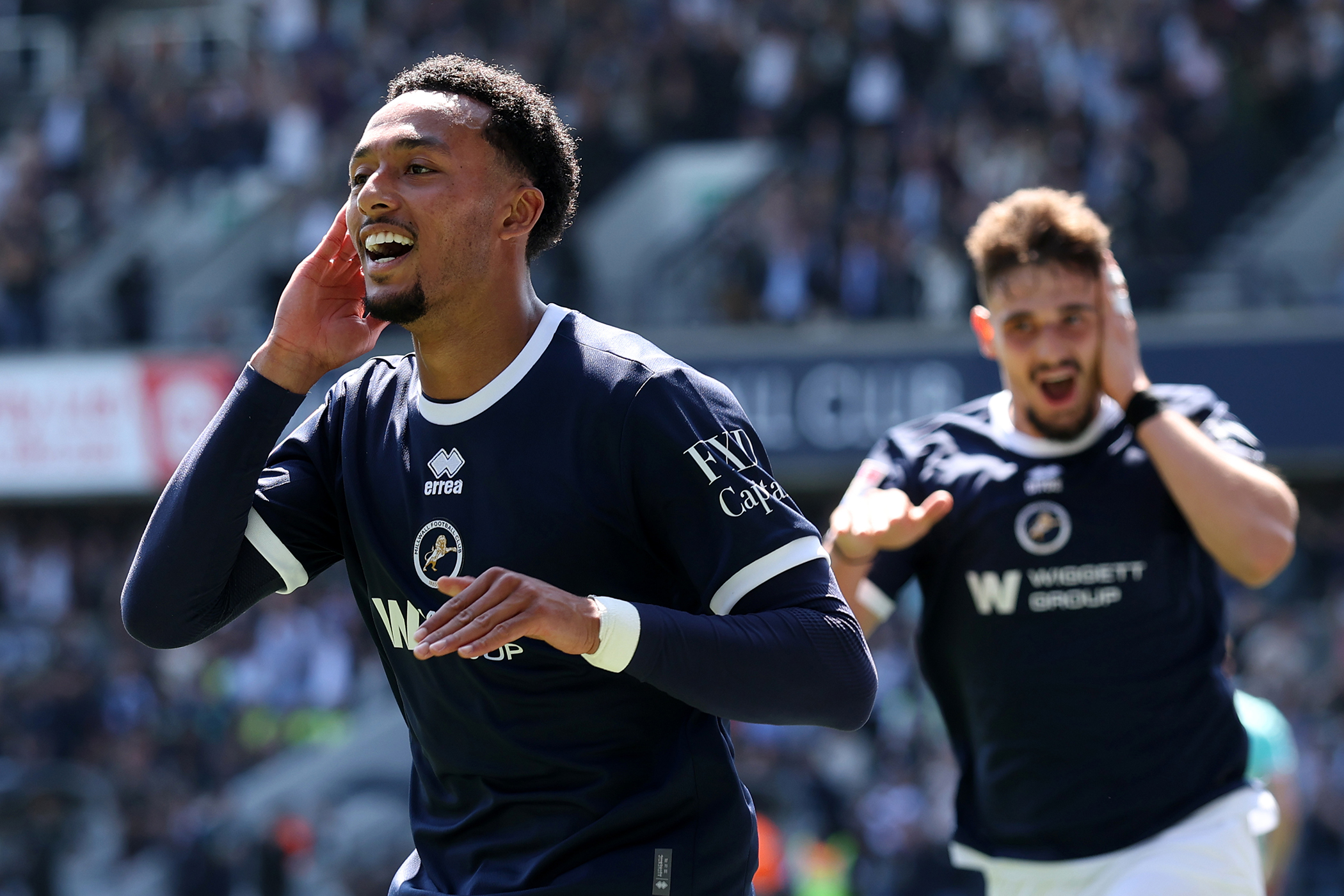
They have good players too: Femi Azeez, who scored twice, and Barry Bannan, the orchestrator, among them. The youth feel extends to the pitch invaders who burst on to the field like a whole school of kids set free for summer. And their ears could have done with covering to block out some of the disapproving words used by large parts of the crowd.
“I asked people not to go on the pitch, so it’s frustrating that they did go on the pitch,” said Neil. “Millwall fans are very self-governing, they know what’s right and they know what’s wrong. They understand the importance of keeping the pitch good [for the semi-final home leg] because we’re all trying to achieve something together. We want the club to go up.”
With a new 999-year lease on The Den, one thing we can be sure of is that Millwall, the cultural outpost, are going nowhere. The team, though, could still be going to the Premier League for the first time. The hard way.
Photograph by Richard Pelham/Getty