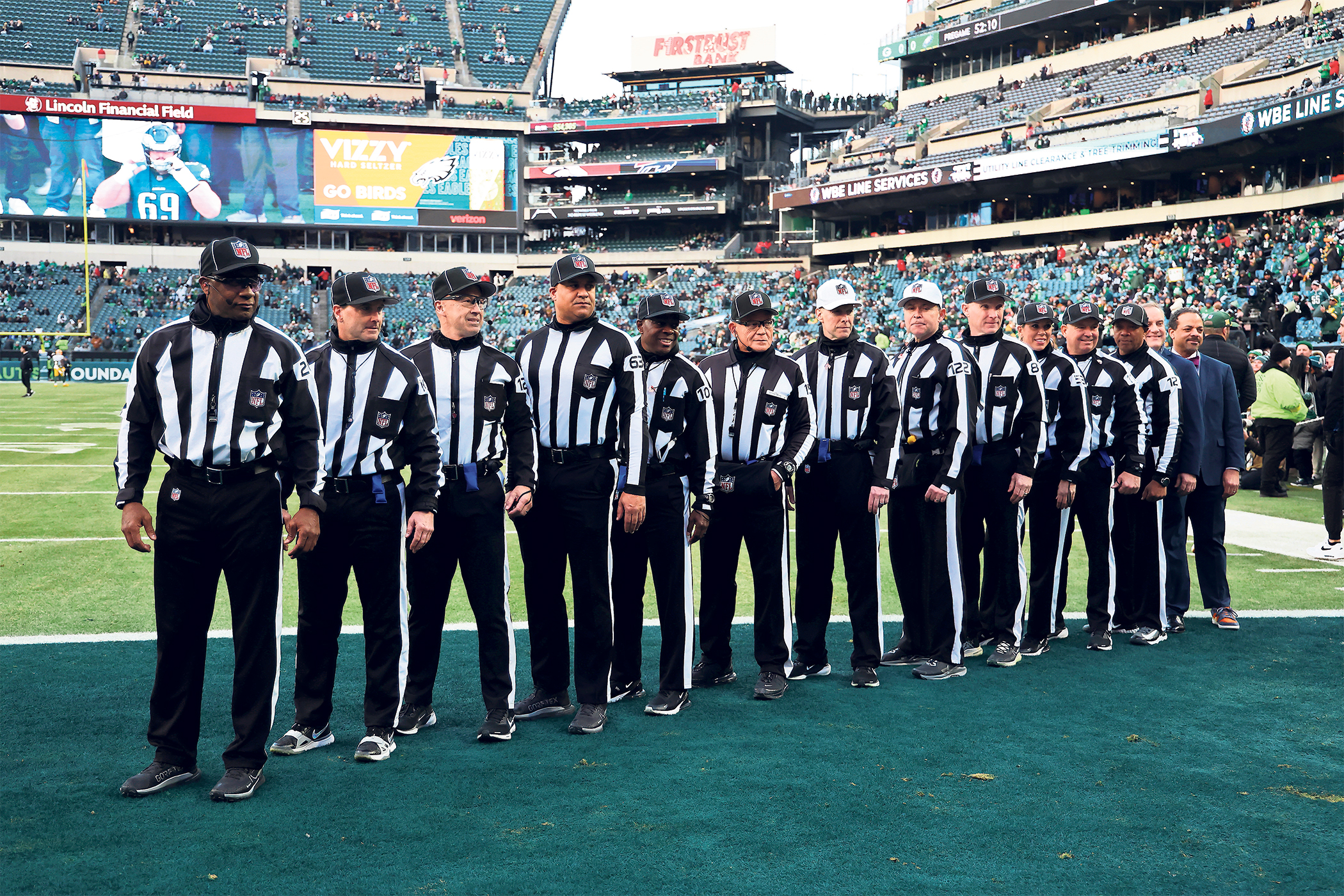

Last month, during a primetime Thursday night game in the NFL between the Buffalo Bills and Houston Texans watched by millions, the referee Adrian Hill suffered an injury familiar to anyone who has tried to accelerate and quickly discovered that one of their legs cannot hack the sudden spike in urgency.
Hill, while trying to catch up with a play, suffered a non-contact leg injury before being helped from the field. Fortunately, there was no major damage.
Here is something you need to know about Hill and all NFL officials: correctly making those high-pressure calls in front of a huge audience is not their full-time job.
The NFL, the most lucrative professional league in the world, employs them part-time, giving up their Sundays (or Thursday and Monday nights) during the course of the 19-week season while spending the rest of the year carrying out their day jobs. Hill, for example, is a software engineer who has previously worked with Nasa.
Yes, the billion-dollar industry that is the NFL employs someone who spends the bulk of his week working as a rocket scientist to oversee whether a player has jumped offside.
To be clear, this is not a trend across all major American sports. The National Basketball Association and Major League Baseball pay their officials full-time, with NBA referees earning anywhere between $180,000 and $550,000 annually (£135,000-£412,000), while MLB umpires make $150,000 to $450,000 (£112,000-£338,000).
A part-time NFL official in their first couple of years in the league will earn upwards of $1,000 (around £750) per game, and it’s that “per game” aspect that matters here, given the relative brevity of the NFL season – officials will work a maximum 19 games – compared with 82 per season in basketball and 162 in baseball. Top officiating crew chiefs in the NFL, those who have been around the longest, can pocket up to $250,000 (£188,000) annually. Not bad for a part-time gig which keeps you occupied between August and January.
The issue with NFL officials being part-time has never been about remuneration, but competence. High-profile blunders for pass interference, or roughing the quarterback when there was barely any contact, or just missing clear calls entirely usually bring the full-time v part-time debate back into the spotlight.
The NFL’s revenue last year was $22.2bn (£19.3bn). It is not outlandish to suggest that the league could afford to pay its select officials for the duration of the year, even if the bill for that annually was about $20m.
Eight years ago, there was a trial. Full-time officials were known as “year-round officials”, with 21 selected in 2017 and 24 in 2018. Between the end of the play-offs and start of the new league year in mid-May – when officials would usually focus solely on their day jobs – those year-round officials instead took part in league meetings. Given there are no NFL games between the Super Bowl at the start of February and pre-season games in August, you can see the appeal of working that role full-time.
Newsletters
Choose the newsletters you want to receive
View more
For information about how The Observer protects your data, read our Privacy Policy
It’s a matter of optics. Knowing that NFL officials are not fully committed all year round to perfecting their craft leaves them open to scrutiny when mistakes happen. And while the benefits might seem obvious, the concept of full-time officials divides opinion among pundits and players.
J.J. Watt, a defensive player of the year who you may know now thanks to his stake in Burnley in the Premier League, said recently that full-time or part-time, officials are human and will make mistakes regardless of their employment status.
Back in 2023, the future hall-of-fame quarterback Aaron Rodgers came out firmly in support of the idea when speaking on the Pat McAfee Show.
“I think those men and women deserve to be paid appropriately where they can make this their full-time gig,” said Rodgers.
“They’ve got a tough job to do, to make calls in real time, and they’re as scrutinised as the quarterbacks and kickers are, as they have one job to do and that’s to interpret the rulebook in zero time possible. I think it’s good that we have the extra official in the [television review] box to help them out with several calls, avoid some of these unnecessary challenges. But I think full-time, yes. More pay, definitely yes.”
The advent of technology and increase in the use of replay assist has also had an impact on decision-making, with Mike Pereira, a former official and later vice-president of officiating for the NFL who now works as a rules analyst for Fox Sports, telling The Athletic that officials were now more tentative in their decision-making, given the technology is there to fall back on.
Former officials have followed Pereira’s route into becoming analysts on major networks, partly because the pay is much better. The recent level of turnover – older officials bowing out and a new crop learning the ropes – has been cited as a factor behind standards dipping across the league.
Previously mistakes were far from ideal but they mattered less until the NFL began to embrace gambling back in 2021 by running in-game odds adverts. Now when a calamitous error is made it is not just hurting fans, but also gamblers. More money is riding on these games than ever before and that comes with greater scrutiny.
There is no suggestion whatsoever of any illegal activity involving an NFL official and gambling. And yet hypothetically, it is not hard to imagine a situation where a part-time official could be offered a substantial sum to turn a blind eye to a pass interference call.
Speaking of optics, when Hill was forced off the field in the third quarter, his match referee responsibilities were passed to the umpire Roy Ellison. There was no spare official on hand to step in because the NFL never has spare officials, so the crew operated with six instead of seven, with Ellison not only fulfilling two roles, but also taking Hill’s mic so that he could address America and the world.
The billion-dollar NFL not only employing part-time officials, but failing to have a spare official at each game in case an injury occurs? It all feels highly unusual.
Photograph by Kara Durrette/Getty Images