
Photograph by Vuk Valcic/SOPA Images via Getty Images
This article first appeared as part of the Daily Sensemaker newsletter – one story a day to make sense of the world. To receive it in your inbox, featuring content exclusive to the newsletter, sign up for free here.
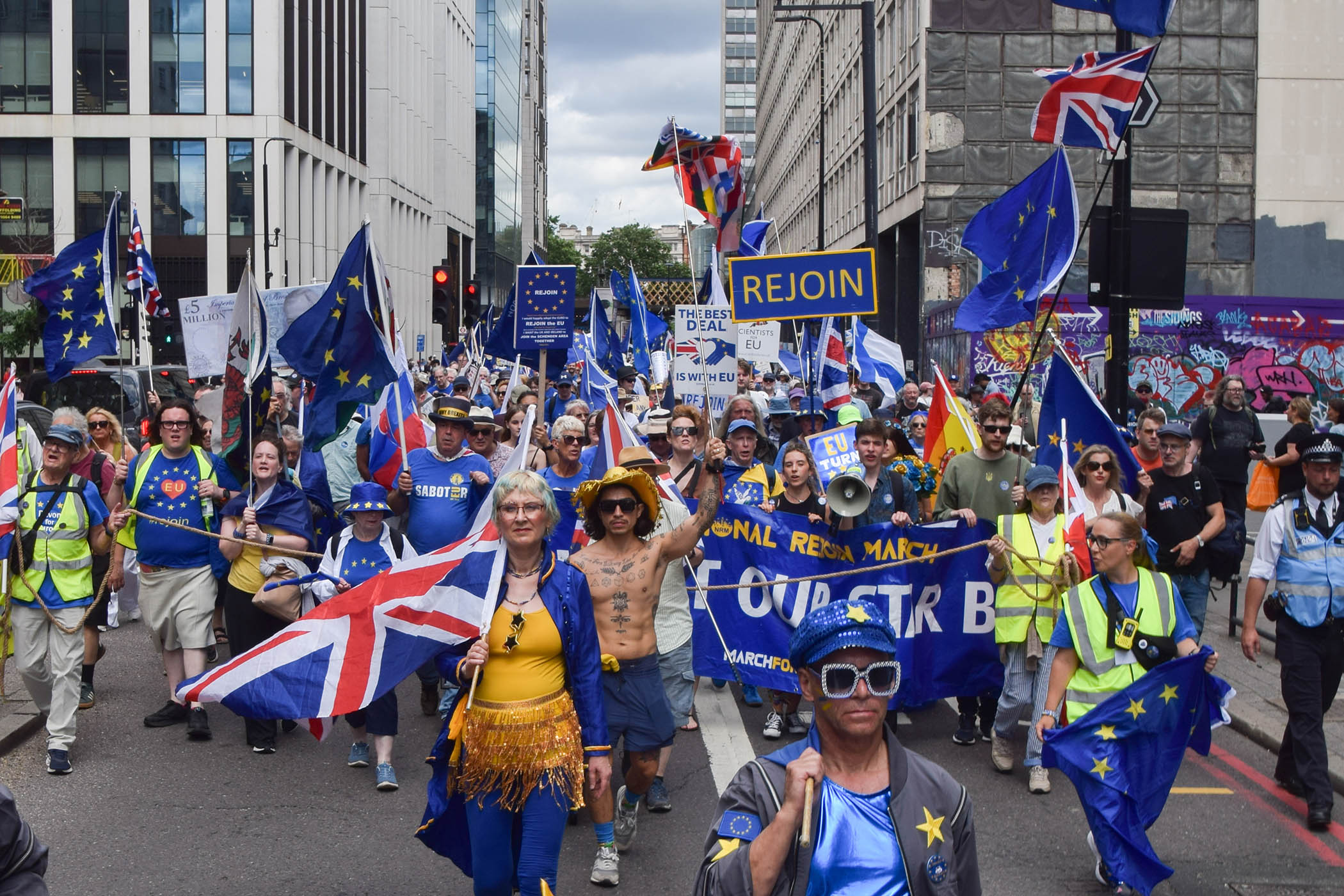
Seven years ago, Brexiters said it was too soon to revisit Britain’s relationship with the EU in a second referendum, even though about 400,000 people had crammed into the streets of London to demand one.
So what? It’s much harder to make that argument now. The original EU referendum was held a decade ago today, and ten years turns out to be a long time in
•
politics, contorted by the appointment of six new prime ministers (and soon a seventh, presumably Andy Burnham) and the failure of Brexit itself;
•
geopolitics, upended by Russia’s war on Ukraine, the inexorable rise of China and the serial disruptions of Trumpism;
•
demographics, as millions opposed to EU membership die and millions broadly in favour of it get the vote;
Vibe check. In 2016, 52% of the British electorate voted to leave. Only 32% would do so now.
Unloved. Economists from Stanford University and the Bank of England believe Brexit has shaved between 6% and 8% off the UK’s GDP. Bloomberg Economics puts it at 2.5%, based on average G7 growth.
Either way, Brexit has cost Britain hundreds of billions thanks to new trade barriers and falling investment.
Counting the cost. It has also resulted in
•
lost opportunities for those barred from living and working in Europe;
•
labour shortages in key sectors including housebuilding, hospitality and healthcare;
•
the rise of xenophobia as a political cause.
In geopolitical terms, Brexit has weakened Europe when Russia’s invasion of Ukraine (not to mention Donald Trump’s susceptibility to Russian propaganda) needed it to be strong.
Original sins. Brexit was sold by harnessing a broad disenchantment with one set of elites to the narrow anti-EU agenda of another. Both sides were guilty of exaggeration, but Brexiters were especially comfortable making extravagant claims that were proved false by events.
•
“I don’t think there is going to be any prejudicial change to our commercial relations with our European allies,” Daniel Hannan said in 2016. UK goods exports to the EU fell by 14% in real terms between 2019 and 2025.
•
“Absolutely everything will get much cheaper,” Nigel Farage said in September 2016. Cost-of-living crises have since derailed at least two governments.
•
“The official bill of EU membership is £350m per week,” Dominic Cummings said, suggesting the money could be spent on the NHS. This figure ignored a generous rebate and the fact that EU membership earned the UK at least four times as much.
Worth noting. There was no genuine argument from the Remain campaign for the EU as a champion of peace, democracy, free markets and the rule of law. Instead there was a limp and insincere campaign by Jeremy Corbyn, an instinctively Eurosceptic Labour leader, and forlorn promises of a better deal for Britain from David Cameron, the prime minister.
“Benefits of Brexit.” A government press release in 2022 trumpeted a “Single Trade Window” to simplify red tape, but it was shelved in 2024. It also hailed blue passports, a review of imperial metrics and a new freedom to use “the crown stamp on pint glasses”.
What next? Voters in 2026 want more Europe, not less. New polling for the European Council on Foreign Relations finds three-quarters want a closer relationship, two-thirds want a return to free movement and 70% of those enfranchised since 2016 want to rejoin.
What’s more… Two-thirds of EU voters would welcome Britain back.
Newsletters
Choose the newsletters you want to receive
View more
For information about how The Observer protects your data, read our Privacy Policy