
This article first appeared as part of the Daily Sensemaker newsletter – one story a day to make sense of the world. To receive it in your inbox, featuring content exclusive to the newsletter, sign up for free here.
In ten days’ time a team of executives and bankers will set out across America to try to persuade investors to sink $75bn into the world’s biggest space company, which has the world’s wildest growth plans and the world’s tallest rocket.
So what? There may be some pointed questions about the rocket. It performed well but not brilliantly in a test flight last week that matters because it set the tone for the SpaceX stock market flotation, due on 12 June and expected to be the biggest ever.
•
That in turn will set the tone for the IPOs planned by OpenAI and Anthropic, SpaceX’s biggest rivals in AI, for later this year…
•
Which between them may determine whether the AI sector continues to attract the colossal investment virtually everyone in it now agrees it needs to keep up with demand.
But wait. Is SpaceX a space company or an AI company?
Answer: both. But in terms of scale it hopes to become an AI company with a space company attached, because it believes 90% of its future sales will come from AI. And its founder, Elon Musk, wants to stand out from the competition by building the bulk of his AI data centre capability in orbit.
In principle, orbiting data centres could steal a march on earthly ones by harnessing solar power efficiently, not overheating because space is so cold, and not bothering nimbys because there are none.
•
To note: Musk’s plans for ODCs appear to have changed in three short months. At an all-hands meeting for his xAI company in February he spoke of building big data centres on the moon and firing them back towards Earth with a version of a rail gun. In SpaceX’s recent IPO prospectus the focus is on a huge “swarm” of much smaller data centres launched from Earth. That’s where the new rocket comes in.
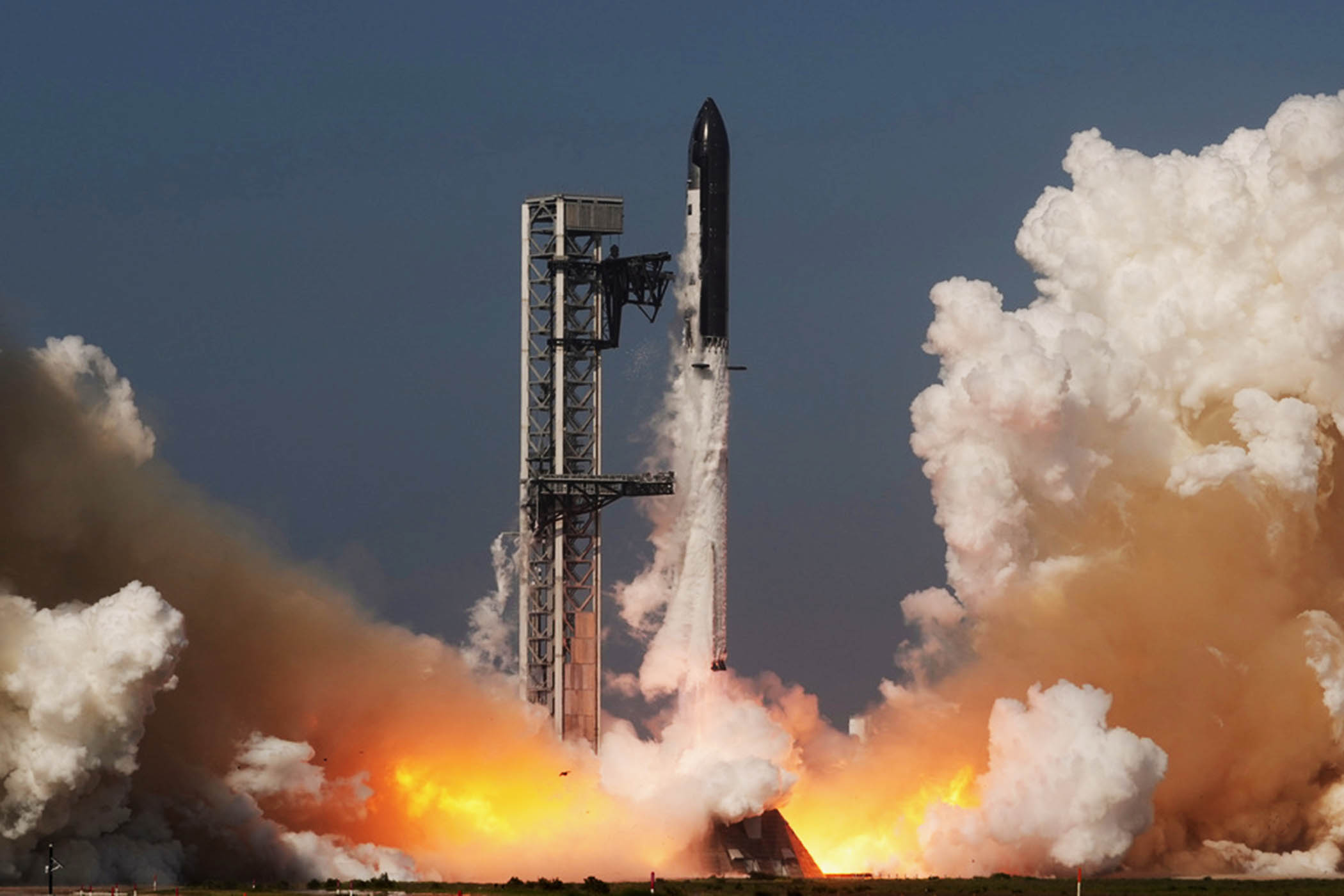
The case for Starship. The latest version of the biggest rocket ever built (“Starship v3”) has about three times the thrust of an old Saturn V moon rocket and has been designed to hoist up to 200 tonnes of payload to orbit at an implausibly low rate of $185 per kilo – less than a fifth the cost of using a smaller SpaceX rocket and about a twentieth of the rock bottom price charged by any of its rivals.
The case against. It doesn’t work yet. Five of 12 test flights have failed. None has made it to orbit. None has put a commercial payload in space, let alone a heavy one. Last Friday’s deployed 22 small dummy satellites similar to those used by SpaceX’s Starlink broadband network, but several engines failed on the ascent and the booster section had to splash down in the Gulf of Mexico rather than head back to the launchpad.
Move fast, break things. That’s the strategy. It has served Musk well in the past and could again. In a best case scenario for AI (humanity is a separate question)...
•
SpaceX fixes Starship’s glitches as it has those on its Falcon 9 and Falcon Heavy rockets;
•
its IPO meets or exceeds expectations, fuelled by the enthusiasm of retail as well as institutional investors, and justifies its $1.75 trillion-with-a-T valuation;
•
OpenAI and Anthropic follow suit, achieving valuations of close to $1tn each; and
•
prodigious investment in data centres rolls on, meeting extraordinary demand in a race for AI market share whose winners become fabulously rich.
Like, trillionaires? Not so fast. Even Musk has to build a permanent settlement on Mars with a million human inhabitants before he can cash in a big chunk of his SpaceX shares.
What’s more… There’s a glass-half-empty scenario for the sector, too, in which AI sweeps all before it in some areas, such as coding, but hype exaggerates overall demand and leads to an oversupply of data centres, insufficient revenues and a bubble that has to burst.
Photograph by Eric Gay/AP
Newsletters
Choose the newsletters you want to receive
View more
For information about how The Observer protects your data, read our Privacy Policy