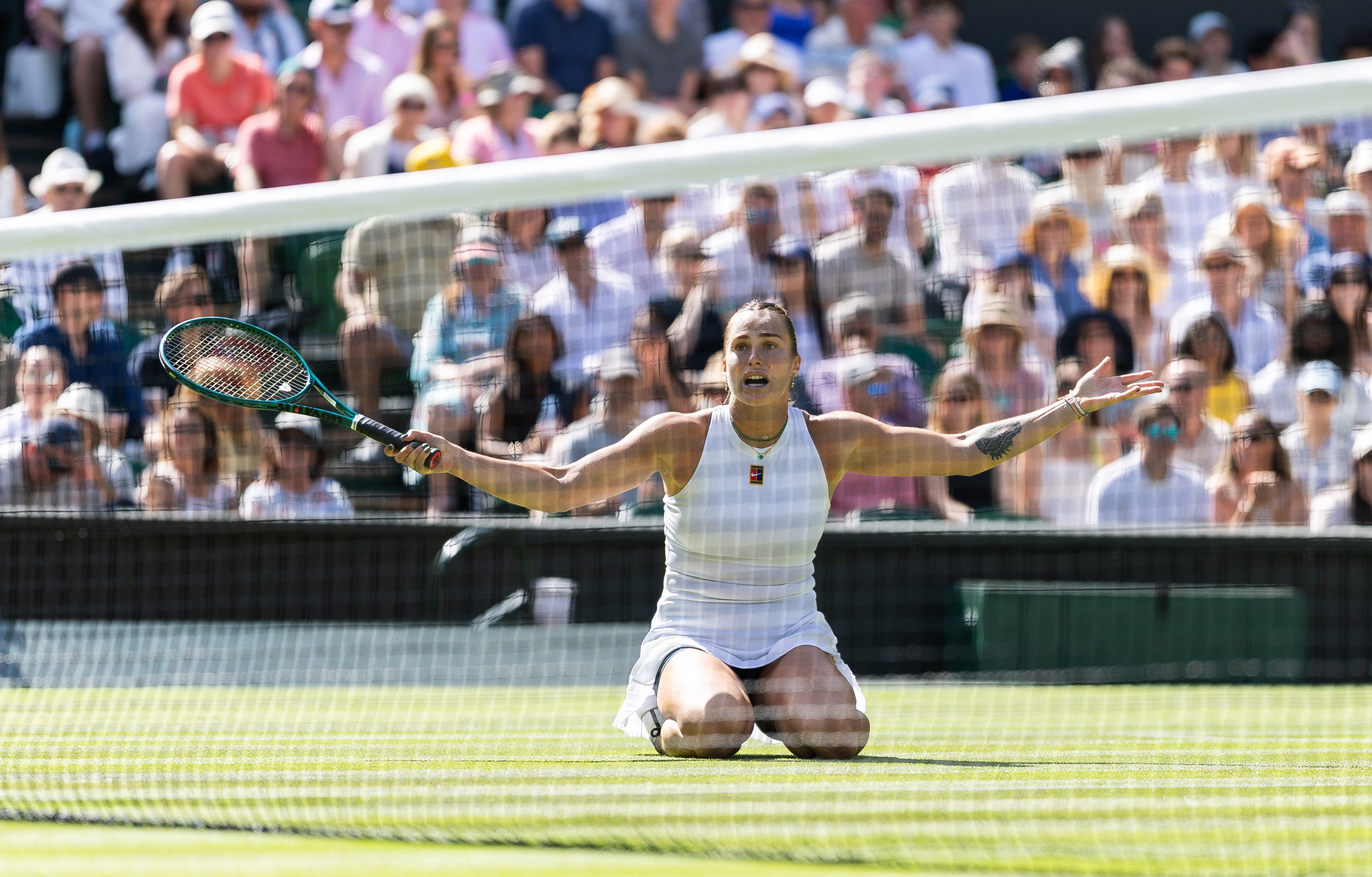




Photograph by Simon Bruty/Anychance/Getty Images
This article first appeared as part of the Daily Sensemaker newsletter – one story a day to make sense of the world. To receive it in your inbox, featuring content exclusive to the newsletter, sign up for free here.
Wimbledon begins today with an expanded prize pot of £64.2m, an increase of 20% compared to last year’s event.
So what? This has not appeased the sport’s increasingly mutinous players. On Saturday they limited their pre-tournament media appearances to 15 minutes, following a similar protest at last month’s French Open. They are unhappy about
•
prize money;
•
packed schedules; and
•
player welfare.
Tennis is having a moment. Some 106m people around the world play tennis – an increase of 25.6% from 2019 – and 1bn fans now watch it. The sport has shed its gentlemanly image to become a global cultural phenomenon, thanks to grassroots investment, social media trends and the emergence of new stars like Carlos Alcaraz and Aryna Sabalenka.
Courtside. These players are demanding a bigger slice of the pie. They want the prize pots of the four Grand Slams to be increased to 16% of each event’s revenues, rising to 22% by 2030.
Short ball. Wimbledon's new prize money is equal to 15% of its revenues. The French Open and Australian Open have also not met the threshold, despite increasing their own prize pots.
Nuclear option. Some of the game's biggest names, including Alcaraz and Sabalenka, have threatened boycotts. Their career winnings are $65m and $49m respectively, and both have lucrative sponsorship deals, meaning they would be just fine if the money remained the same.
Grinders. But life is a slog for lower-ranked players, whose winnings must fund their coaches and travel as they compete in a sport that spans continents. Take Jan Choinski, the men’s number 100. His lifetime earnings are $1.1m. But at the age of 30, with an annual expenditure of about $100,000 a year as a professional tennis player, he is barely breaking even.
Lodestar. This point was emphasised by Sabalenka on Saturday. She said: “We don’t do it for ourselves. We do it for the rest of the players who are suffering to even hire a coach.
Mind the gap. There is also a pay discrepancy between men’s and women’s events, even if the Grand Slams have long offered equal prize money. Katie Boulter drew attention to this in 2024, when she received $142,000 for winning the San Diego Open on the same weekend that her boyfriend, Alex de Minaur, got $415,125 for triumphing in the Mexican Open.
Meanwhile, players are expected to play more tennis than ever before. The men’s tour has nine Masters 1000 events, the level below Grand Slam, and will soon have a 10th in Saudi Arabia. These tournaments used to last a week, but seven of them now take place over a fortnight.
Ironically, the main justification for the expanded format was that it would generate more revenues to share with players. Another touted benefit was that it would allow for rest time between matches.
Instead, an already demanding tournament calendar has become physically gruelling. Iga Świątek, the 2025 women’s Wimbledon champion, has called the “schedule overwhelming” while Alcaraz, a two-time men’s winner, has described the number of tournaments as “too high”.
On the sidelines. Alcaraz has been forced to miss this year’s French Open and Wimbledon due to a wrist injury. He is not alone: retirements from matches have risen by 25% on the men’s tour and 50% on the women’s since the 1990s.
Different sport. Added to the demands of a packed schedule is the fact that tennis has become a much more aggressive game, featuring heavy-hitting and longer rallies. Weather conditions are also getting tougher as the climate changes, and heat exhaustion is an increasing problem.
What’s more… In addition to a greater chunk of Grand Slam revenues, players want the tournaments to contribute to welfare benefits, including pensions, healthcare and maternity pay.
Newsletters
Choose the newsletters you want to receive
View more
For information about how The Observer protects your data, read our Privacy Policy