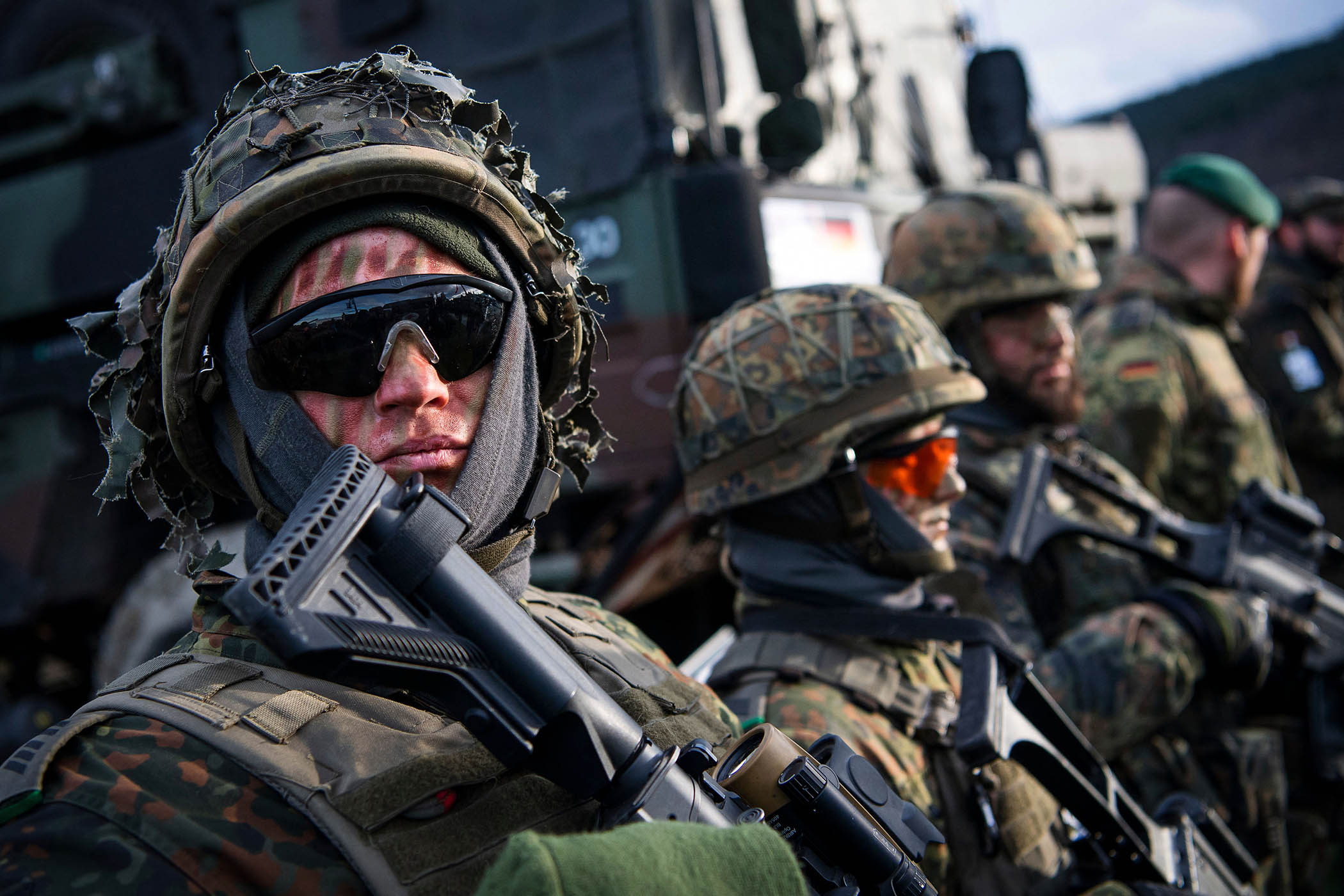



Photograph by Jonathan Nackstrand/AFP via Getty Images
This article first appeared as part of the Daily Sensemaker newsletter – one story a day to make sense of the world. To receive it in your inbox, featuring content exclusive to the newsletter, sign up for free here.
Keir Starmer has come under criticism for leaving a gap of almost £5bn in the UK’s defence spending plans, which Andy Burnham will have to plug with taxes, cuts or borrowing.
So what? Defence spending rows are fast becoming a mainstay of British politics. But they are just one part of a bigger picture, as Europe races to rearm in response to the twin threats of an aggressive Russia and an apathetic US. This process
•
has a sense of urgency; but
•
is uneven across the continent; and
•
has been hampered by national interests.
Aim big. Nato members have committed to spending 5% of GDP annually on defence by 2035. Of this, 3.5% must go towards “core defence”. Another 1.5% can be spent on “security-related investments”, leaving room for creative accounting. Alliance members have pondered whether to include bridges, rural broadband and civilian coastguards in this bracket.
But a serious process of rearmament is underway. Germany has loosened its strict debt rules as it aims to build Europe’s largest land force, increasing its defence budget by 24% compared to last year. It accounts for a quarter of the growth in all European defence spending since 2024. Poland is another leader: its defence budget is now 4.8% of GDP.
Berater-in-chief. Donald Trump can take a lot of credit for this, since his threats over tariffs, Greenland and Iran mean more Europeans now see the US as a threat than an ally. So can Vladimir Putin. The war in Ukraine, with its emphasis on drones and long-range precision strikes, has convinced European military planners that their hardware is out-of-date. It has also led Nato intelligence to conclude Russia could be ready to invade the alliance by 2029.
In a nutshell. As the European Council on Foreign Relations recently put it, Europeans need a new military model that sets them up “to defend themselves with America where possible, with less America where necessary and without America if it comes to that.”
Growing pains. But several alliance members are struggling to meet their commitments, not least the UK. Labour has spent months clawing together money for the defence investment plan, which was supposed to come in the autumn and was finally published on Tuesday. But its extra £15bn for the military is well off a roughly £28bn shortfall, and part of it is unfunded.
Left for later. The document increases British defence spending to 2.7% of GDP from 2027 onwards. Labour has deferred setting out a timetable to reach 3% and then 3.5% until the future, meaning arguments about the issue will rumble on.
All together now. If Europe is to stand on its own feet, collaboration will be key. But parochial priorities threaten to scupper joint action. Earlier this month, Germany pulled out of a landmark fighter jet programme with France due to disputes about control. The UK has also walked away from talks to join the EU’s new defence fund, after the bloc demanded a high price for entry.
The boring bit. Even if Europe does find enough money, it will need to spend it well to avoid waste. It also needs to streamline cumbersome, expensive and fragmented procurement processes. These mean “more military spending does not automatically and immediately translate into military capabilities,” according to the Kiel Institute for the World Economy.
Reality check. Although Europe is now taking its own defence seriously, it is unlikely to completely break with the US, which it still relies on for missile interceptors, satellite surveillance and the networks needed to run American weapons purchased by its militaries.
What’s more… Countries far away from Russia are still reluctant to spend more. Spain refuses to dedicate 5% of GDP on defence, while Belgium has only just met the old Nato target of 2%.
Newsletters
Choose the newsletters you want to receive
View more
For information about how The Observer protects your data, read our Privacy Policy