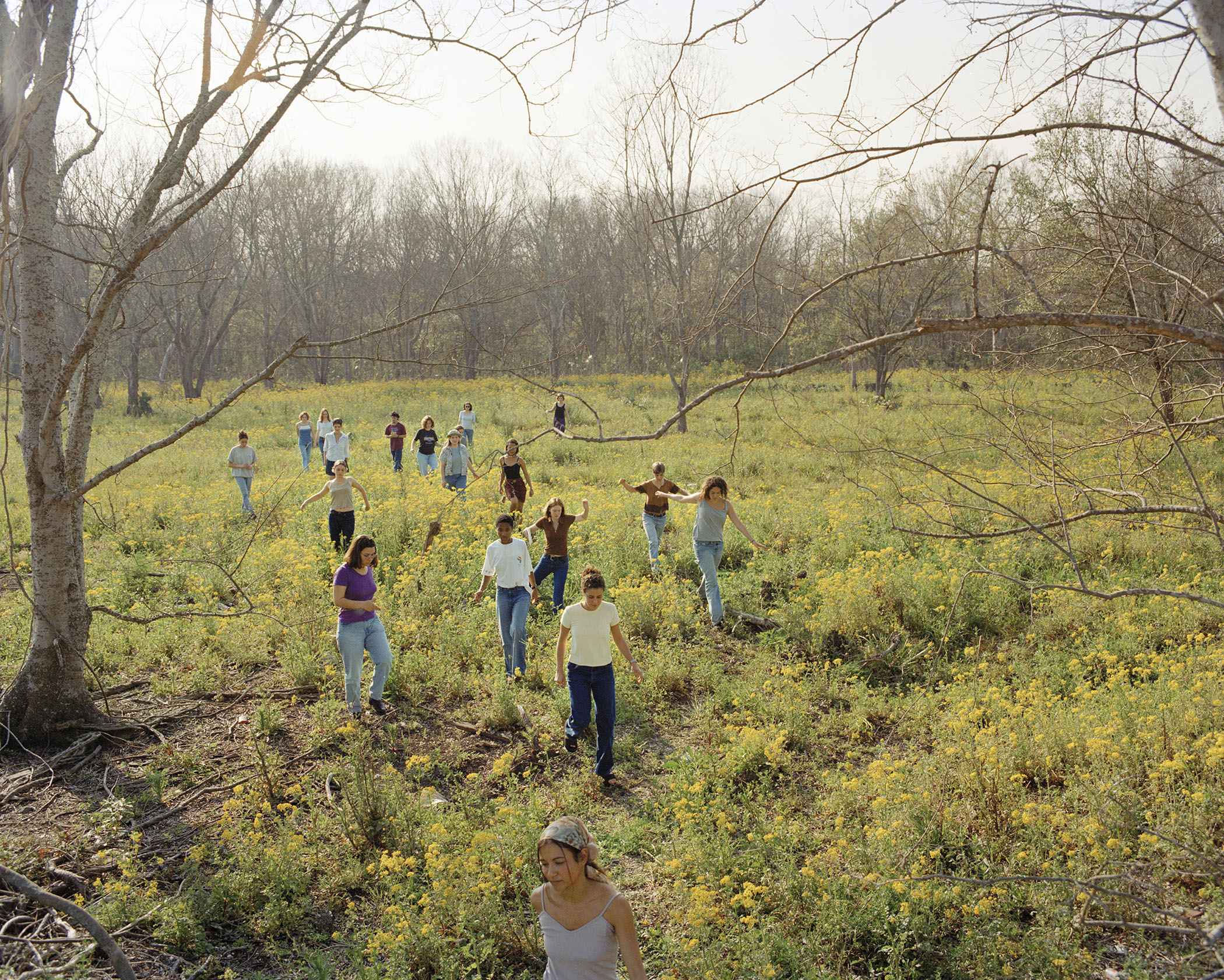

It’s early spring in Tennessee and 19 young women are making their way across a forest clearing. The trees are bare, but on the ground ragwort has sprung up, carpeting the scene in green and yellow. The women in the middle, as though dancing to music that only they can hear, throw out their arms to steady themselves. The prevailing mood, as they move towards some unspecified destination, is calm, collected, purposeful.
This photo, which features in the inaugural exhibition at FotoFocus gallery in Cincinnati, is taken from Justine Kurland’s series Girl Pictures. Between 1997 and 2002, Kurland zigzagged across America photographing adolescent girls in outdoor settings. It began as a fictive exploration of teenage runaways and evolved, Kurland says, into “a kind of feminist world-building [imagining] what would happen if all these girls came together in solidarity”. She wanted to show “the power of togetherness and how [the girls] could become more powerful through each other”.
On months-long road trips, Kurland trawled the streets of America’s towns looking for subjects. “I’d see a bunch of girls hanging out in front of a high school and I would talk to them about the project. If they wanted to do it, I’d tell them to talk to their mothers to make sure it was OK, but I don’t know if they did or not.” She scouted locations in advance and created loose narratives for each shoot: “This is where they’re going to build a fort, or make dinner from roadkill, or braid each other’s hair.”
This picture was a little different: the New York Times had commissioned Kurland to photograph the women’s studies class at Vanderbilt University in Nashville. Sticking with her vision of using photography “to imagine the world as you want it to be”, she tried various set-ups with the students. “The one that I liked,” she says, “was of them coming forward and out of the picture – it was this idea that they might spill out of the picture and into the world to do the work that they had to do as feminists.”
Newsletters
Choose the newsletters you want to receive
View more
For information about how The Observer protects your data, read our Privacy Policy