Fiery, prolific, exhilaratingly original and dead at 36: Ana Mendieta’s brutally short life is not easily disentangled from her work. Nor should it be, given that almost everything she made with her hands and eyes, and sometimes her entire naked body, spoke to her existence as a Cuban exile in America. Water, fire and blood, feathers and clay, blossoms and sand, she made sculptures – and made herself into sculptures – that invoked the baked earth and glistening seas of the homeland for which she yearned.
Indeed, Tate Modern’s tremendous survey proves that the only thing that has nothing to do with the art is Mendieta’s death, falling from a 34th-floor window in Greenwich Village after a row with her husband in 1985. The minimalist sculptor Carl Andre was acquitted of her murder. His name is never mentioned in this show, or its catalogue, a convention observed now for more than four decades. But the theory of suicide – rejected as highly implausible by her friends and family – appears just as irrelevant, one now sees, to the great and vivifying nature of her art.
Mendieta is best known for the Silueta series, in which she finds the most ingenious ways to leave her silhouette on the landscape. It is a revelation to see so many here, in photographs. You see Mendieta, lying on the ground, covered in grass, or in sand, or in glowing white flowers as if she were their earthly origin. Or you see the outline of her body, traced like a path in clay, marked out in votive candles, or burned with gunpowder into the ground.
Sometimes the arms are pinioned by her sides, like an Ancient Egyptian statue; sometimes they are raised as if in merry greeting. Occasionally, there is a shallow space where a body once lay. A trio of images – she was a terrific photographer – shows a declivity filled with red pigment, bright and shapely to begin with, then gradually washed away with the tide, leaving a gorgeous colour and softness behind.
Two sinuous figures, like spooning lovers, lie fashioned out of sand on a Florida shore. They will slowly disappear in an ecstasy of twinkling brine. Mendieta spoke of discovering art on Cuban beaches in childhood, making castles and waterways and curvaceous shapes in the sand. The insinuation by Andre’s defence lawyer that Mendieta was obsessed with destruction has its marvellous refutation in these memories. Besides which, this 1981 work is titled Ochún, after the Yoruba goddess of fertility and love; and this is the very water that flows from Florida back to Cuba.
Mendieta is fascinated by fusion and sublimation, by human and planetary union, matter turning into energy
Mendieta is fascinated by fusion and sublimation, by human and planetary union, matter turning into energy
It is fascinating to see how elusive Mendieta can be. A Silueta can be almost undetectable, at times, so that you have to stare hard into a riverbank or deep glade to make out any human presence at all. She was creating these works from the early 1970s, when land artists were making sun tunnels and spiral jetties across America. But her work is always figurative. You could call it a one-woman show, since every piece is based on her own diminutive form. Yet it never seems egotistically personal.
Mendieta is fascinated by fusion and sublimation, by human and planetary union, matter turning into energy. There is a powerful piece in which the human imprint seems to lift off the ground in the form of smoke and another where a woman of snow seems to leave her passing presence on the trunk of a wintry tree.
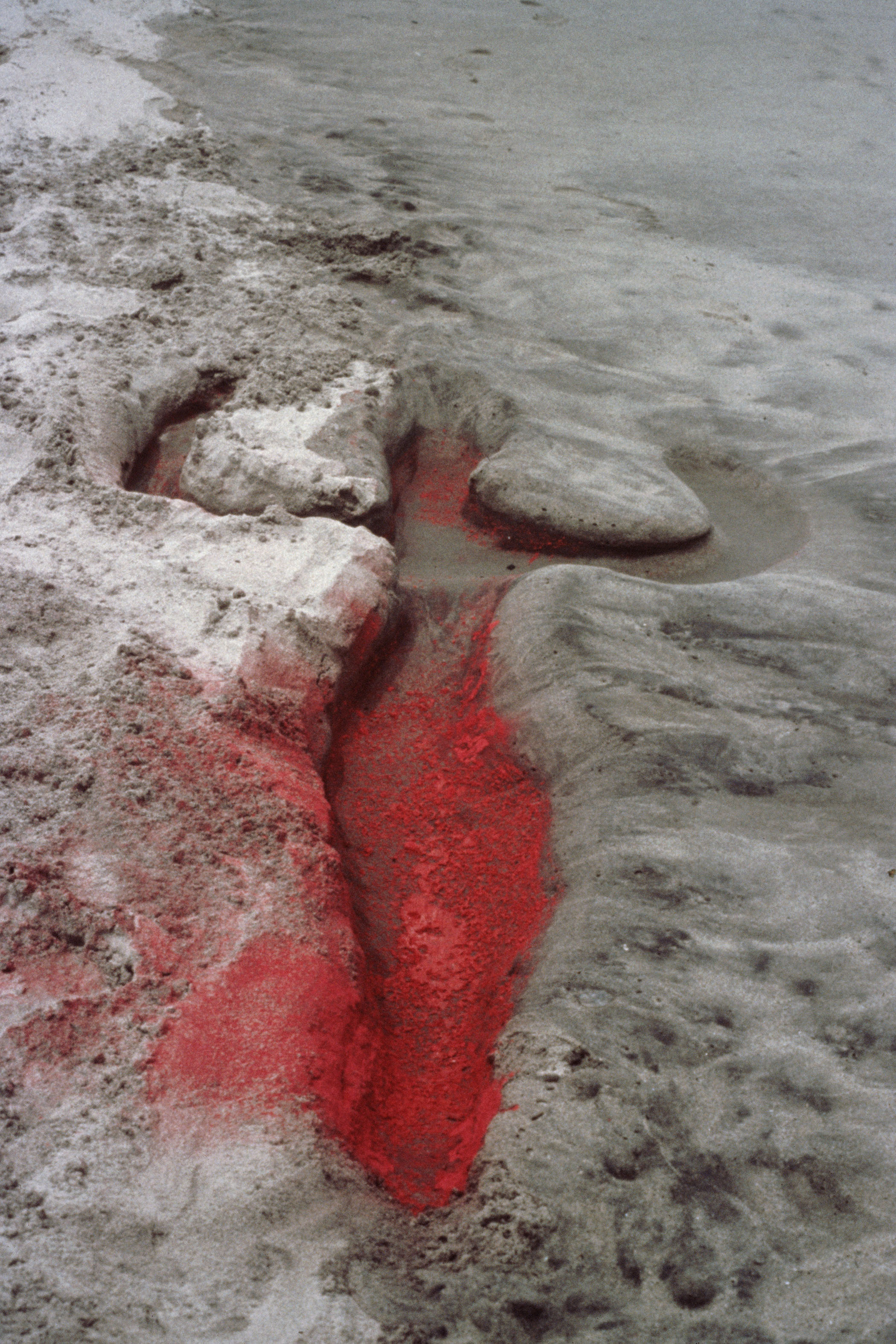
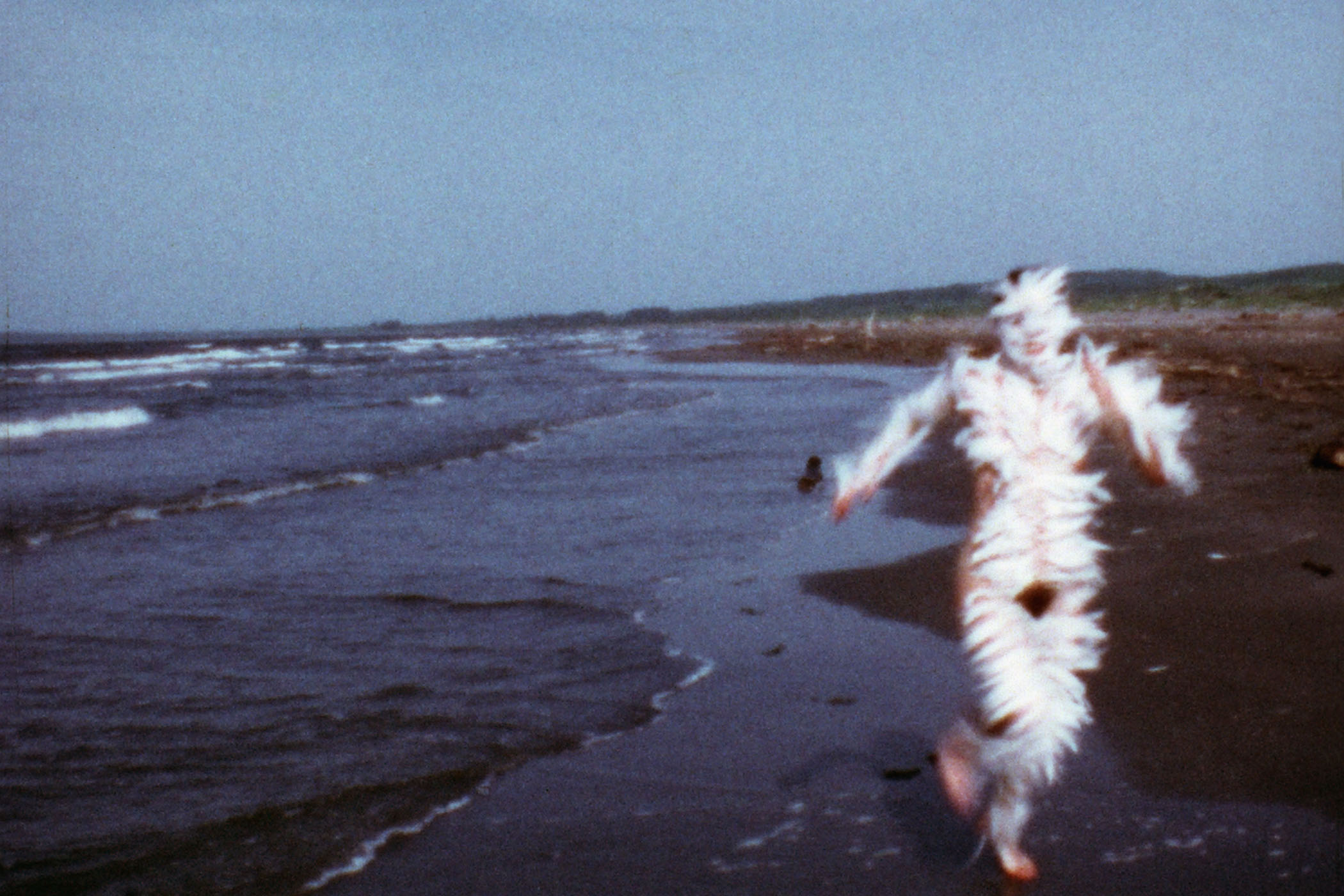
‘Occasionally, there is a shallow space where a body once lay’: from Ana Mendieta’s Silueta series, 1976. Main image: Bird Run, 1974
Her images are always beautifully formed, often shaped with the tips of her fingers or the flat of her palms. She draws vulval shapes in clay and they rhyme like leaves within leaves. She prints cave walls with her hands, like our ancestors in Lascaux. A short film shows Mendieta from behind, dipping her hands in an unseen vessel, shaping words with her palms on a wall. “There is a devil inside of me” and “she got love”. The phrase is all the more sinister for being inscrutable until the very last syllable and written in what appears to be blood.
Mendieta studied intermedia art at the University of Iowa. She was there when a young nursing student was atrociously beaten and murdered. One of her responses was to strew the ground outside her apartment door with bloody remains and photograph the reactions of passing strangers. Some stop to look; others sidestep the scene; most hurry on by. Nobody knocks on the door.
The film works are unforgettable, and nearly all made before she was 30. A dark figure walks towards an even darker tree, presses into it and suddenly glows with blazing red light. A female figure in luminous white feathers hurtles along a beach towards the camera as if about to surge upwards into flight.
Newsletters
Choose the newsletters you want to receive
View more
For information about how The Observer protects your data, read our Privacy Policy
It is astounding to think that Mendieta left so much art, enough to fill a floor of Tate Modern, by the age of 36. Her influence is palpable, what is more, in contemporary art. A single sequence of photographs of the artist squashing herself against a sheet of glass, distorting her face and form, prefigures works by Douglas Gordon and Jenny Saville, among many others.
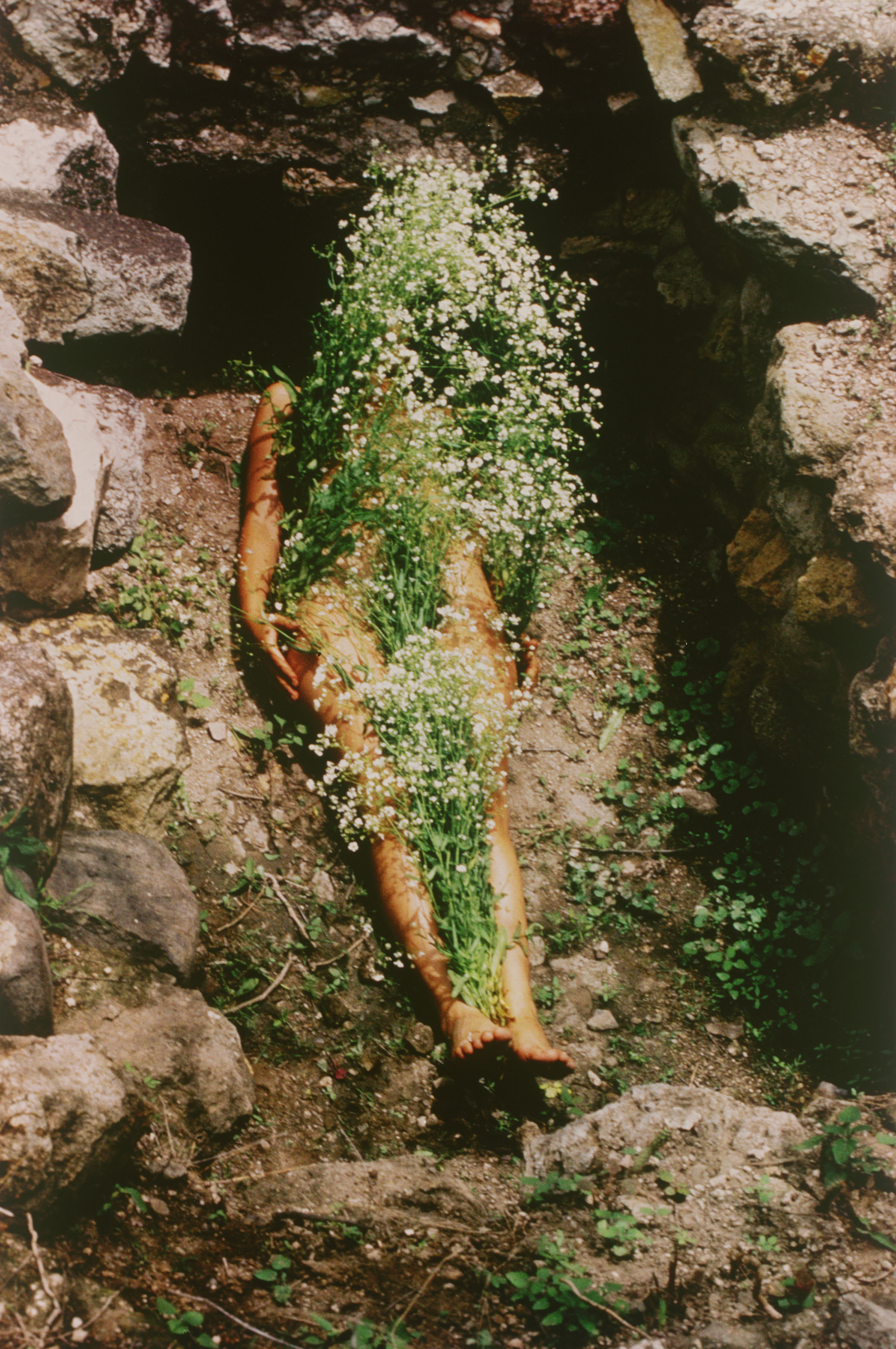
Imágen de Yágul, 1973
Mendieta wanted, she said, to invoke emotion from first to last. And so she does, even when at her most ethereal, working with frost or moss. There is force of personality in every object, image and film. Tate Modern is showing a group of what would turn out to be Mendieta’s final works, where the silueta is burned into the trunks of fallen trees.
It took the New York Times more than 30 years to publish an obituary for Mendieta and her name is still insufficiently known in Europe. Although this is by some way the best of Tate Modern’s trio of current shows by women, alongside Tracey Emin and Frida Kahlo, Mendieta’s fame remains decades overdue, though in her case better late than never.
Ana Mendieta is at Tate Modern, London SE1; until 17 January 2027
Photographs by The Estate of Ana Mendieta Collection, courtesy of Marian Goodman Gallery and Alison Jacques