

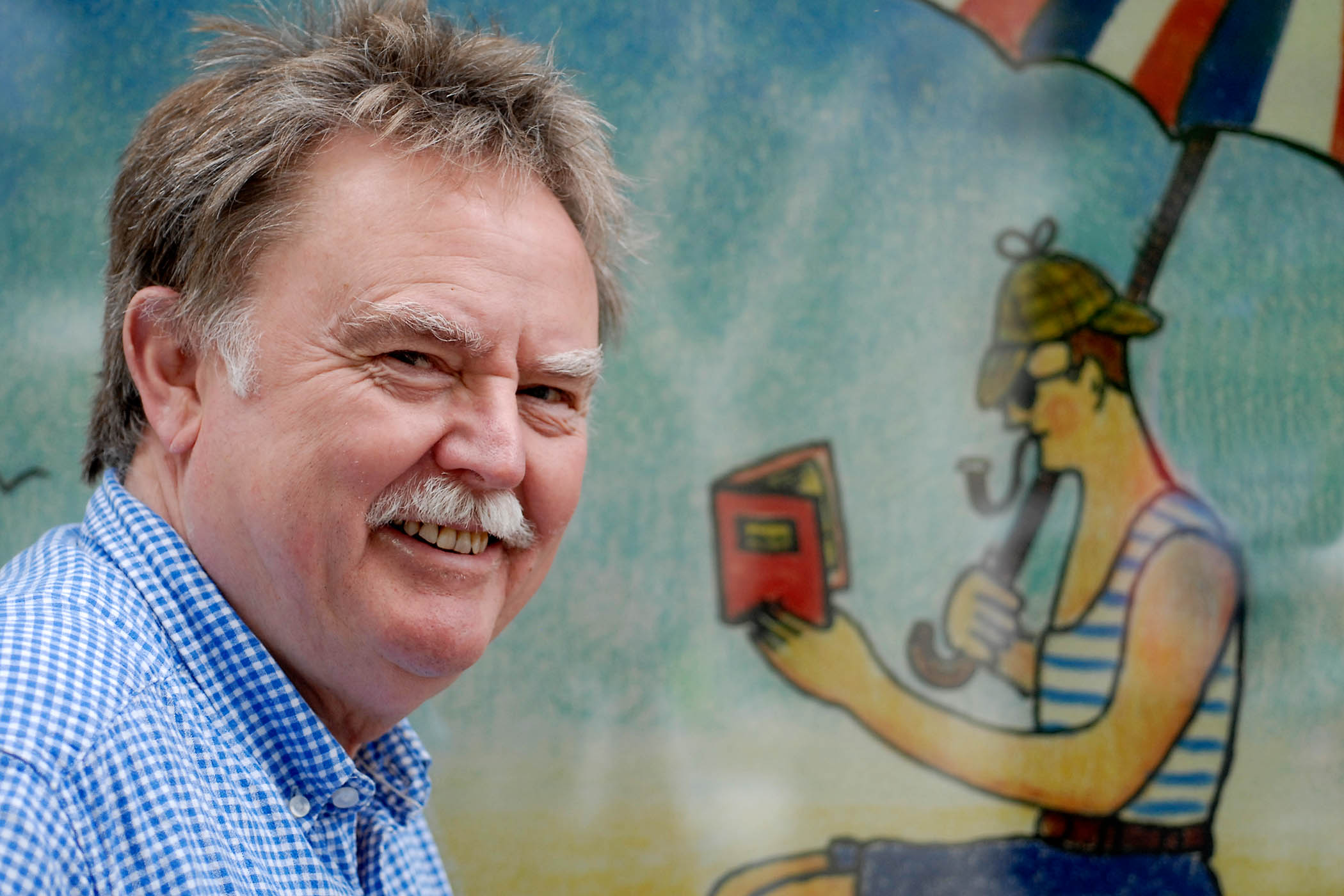

“Antarctica is the one environment on Earth where a man has reasonable control over his own fate,” said the polar historian Roland Huntford. “There are no hostile men; no hostile bacteria. It’s all down to you.” That belief underpinned Scott and Amundsen: The Last Place on Earth, Huntford’s account of the 1911 race to the South Pole, in which he argued that the true hero was the Norwegian Roald Amundsen, who got there first and brought his team home alive, while the doomed British explorer Robert Falcon Scott was incompetent and reckless.
Huntford’s book, published in 1979, challenged 70 years of hero-worship for Scott, who froze to death with his men on their return journey after reaching the pole 34 days behind Amundsen. The British, he said, love a glorious failure, especially if they die.
He insisted his aim was not to destroy Scott but to elevate Amundsen, whose achievements he felt had been wilfully diminished in Britain. No previous English-language biographer had used the Norwegian sources extensively. In an age of amateur sportsmen, meticulous preparation and a desire to win were somehow considered to be cheating to the British. At a Royal Geographical Society dinner in 1912, the president, Lord Curzon, gave a toast not to Amundsen but to his dogs. Scott’s men had pulled their equipment themselves after their motor sleds failed.
The book caused an uproar with Huntford’s claims that Scott had been cavalier with his men’s lives and that his wife, Kathleen, had had an affair with Fridtjof Nansen, another Norwegian explorer. Captain Scott Society’s chairman described it as “a kick in the balls for a British hero”. Scott’s son, Peter, sued successfully for a disclaimer stating that he rejected the book’s assertions.
The controversy endured after a television adaptation was based on the book. Ranulph Fiennes, who wrote his own biography of Scott in 2003, described Huntford’s work as “character assassination”, and recalled a conversation that Peter had with another biographer, Elspeth Huxley, who told him that Huntford was “animated by a burning hatred of your father”. There was evidence of this. “I took a dislike to him because I thought he personified the kind of third-rater that has got to the top of society here and brought the country to its present state,” Huntford told the Guardian in 2012. Scott’s prose, admired by others, he dismissed as “appallingly maudlin” and “romanticised trash”.
Huntford was born Roland Horwitch in Cape Town in 1927, but changed his surname in 1955. He came to England after the second world war to study physics at Imperial College London but was asked to leave after two years, spending his 20s as a dilettante in Europe. Introduced to Ibsen by someone he claimed was a Danish communist double agent, he became obsessed with the playwright, learning Norwegian to read works in the original language. He took a job at the UN High Commission for Refugees in Geneva, but the Scandinavian lifestyle appealed more and he spent much time skiing and camping in the Baltic.
In 1960 he met Chris Brasher, The Observer’s sports editor, and asked for a job as a ski reporter. He became its Scandinavian correspondent, writing for 14 years covering cold war politics and winter sports. Initially he was based in Helsinki, but after a piece on the sensitive Finnish-Russian relationship, he was quietly moved to Stockholm where he met his future wife, Anita. They were married in 1966 and had two sons, Nicholas and Anthony. Anita died a month before her husband.
His 1971 polemic The New Totalitarians, a critique of Swedish socialism, made him a bitter enemy of Olof Palme, the then prime minister, which led to a hastened departure from the country. The Observer nudged him towards his big project in 1974 when he interviewed Tryggve Gran, the only Norwegian hired on Scott’s team. Gran was involved in laying supply depots for the polar attempt and had carried the union jack to Scott for 50 miles on his own after discovering the leader had left it back at base.
“There’s a book in this,” his editor told Huntford. He agreed but was surprised when the published article said he was working on a biography of Scott and Amundsen. “That sort of settled things,” he said. He moved to Cambridge to be near the Scott Polar Research Institute.
In 1985 Huntford published a biography of Ernest Shackleton, whom he admired for bringing his men home alive when their ship Endurance became stuck in ice. “Only in Britain do we revere the man who died in failure above the survivor,” he said. He returned to Scott in 2009 with Race for the South Pole: In Their Own Words, placing British and Norwegian expedition diaries side by side with his own commentary.
Newsletters
Choose the newsletters you want to receive
View more
For information about how The Observer protects your data, read our Privacy Policy
Huntford also wrote the first English-language biography of Nansen and a history of skiing. He left an unpublished novel in which he imagined what would have happened if Scott had made it home alive. He lived in Cambridge until his death, relishing his reputation as an iconoclast, and took comfort from a line by Ibsen: “The strongest is he who is most alone.”
Roland Huntford, polar historian, was born on 4 September 1927 and died on 23 January 2026, aged 98
Photograph by GNM Archive