
Related articles:
This article first appeared as part of The Puzzle edit newsletter – trends, histories, insights and brain teasers all in one place. To receive it in your inbox, featuring content exclusive to the newsletter, sign up here.
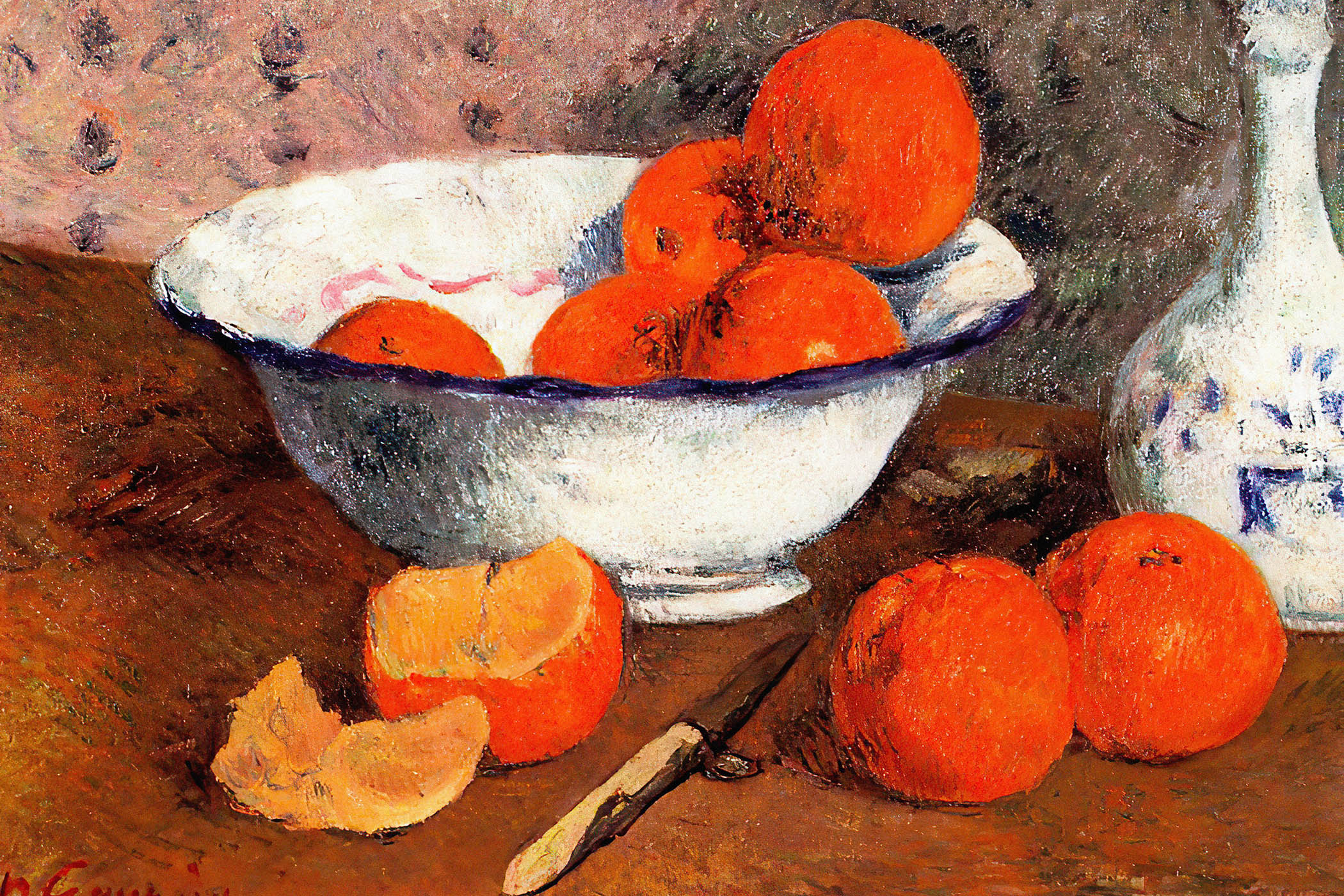
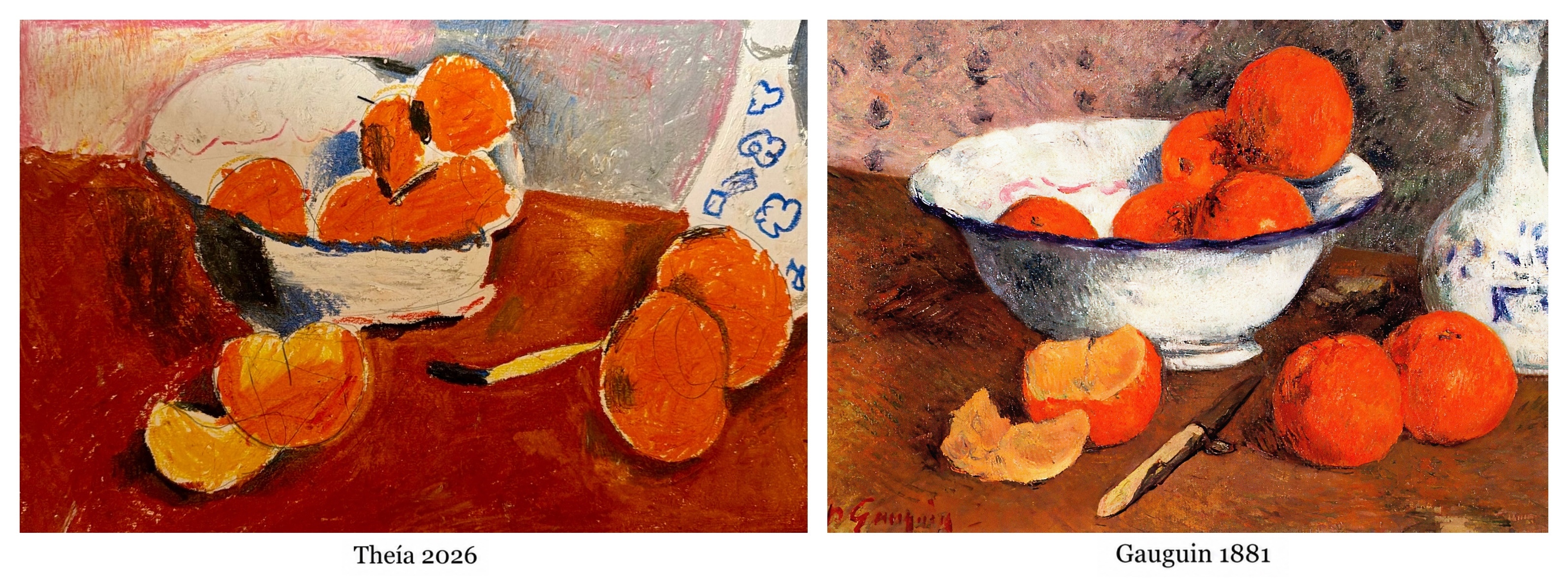
My daughter Theía is six, and over the May half-term she finished her second stint at a branch of Cygnets, a nationwide fine art school that teaches children traditional art techniques by having them recreate famous artworks. This time it was Gauguin’s Still Life With Oranges, painted in oil in 1881 and hanging in the Musée des Beaux-Arts in Rennes. Theía’s version, in oil pastel, is hung on her art gallery wall that runs the length of our stairs.
She came home with smudges on her hands, arms and cheek (the way you do when you’ve properly lost yourself in something), and a piece of paper that was, unmistakably, the same painting: same bowl, same scattered fruit, same white-and-blue vase holding the whole composition together. The class isn’t really about the finished picture. Famous images are just how it teaches children proper fine art technique. Not so dissimilar from a puzzle in The Observer…
Guess the picture, set by Laura each week, demands the same close, sustained attention to a single artwork that Cygnets does, just arrived at by recall instead of copying. I suspect some readers may not be familiar with it, as it has existed only in print in the New Review – until this weekend.
“It started during lockdown when the galleries were all closed, and I had nothing to write about, so I started doing this,” Laura tells me. What began as a stopgap is now a staple of the New Review’s puzzle pages. You’re never shown the whole painting, only ever a detail: a shoe, a hand, an apple, perhaps even a single brushstroke. The question changes from week to week, sometimes simply asking what the painting is, where it hangs, or who’s depicted in it. “The picture has to be relatively well known,” Laura says, “as nobody would be able to guess it otherwise.” She’s alert to the fact that a determined reader could run the image through recognition software rather than actually look, but there’s no prize or competition, so there’s little to gain from cheating yourself out of the fun.
Laura also works within a self-imposed limit: nothing by an artist who died less than 75 years ago. It rules out some of the 20th century’s biggest names, but it has pushed her somewhere more interesting, towards the 1500 to 1950 window, and deliberately towards women artists from that period who are only now becoming more popularly known. For me, this is part of the puzzle’s appeal: some paintings will be well known enough to be guessable, but others are obscure enough that you discover something new.
A reader once wrote in to say the puzzle was too hard, and asked why she couldn’t just run John Constable’s The Hay Wain. A few weeks later, Laura ran the smallest detail, a background figure from Constable’s famous canvas. She doesn’t know how many people got that one; readers who solve it in their heads rarely write in to say so.
I knew what Theía was drawing before she’d finished it, so I can’t claim to have guessed the Gauguin cold. But hand me a detail of it out of context, that blue-patterned vase, say, or the bowl with one orange poking over the rim, and I think I’d get there. With Guess the picture, I might get the odd one in that same way. Other weeks, I’ve got nothing at all, but delight in the discovery of something new at the reveal.
Related articles:
Theía’s had her own version of that: not zooming in on one part of a painting, but being walked, stroke by stroke, through how one is built, learning to notice the finer, easily overlooked details along the way. I took her to the Tate not long ago expecting to get through most of the building in a day. We managed two rooms, because she stopped at almost every picture to properly look and discuss it, even the ones she didn’t much like. Regular readers will already know she test-solves Observers Needed puzzles; between that, Cygnets, and now Guess the picture, she’s learning to look deeper at whatever’s put in front of her rather than settle for the obvious. She’s unlikely to get the answer right any time soon, but it’s becoming something the two of us discuss together, not just a part of my day job.
Guess the picture is now available digitally at observer.co.uk/puzzles and in The Observer app. The first four puzzles are playable now, with the archive expanding over the coming months alongside a new puzzle each week.
Newsletters
Choose the newsletters you want to receive
View more
For information about how The Observer protects your data, read our Privacy Policy
Paul Gauguin - Still Life with Oranges 1881