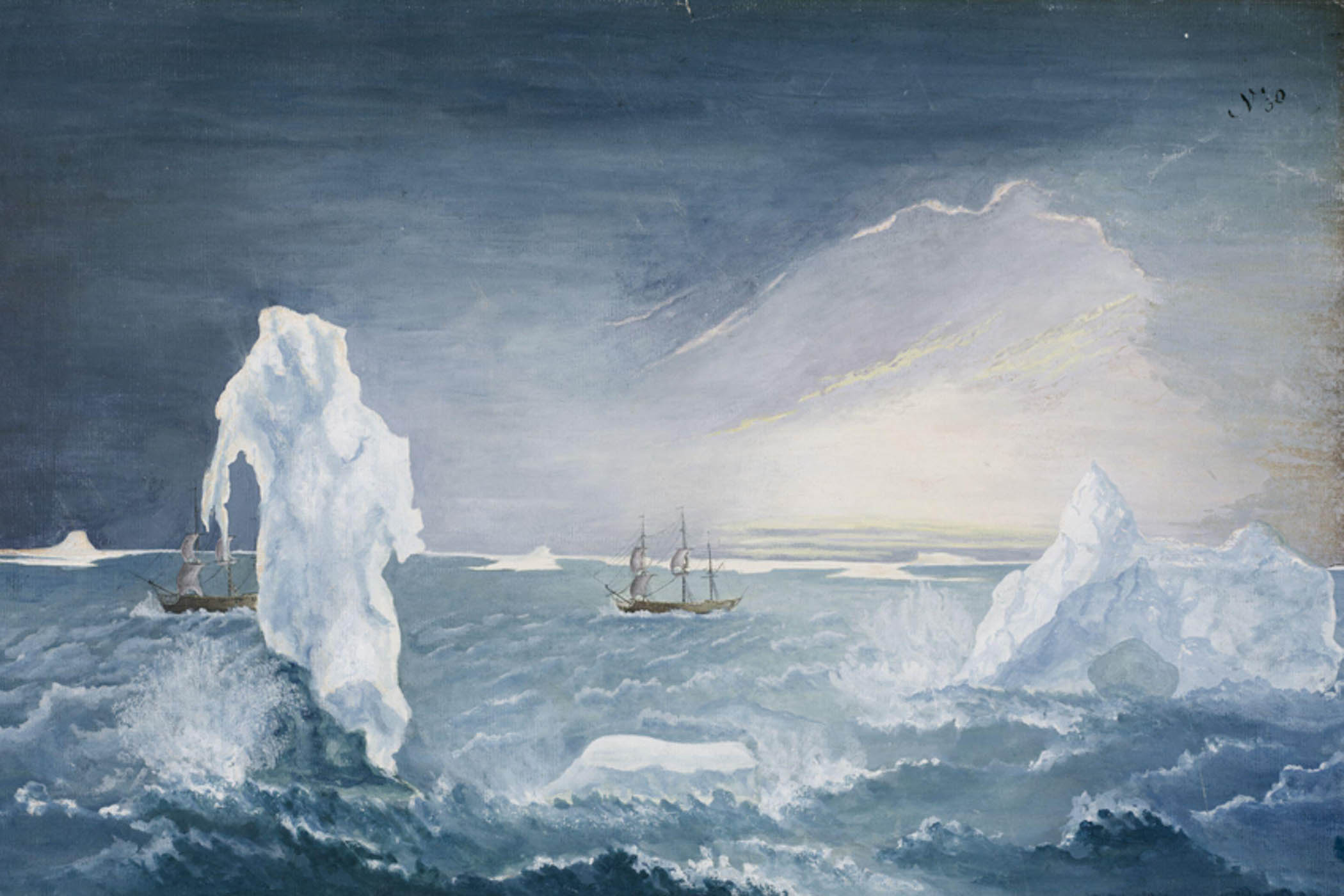

George Forster celebrated his 18th birthday on the HMS Resolution in the middle of the South Atlantic, between Cape Town and Antarctica, on 27 November 1772. It was bitterly cold, and a few days earlier Captain James Cook had issued the crew jackets and trousers made of heavy woollen cloth, but everyone soon discovered that they offered little protection against the icy wind and water. As the ship sailed south, the weather grew worse and the waves higher. Furniture tumbled, water rose ankle-deep in cabins, crockery fell from tables. Soon the first icebergs appeared. Day after day, they narrowly avoided being crushed or becoming trapped in the ice, while storms, sleet, hail and snow battered the Resolution. The noise was unbearable and everything wet, but George Forster marvelled at this frozen world. Tinged in the most brilliant sapphire blues, the icebergs were anything but white, he wrote, admiring how the setting sun traced their outlines in gold and purple. Huge whales dived under the ship and albatrosses rode the winds with barely a flap of their huge wings.
Forster had joined Cook’s voyage in July 1772 as the expedition’s draughtsman and assistant naturalist. But this wasn’t his first expedition. At just 10 years old, and in charge of collecting and identifying plants, he had accompanied his father, Reinhold, on a wild journey through Russia. While other children sat in orderly rows at school, George Forster found himself galloping across the Russian steppes and listening to the stories of hardship shared by starving German settlers along the Volga river. It was there that Forster first observed the brutal reality of inequality and despotism – themes that would occupy him for the rest of his life. It was the beginning of what he later called “my inclination to observe people’s hearts”.
From an early age, it was clear that he possessed a brilliant mind. He absorbed languages as easily as scientific concepts. Just before his 12th birthday, his father took him to London where the young boy soon became the family’s breadwinner by translating popular travel accounts. By the time he was 16, he attended the learned meetings of the Royal Society, and at 17 he embarked on Cook’s voyage. Although almost forgotten today, he became famous after the Resolution returned, feted from London to the court of Catherine the Great in Russia. He met George III in London and the Holy Roman Emperor in Vienna, but also leading intellectuals and revolutionaries such as Mary Wollstonecraft and Thomas Paine in Paris during the French Revolution. He was friends with Germany’s most celebrated poet, Goethe, and the great Benjamin Franklin, and was a mentor to Alexander von Humboldt, with whom he travelled through England.
I first came across Forster while writing The Invention of Nature, a book about Humboldt. Throughout his long life, Humboldt explained that Forster had been the inspiration for his own five-year expedition to South America, and credited the explorer for guiding his thinking about both politics and the natural world. But it was Forster’s own voice that pulled me into his story. His non-judgmental descriptions of Indigenous people and white supremacy made me wonder how someone raised in a society deeply steeped in racism was able to accept other cultures with such an unbiased mind. Forster wanted to find what connects us, rather than what sets us apart – an idea that feels particularly relevant in our current climate of discord and hatred. It also helped that his life read like a thrilling adventure story, and I have always enjoyed writing about forgotten “heroes”.
Where the crew were frustrated with Tahitians for taking knives, bedlinen and clothing, Forster sought to understand
Where the crew were frustrated with Tahitians for taking knives, bedlinen and clothing, Forster sought to understand
The Resolution voyage shaped Forster’s life and his thinking. It was a dangerous three-year exploration of extremes. Most importantly, though, it was a voyage of human interaction. As Forster encountered islanders across the South Pacific, he recorded their languages, observed their customs, enjoyed their food. He was an intuitive ethnographer and his detailed accounts of the Indigenous people are still regarded as the best descriptions of Polynesian culture before European contact. At a time when most Europeans regarded Indigenous people as inferior or lesser beings, Forster tried to treat the islanders without prejudice. Different peoples, he believed, had different cultures and value systems, and he refused to use European morals as a framework to judge others. All he wanted, he said, was “to throw more light upon the nature of the human mind”. No matter who he encountered – whether Māori, Tahitian, Tongan, or Easter Islander – he was aware, he said, “of the rights which I possess in common with every individual among them”.
Few Europeans approached Indigenous people with such an open mind. Where the crew were frustrated with Tahitians for taking knives, bedlinen and clothing, for example, Forster sought to understand. Instinctively, he realised that the Tahitian concept of property must be different. When Cook tried various punishments, from locking up the offenders to firing musket shots, Forster insisted that virtue and vice were relative concepts. “No one should judge a people without considering the moral principles that guide them,” he wrote, “this way we avoid any accusations of imposing our values upon a foreign nation.
Another instance was a particularly fraught (and ultimately deadly encounter) on Tanna, an island in the Vanuatu archipelago, where one islander was shot and killed by the Resolution crew for crossing a line that Cook had drawn in the sand. Cook often marked out an area at the beach for landing their dinghies, insisting that the islanders were not allowed to step over this artificial boundary. When one man did so, the marine on guard shoved him back. Undeterred the islander moved forward again, only to be pushed back even harder. When he lifted his bow and arrow, the marine pulled the trigger and shot him. Forster was horrified. The islander, he wrote, had “refused to be controuled on his own island by a stranger”, and had crossed Cook’s line, “perhaps with no other motive at present than that of asserting his liberty of walking where he pleased”. Where the rest of the crew claimed that the marine had acted in self-defence, Forster believed that the people of Tanna had every right to avenge the murder. For him it was yet further evidence that Europeans brought death and destruction to the South Pacific – “it is much to be lamented that the voyages of Europeans cannot be performed without being fatal to the nations whom they visit”.
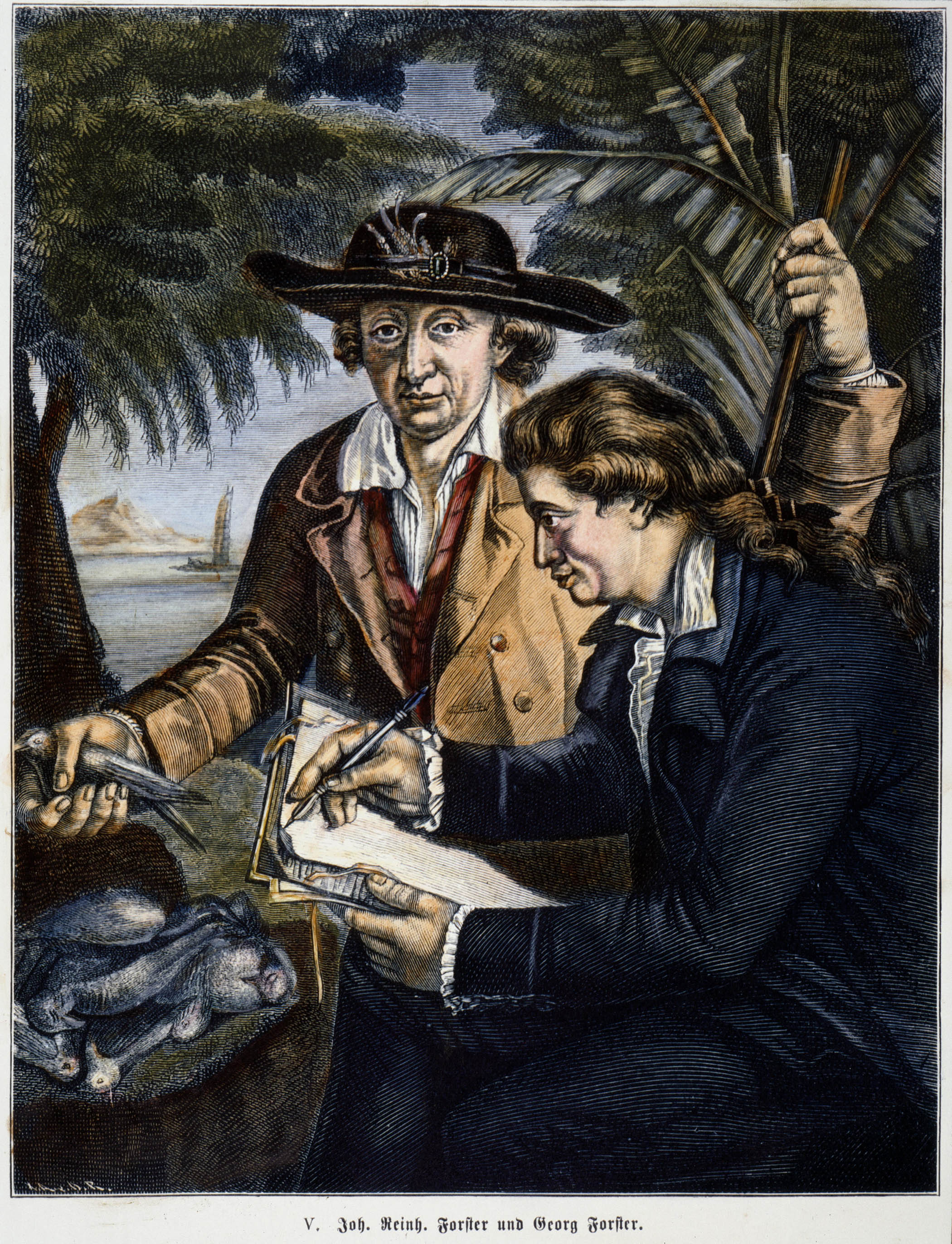
Above: George Forster with his father and, main picture, Forster’s painting of icebergs at sea.
For me, Forster’s attitude shines out from the darkness of colonial history. He was outspoken in his books, essays and letters – and the more I read his words, the more I became curious why he was so different from most of his contemporaries. Where did his open-mindedness come from? Was it because he had been exposed to various cultures from the age of 10, when he travelled through Russia? Or because he didn’t even know to which country he belonged? He was born near Gdańsk, in a region that would become Prussia, lived in St Petersburg, London and Warrington as a child, and then circumnavigated the world with Cook. Instead of being bound by national borders or ideas of racial hierarchy, he described himself “as a human, a citizen of the world”.
Forster was unusual in many respects. Unlike the American and later the French revolutionaries, who mostly excluded women, enslaved people and non-Europeans, Forster was already writing about what he called “the general rights of mankind” in 1777. He publicly attacked Kant’s theory that humankind had developed into four distinctly separate races defined by the colour of their skin. At a time when most Europeans considered themselves the pinnacle of the human species, George Forster argued against white supremacy and slavery. The hypothesis of two types of humans – those who were apparently “morally and physically perfect, and those who were ugly by nature and evil by inclination” – was absurd, he wrote. Today he would also be called a feminist. Unlike most of his fellow men, he admired strong and independent women (and married one). He believed in the equality of men and women, was a proud father of two daughters and even accepted his wife’s numerous affairs. “I don’t know this unfair difference between the sexes,” he told her during their courtship.
He was also a prescient scientist and developed a stunning – and, as we know today, correct – theory about Polynesian migration. By comparing languages and examining the distribution of breadfruit trees across the South Pacific, he concluded that Polynesians had travelled from Southeast Asia eastwards across the Pacific. It would take more than 200 years for the world to catch up with him, and to prove his theory with DNA analysis and archaeological studies. Eventually, Forster became a revolutionary himself. Electrified by the French Revolution and his lifelong belief in the equality of humankind, he helped organise the first free election ever held on German soil, and in 1793 co-founded the Mainz Republic, the first republic in the German territories – a decision that cost him life and livelihood. For me, Forster’s most important legacy is his unshakeable belief in humankind and his deep-seated belief in equality of races – an understanding far ahead of his contemporaries. In times like ours, when the world seems to retreat behind national borders, when conflict is encouraged and differences are highlighted, his story gives me hope.
The Traveller: The Revolutionary Life of George Forster and His Search for Humanity by Andrea Wulf is published by Allen Lane (£30). Save 10% off RRP at The Observer Shop
Photographs by Alamy
Newsletters
Choose the newsletters you want to receive
View more
For information about how The Observer protects your data, read our Privacy Policy