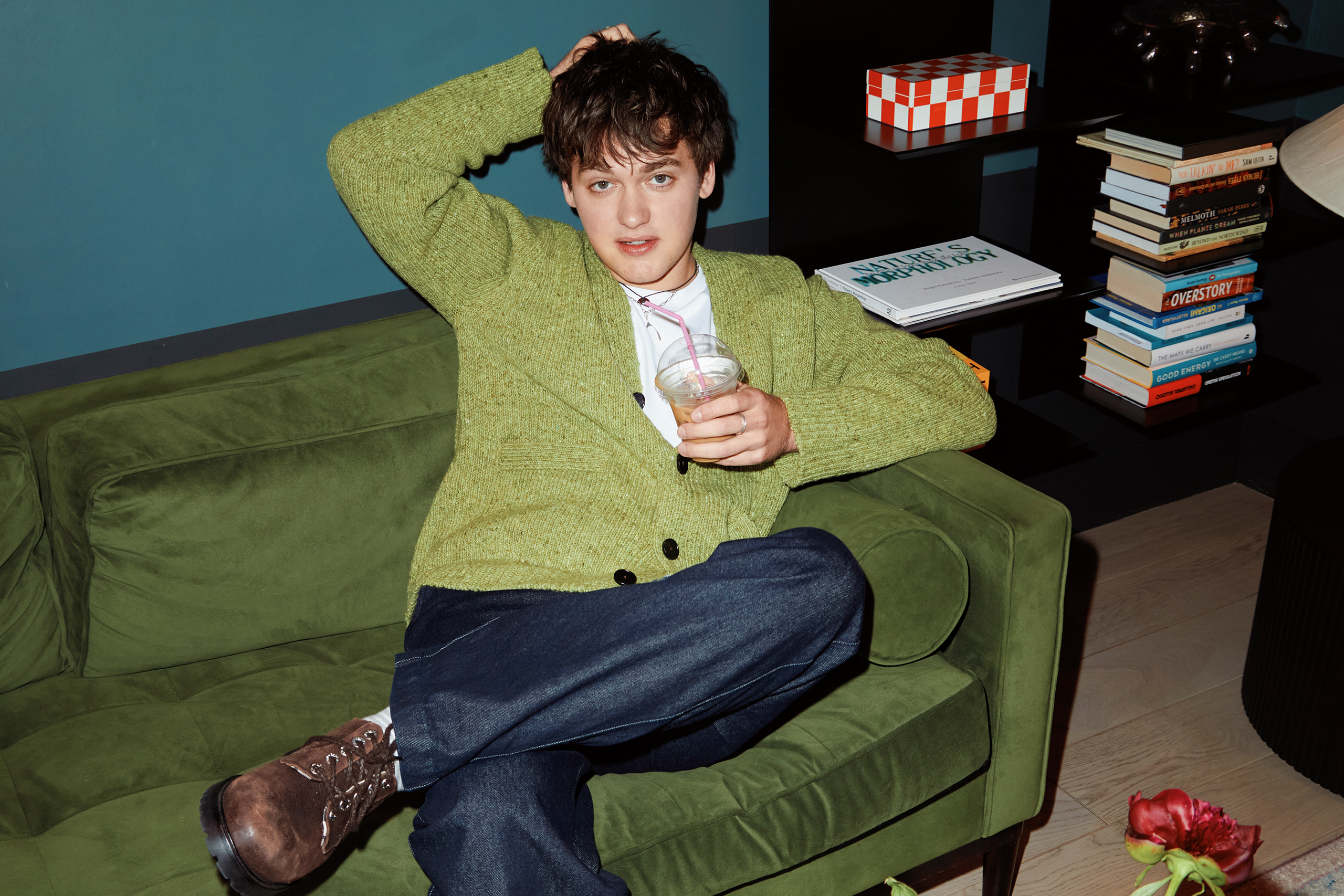

Joe Anders is nervous. Though he has lived around fame his entire life, this is his first significant newspaper interview. He’s 22, with big blue eyes and a formidable laugh. We meet for coffee in Marylebone – he arrives wearing two necklaces, lots of rings, a scruffy canvas jacket and a heap of energy – to discuss Cape Fear, an Apple TV adaptation of the 1962 thriller, in which he plays a troubled teenager named Zach. Cape Fear was filmed in Atlanta over several months, stars major Hollywood actors Javier Bardem and Amy Adams, and involved difficult, harrowing acting: many scenes of violence, self-harm and psychological breakdown. “To be honest, it messed me up a bit,” he says. “I haven’t really been sleeping properly since. I don’t know how to talk about it.” Then, worried about seeming ungrateful, he doubles back. “I learnt a lot. Seriously, I learnt so much.” When I compliment his performance, for which he perfected a very passable American accent, he looks alarmed. “There’s no world in which I could watch myself and be, like, ‘I’m so good.’”
Though Cape Fear introduces Anders as an exciting young actor in his own right, it is impossible not to talk about his parents, who are Hollywood royalty: his mother is the actor Kate Winslet, his father the director Sam Mendes. Anders has faced questions about his family again and again in the press, and will do so again here, even though he changed his name professionally in 2022, two years after the term “nepo baby” entered the lexicon. He is in the early throes of a career in an industry in which his extremely successful parents loom large, and their standing has cast a unique glow on his early life. When Anders was born, rumours swirled that his parents refused to fly on the same plane in case it crashed. Both had had recent near-miss experiences. Mendes was due to take the plane that was hijacked and flown into the Pentagon on 9/11. Earlier, Winslet had travelled on a flight during which a man stood up and announced he was a terrorist.
Anders was born in New York, where his family lived happily together for seven years until his parents separated. He still listens to the sound of New York traffic on YouTube to fall asleep, which “is weird,” he knows, but which “comforts me”. Both his parents remarried and had more children, creating “a big blended family” about which Anders is careful not to speak about. (“We all love each other very much,” he says.) He is closest with his older half-sister, Mia Threapleton, who is also an actor – they weathered the storm of their childhood together. Around the time of the split, Winslet told a journalist, “There’s no way I’m going to let my children be fed up because my marriages haven’t worked out. I will make the best of it.”
‘I think I’ve failed at this interview. I just wanted to remain mysterious!’
‘I think I’ve failed at this interview. I just wanted to remain mysterious!’
Winslet made the best of it by moving Anders and Threapleton to the Oxfordshire countryside, and sending Anders to Bedales, the famously bohemian boarding and day school. “Hearing wood pigeons,” Anders says. “That became normal for me.” He returned every now and then to the US to visit Mendes. In England, he had fallen behind in school. “I had to catch up a bit,” he says. “I couldn’t do the joined-up handwriting.” Bedales has a curious reputation: students are free to pursue whatever arts they are interested in. (Daniel Day-Lewis, Minnie Driver, Lily Allen and the model Cara Delevingne are all alumni.) Anders chose acting. At 16, Covid shut both the school and the rest of the world down, and he missed his GCSEs, though it was “probably for the best,” he says, because “I don’t think they were going my way.” He still carries the shy politeness of a generation whose adolescence disappeared into lockdowns, which he spent learning to make pasta from scratch. “I got really into ravioli,” he says. “Like properly obsessive about it.”
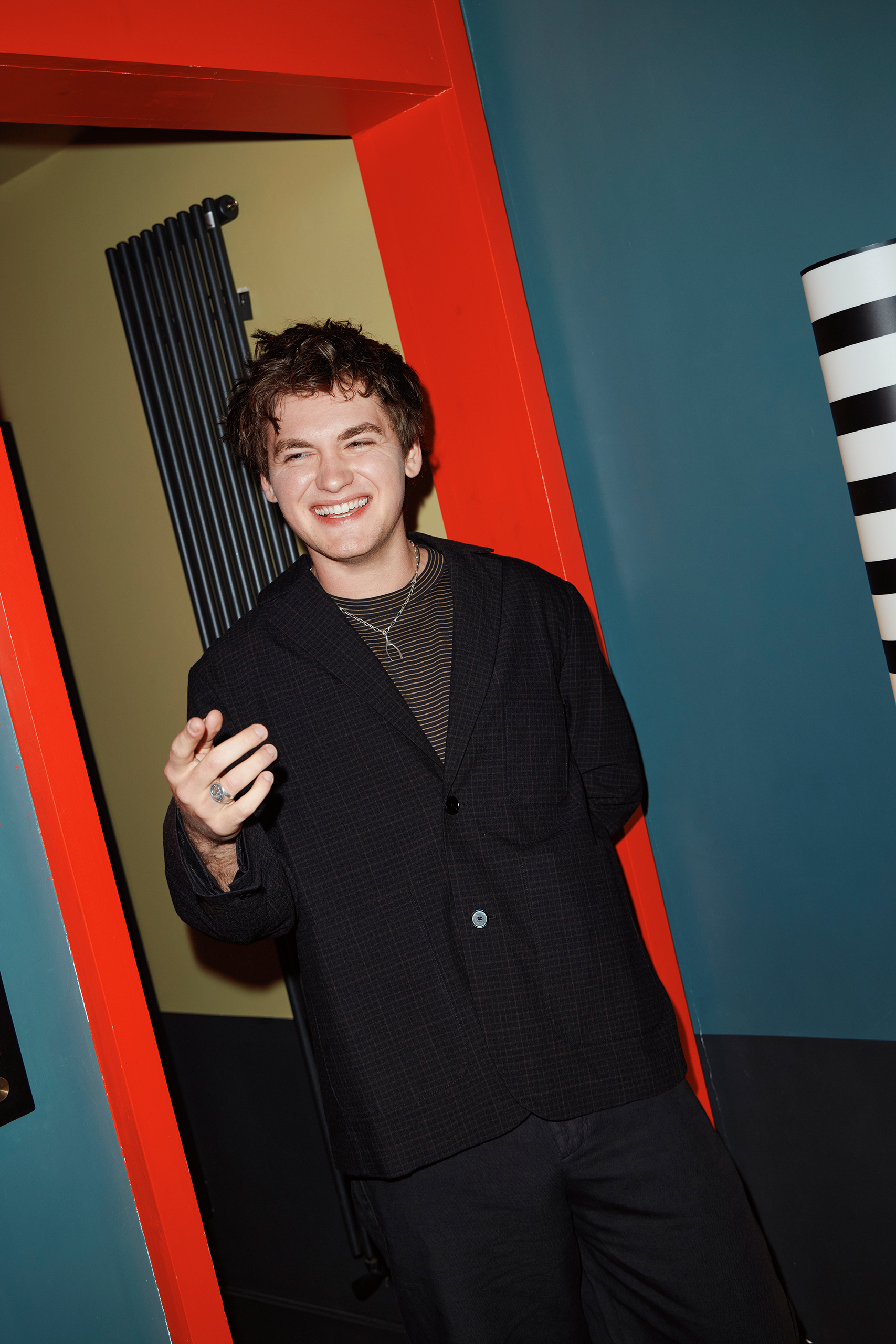
Joe Anders wears blazer and trousers both Toast and T-shirt U by Uniqlo
When Anders was 19, Mendes suggested he take a weekly screenwriting course at the National Film and Television School, in Beaconsfield, where he was encouraged to “write from the heart”. He wrote a play inspired by the death of his maternal grandmother from cancer, when he was 13. It became a script titled Goodbye June, about a group of siblings trying to recreate one last Christmas for their dying matriarch. When Winslet read the script she loved it so much she decided to direct it. Netflix agreed to come on board. A huge crew was assembled. Winslet starred as one of the siblings, alongside Helen Mirren, Timothy Spall and the Australian actor Toni Collette.
Goodbye June was Winslet’s first project as a director. When it came out, last December, it received negative reviews. When I ask Anders about the criticism he says he doesn’t like to think about it. “I was trying to write a story that would mean something. And it did. People came up to me at Q&As, told me about their lives and families. It was the greatest compliment.”
He resists the idea that the film was about his family. “It’s not based on real life in any way,” he says. But for Winslet there was something unmistakably personal in what her son had written. In interviews, she recalled how dismissive Anders had been about his own work. “It’s a draft,” he told her. “I don’t think it’s any good.” But she was immediately struck by “how real the story was, how relatable all the characters were,” and especially by the way he had “somehow been able to weave humour around a subject that so rarely has humour.” Winslet told him: “We’re going to make this.” Panicking, Anders responded, “Don’t do that mum thing.” At the café, where we have both ordered schnitzel, he tells me, “I never wrote it thinking about the possibility it could be made real.”
Anders is aware that most 19-year-olds would never have their first script turned into a Netflix film, but also that when he wrote it he was not most 19-year-olds. When I ask what he thinks of the term “nepo baby”, he sighs diplomatically. “I think, obviously, I am very lucky I’ve been born into a family that works in an industry I admire and love and want to be a part of,” he says. “I mean, I’m unbelievably lucky. I’m not deluding myself about how lucky I am.” Though he finds it grating. Recently, while applying for a job, he was forced to read through his own IMDB page. “The first thing that comes up is: ‘Kate Winslet’s son’. Which I understand. And I love my mum and dad, obviously. But I hope that one day it’ll just be ‘actor and writer’.”
Related articles:
Before changing his name, Anders had stayed “as far away from any idea of acting, directing, writing as possible,” because he didn’t want it to seem as though he was riding his parent’s coattails. (In 2019, he cameoed in his father’s film, the First World War epic 1917, but was credited as Joe Mendes.) Two years ago, he appeared in a Sky film called Bonus Track, and was cast, he says, without anyone knowing who his parents were. It was a turning point in his life. “No one knew who the fuck I was or where I’d come from,” he says. “It really made me believe, ‘Oh, I can actually do this myself. I can change my name, and really try this out on my own.’”
It’s hard to believe no one knew who Anders was when they cast him, but either way the film, a lovely queer romantic musical co-written by Josh O’Connor, and in which Anders’s ability stands up, worked as a vehicle for his talent.
Newsletters
Choose the newsletters you want to receive
View more
For information about how The Observer protects your data, read our Privacy Policy
Were his parents supportive of his decision to pursue acting? “They just want me to be happy,” he says. They also wanted him to do something they might actually know something about. “If I’d wanted to become a car engineer they’d be really clueless.”
Anders is the same age now as his mother was when she starred in Titanic, a film that catapulted her on to the world stage. In an interview last year, Winslet recalled the “horror” of it all. Tabloids tapped her phone. News commentators speculated on her dress size. People searched through her rubbish to “try and figure out what diet” she was or wasn’t on. Sometimes, she said, she was “terrified to go to sleep”. Even years later, in New York, she was followed, while holding hands with her young children, by photographers who “wanted to know the reason Sam and I had split up”.
‘You have an odd relationship with fame when you grow up around it.’
‘You have an odd relationship with fame when you grow up around it.’
As much as Anders’s parents have given him “all the luck and privilege in the world,” he says, they’ve scared him, too. When I ask about fame, he says, “I don’t really fancy being broken, to be honest,” and then, “You have an odd relationship with it when you grow up around it.” He avoids social media – better not to look at what people are saying. And “if it comes up in a meeting” – he means starting a social media account – “I just say, ‘Let’s not go there.’”
Winslet has received pushback for insisting her children are discovering success independently. “There are lots and lots of people in the world whose children go into the family business,” she has said. But Anders isn’t so convinced. “I don’t want to be given anything,” he says. “I want to earn it, however I can. I hope I get that across.” He pauses briefly. “No one’s helping me when I’m upset. When I’m in Atlanta for seven months; I haven’t got my mum there telling me what to do. I haven’t got my dad there directing me. Nobody’s there to help me develop a character. It’s just me!”
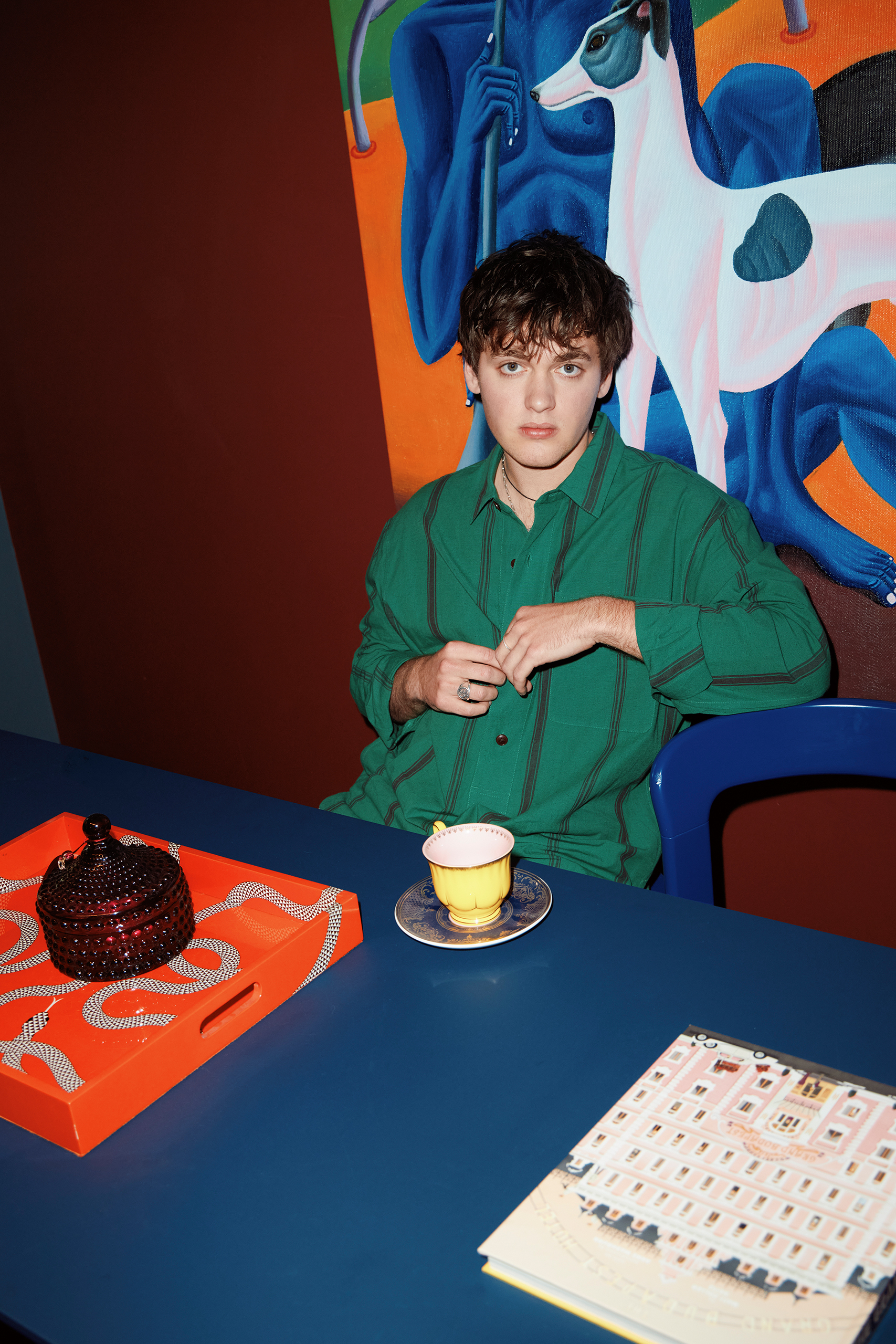
Joe Anders wears shirt by Toast
It’s difficult, I find, not to feel protective of him, having grown up with a successful actor as a parent, too. Yet he’s still chosen this life. The son of one of the most famous actors in the world could have disappeared into almost any other life, and instead he became an actor. He’s entering an industry he has spent his whole life watching wound the people he loves the most.
We wander out of the restaurant and over to Regent’s Park. Out of his jacket pocket pokes a little notebook and pencil. He reads a lot of poetry, he says. He tries to meditate. He lives alone in east London, cooks chicken dinners for his friends, though he doesn’t think of himself as “settled”. During our time together he speaks in long, spiralling sentences that double back on themselves, and at various points he apologises for sounding pretentious before saying something unexpectedly sharp or vulnerable. I reassure him that things have gone fine, but he won’t have it. “I’ve failed at this!” he says, jokingly, of the interview. “I wanted to remain mysterious!
As we leave the park, Anders stops to look at a group of goslings – scruffy balls of fluff. He lights up. “This is incredible!” he says. “I’ve never seen anything like this!” He is hoping, in this next stage of life, to get a cat. Recently, he considered adopting a Scottish Fold named Vanilla, described in an online advertisement as “sleepy” and “bad at jumping”. “I loved him immediately,” Anders tells me. “But I travel too much.” We wander on, watching the goslings wobble after their parents, which seems almost too neat an image. Born into a world already in motion, trying to teeter through it gently, Anders has inherited both privilege and problem. Now he is trying to figure out what he’s supposed to do with a fame that arrived long before he did.
Cape Fear is out on Apple TV on 5 June
Photography by Andrew Woffinden; fashion editor Helen Seamons; grooming by Jennie Roberts at A-Frame Agency, skin using Dior Backstage Foundation and hair using Kevin Murphy; fashion assistant Roz Donoghue