

When Margaret Calvert first moved into her home, a terraced house in a quiet residential neighbourhood in Islington, north London, there weren’t any trees on the street. But if you paid for the work, the council would come and plant saplings of your choosing. “Those trees were my choice,” says Calvert today, pointing up out of the window of her basement kitchen at a colossal tree providing a shady canopy for half the street. “Look how huge that Canadian maple is now!”
Calvert bought this mid-Victorian townhouse in 1971 for the almost unfathomable sum of £18,500. She was, back then, already well on her way to becoming a world-renowned graphic designer and typographer. Born in 1936 near Durban, South Africa, she came to Britain as a teenager – she still has a soft but unmistakable South African accent – and studied at Chelsea College of Art. There she met Richard “Jock” Kinneir, a visiting graphic design lecturer, who once described her as the student “who applied herself most rigorously to what she was doing”.
Woman at work: the road signs on which Calvert and Jock Kinneir collaborated are celebrated
When she graduated, in 1957, Kinneir offered Calvert a job and eventually their office was renamed Kinneir Calvert Associates. Together, they went on to design projects that have had a profound impact on everyday British life, most notably the signs, systems and typefaces for the UK’s motorways and roads, which are still in use.
Today, Calvert is sitting in her kitchen at a sturdy Norwegian pine dining table, drinking strong coffee, eating a piece of blood-orange drizzle cake. “I’m not an interior design person, I don’t have indoor plants,” she says. “I’m just about making the place fit like a comfy overcoat.” This basement floor, with its small conservatory overlooking a sunken, high-walled garden, is her living space, where she relaxes and welcomes regular guests, one of whom is the illustrator and author Marion Deuchars, who visits with her lurcher, Pip. “He comes to the door, scratches at it and howls, because he knows he’s getting treats,” Calvert says. She and Deuchars worked together at the Royal College of Art, where Calvert taught part-time and served as Head of Graphic Design from 1987 to 1991. She even taught Deuchars’s husband, the graphic designer Angus Hyland. “Some of my old students are now in their 60s and 70s,” she says with a chuckle.
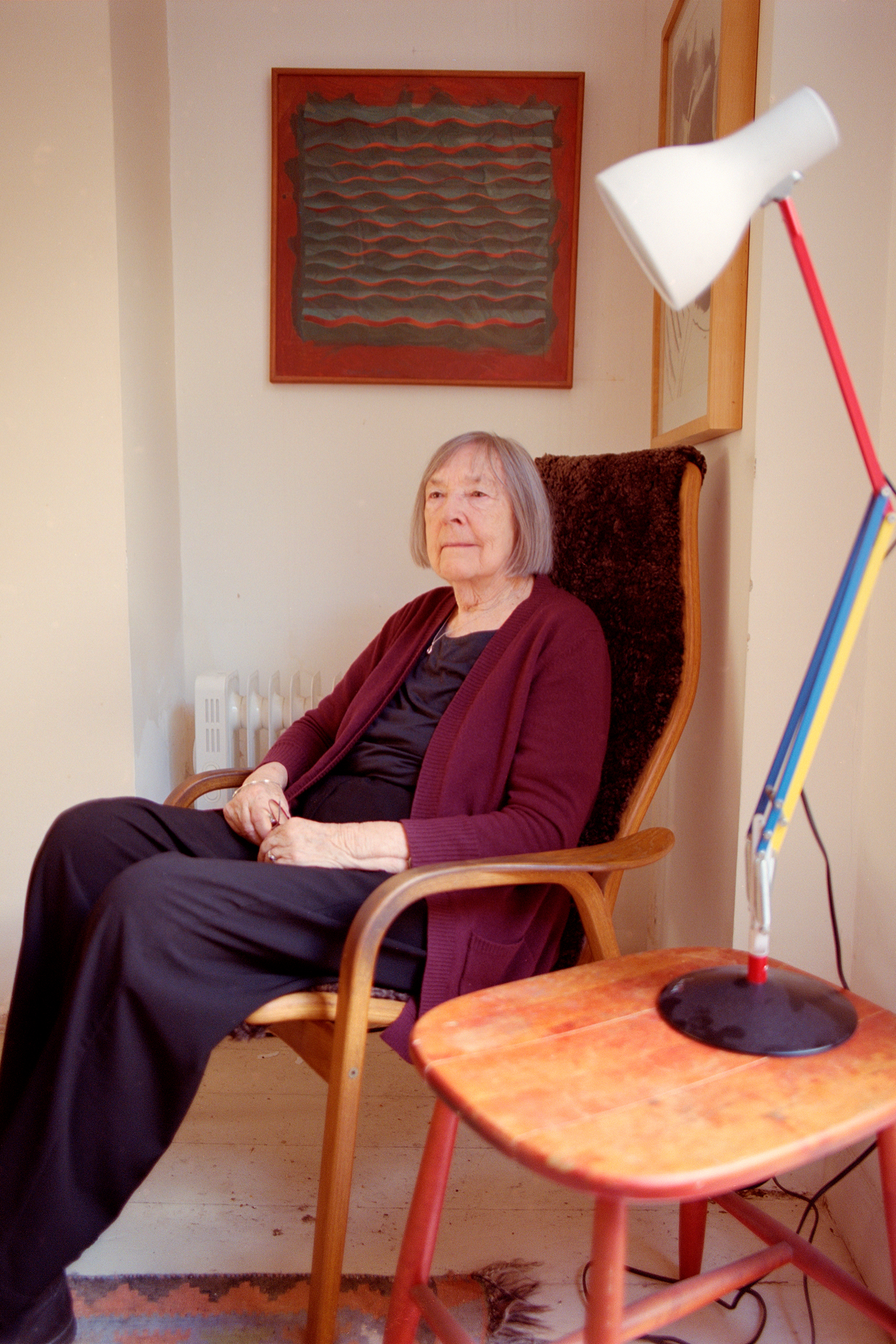
Quite corner: ‘I’m not an indoor design person’, says Calvert
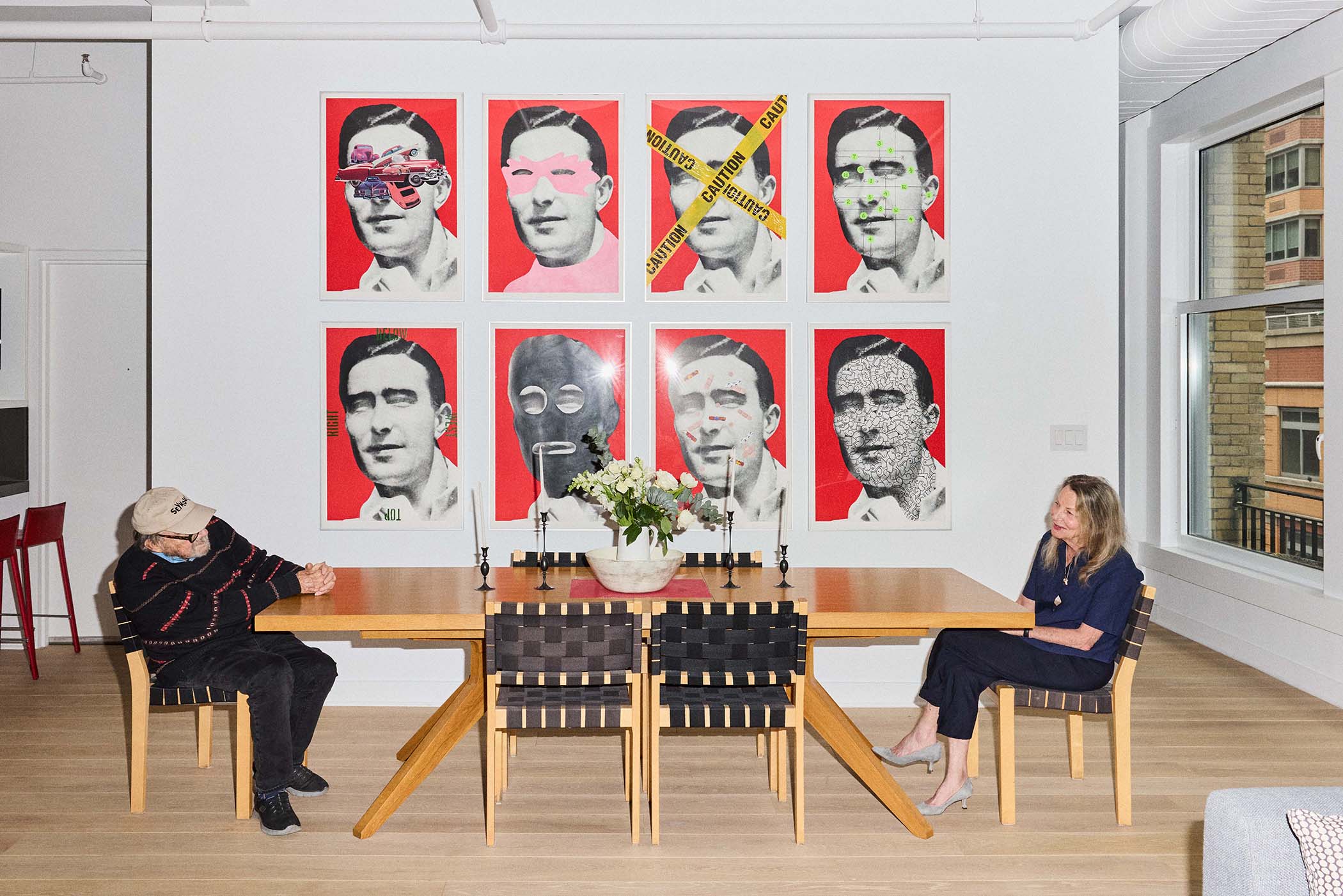
In the basement, there are links to what she calls “the college” everywhere. Almost every artwork – aside from a Paul Klee poster (“I admire him immensely”) – was made by a former student who has gone on to become a successful artist or designer, from a piece by artist Sam Messenger to a colourful, graphic painting by Hyland.
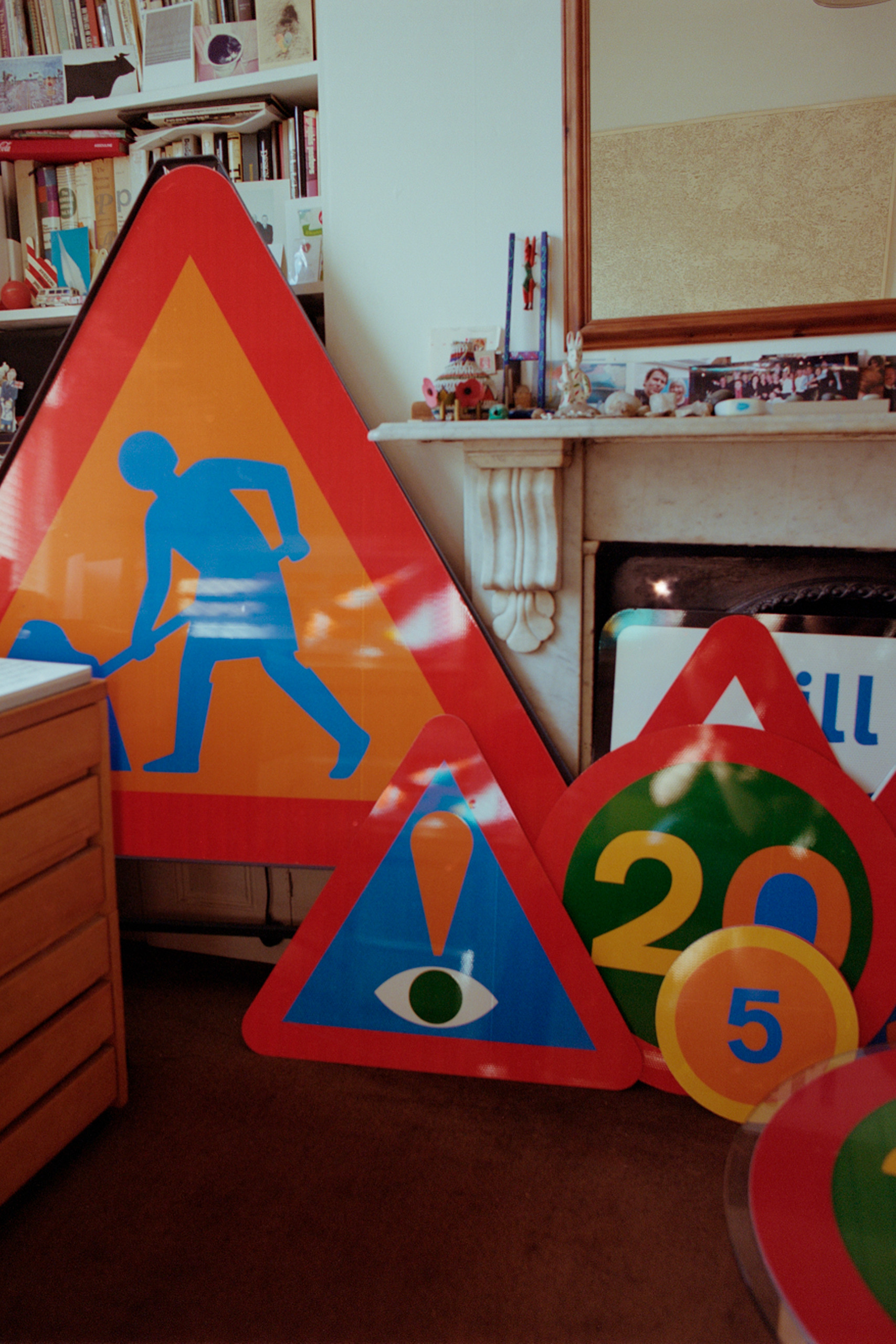
Calvert’s studio is upstairs, across the two rooms that make up the ground floor. There are usually one or two large reflective road signs here, but when I visit the front room is overrun with ones that have just come back from an exhibition at the nearby Osh Gallery. On the mantelpiece and bookshelf are peculiar knick-knacks and trinkets picked up on Calvert’s travels, including photos of friends and family, a handful of toy cars, and a dried leaf she found on Table Mountain in Cape Town. “I should clear them away,” she says, “but somehow they’re part of my life.”
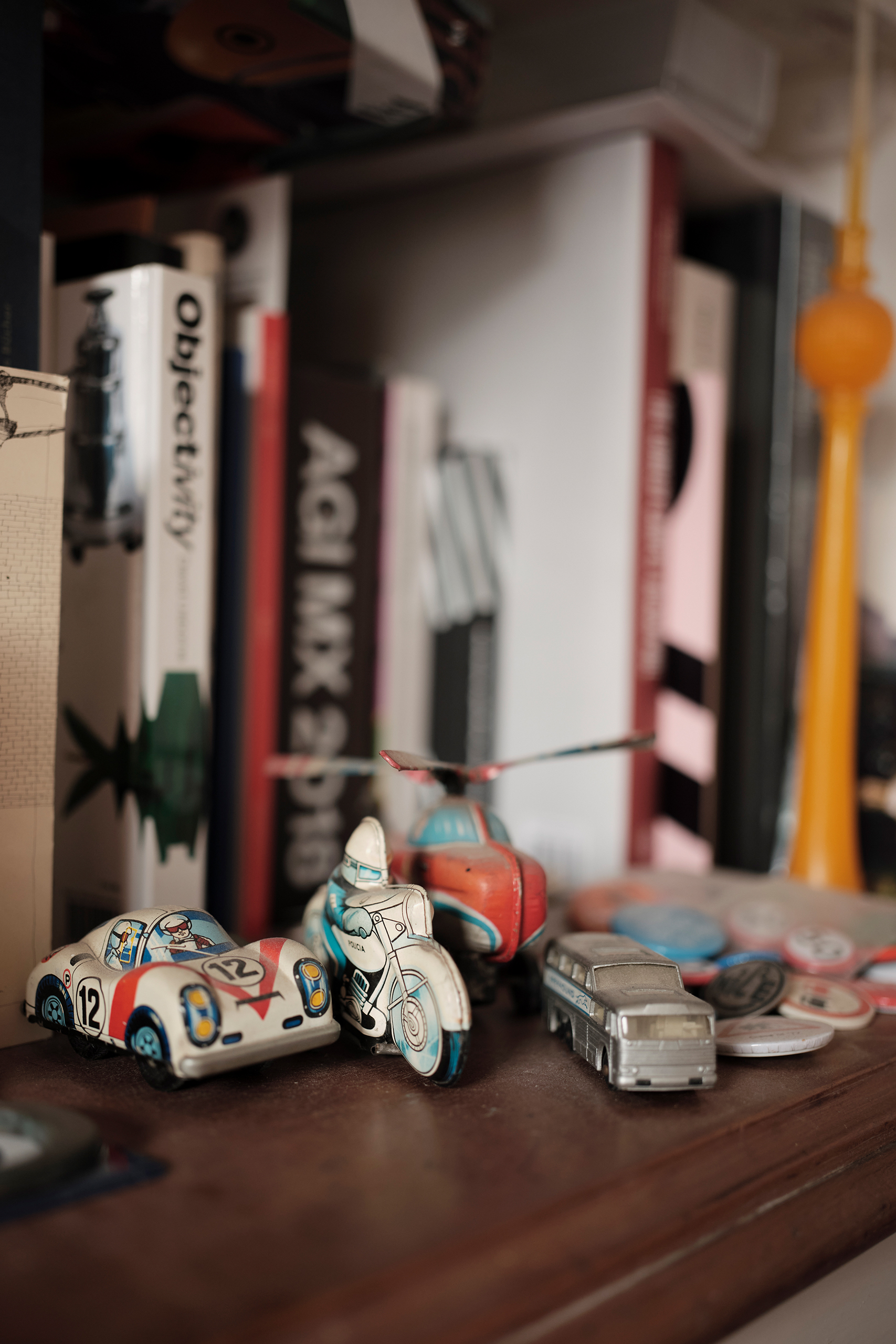
‘I should clear them away, but somehow they’re part of my life’: some of Calvert’s knick-knacks
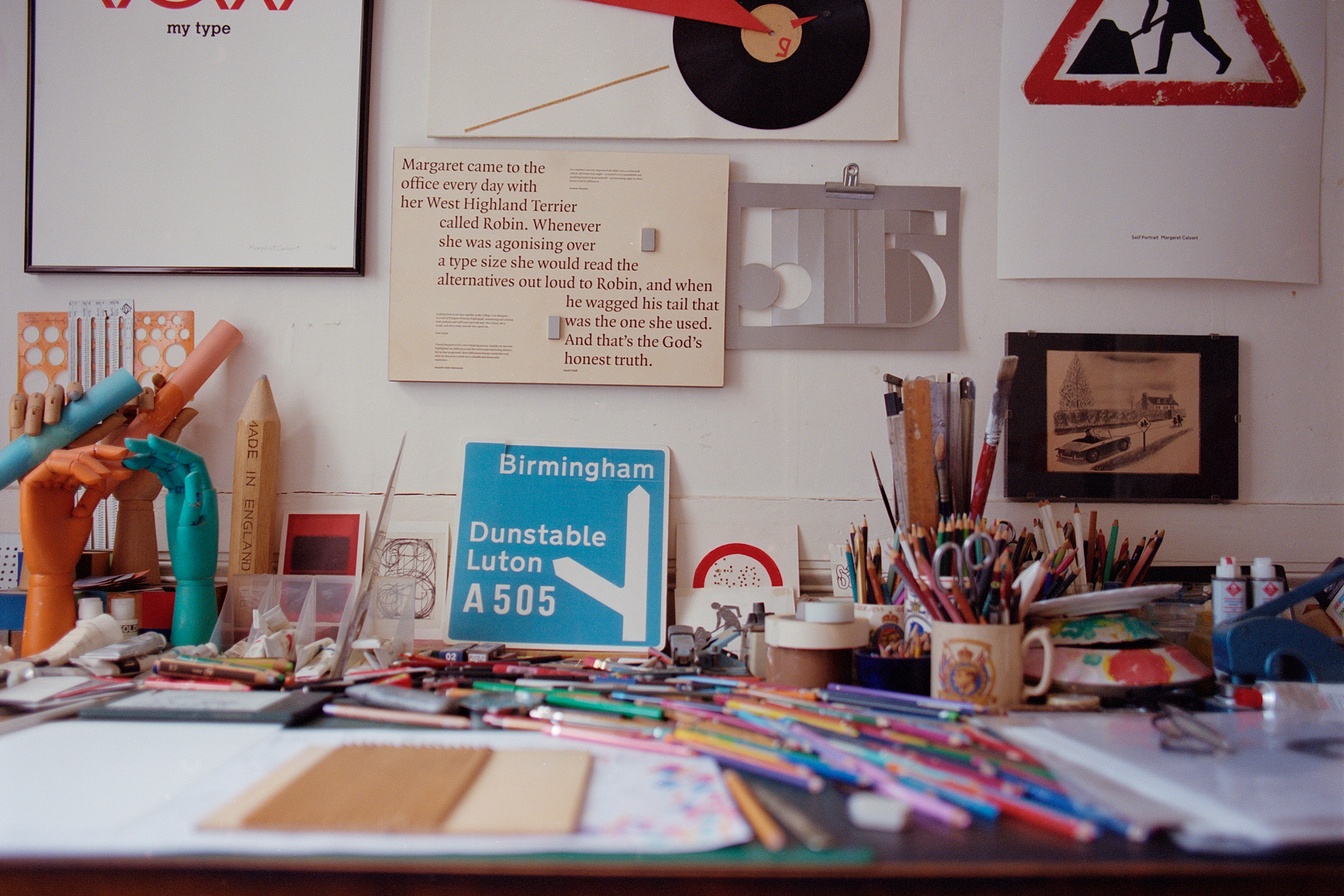
The brighter back room is dominated by two desks covered in countless coloured pencils, fine-nibbed pens, acrylic paints and brushes, and a well-used Stanley knife – the traditional tools of a graphic designer. Calvert sits at this desk most days, for between three and five hours (“I can’t not work,” she says). Most of that time is spent sketching out ideas for projects large and small. “Left to my own devices, I would always want to draw,” she says. In no mood to slow down. She is currently preparing work for an exhibition next year in Japan.
‘I can’t not work. Left to my own devices, I would always want to draw’
‘I can’t not work. Left to my own devices, I would always want to draw’
Nonetheless, she has had the chance recently to pause and reflect on her career (to date). Last month, Thames & Hudson published a monograph, Margaret Calvert: Woman at Work, the first book dedicated to her work. She describes it, with a little twinkle in her eye, as “a life story, with all the juicy bits cut out”.
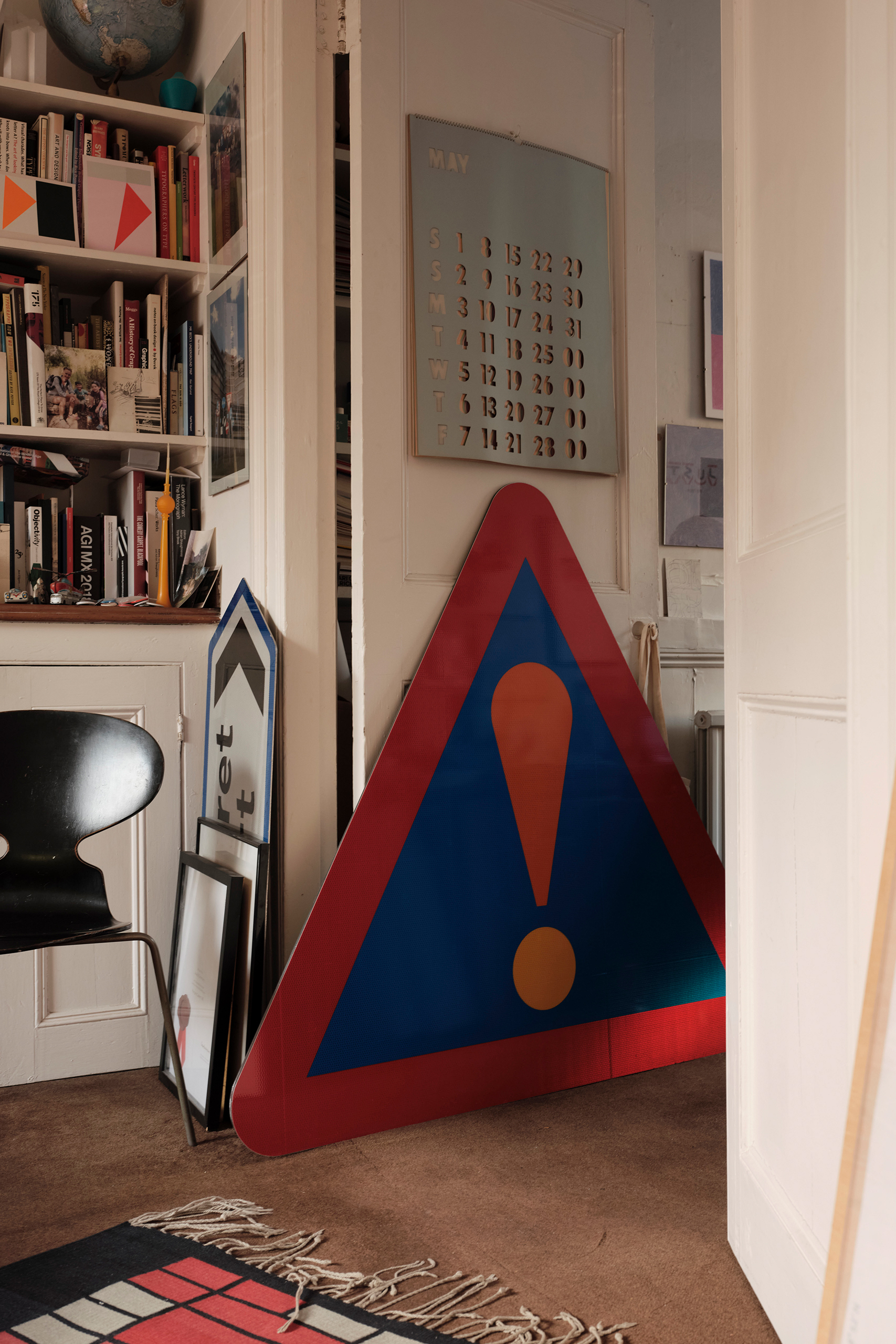
Marking the days: the calendar is one of her works which Calvert likes best
Not being one for self-aggrandisement, Calvert has found the attention that has come with the book slightly uncomfortable. “I’m suspicious of any applause,” she admits. “When I was a child, nobody ever made a fuss over me. I’m getting a lot of fuss now.” But over the years she’s learnt to deal with it. “At the age I am now, it just has to be water off a duck’s back.” Sitting at her dining table and flicking through a book with her name on the cover, she permits herself to feel a modicum of satisfaction with how it turned out, though she’d never use the word “proud”.
One thing she still struggles with, however, is when people give her sole credit for the road signs without mentioning Kinneir, who died in 1994. “I always make it clear that Jock was commissioned to do the road signs,” she says. “I just happened to be there at the right moment and we complemented each other well.” Recalling that one newspaper recently described her as the “genius” who designed all the road signs, she bristles. “That upsets me, it’s just wrong.”
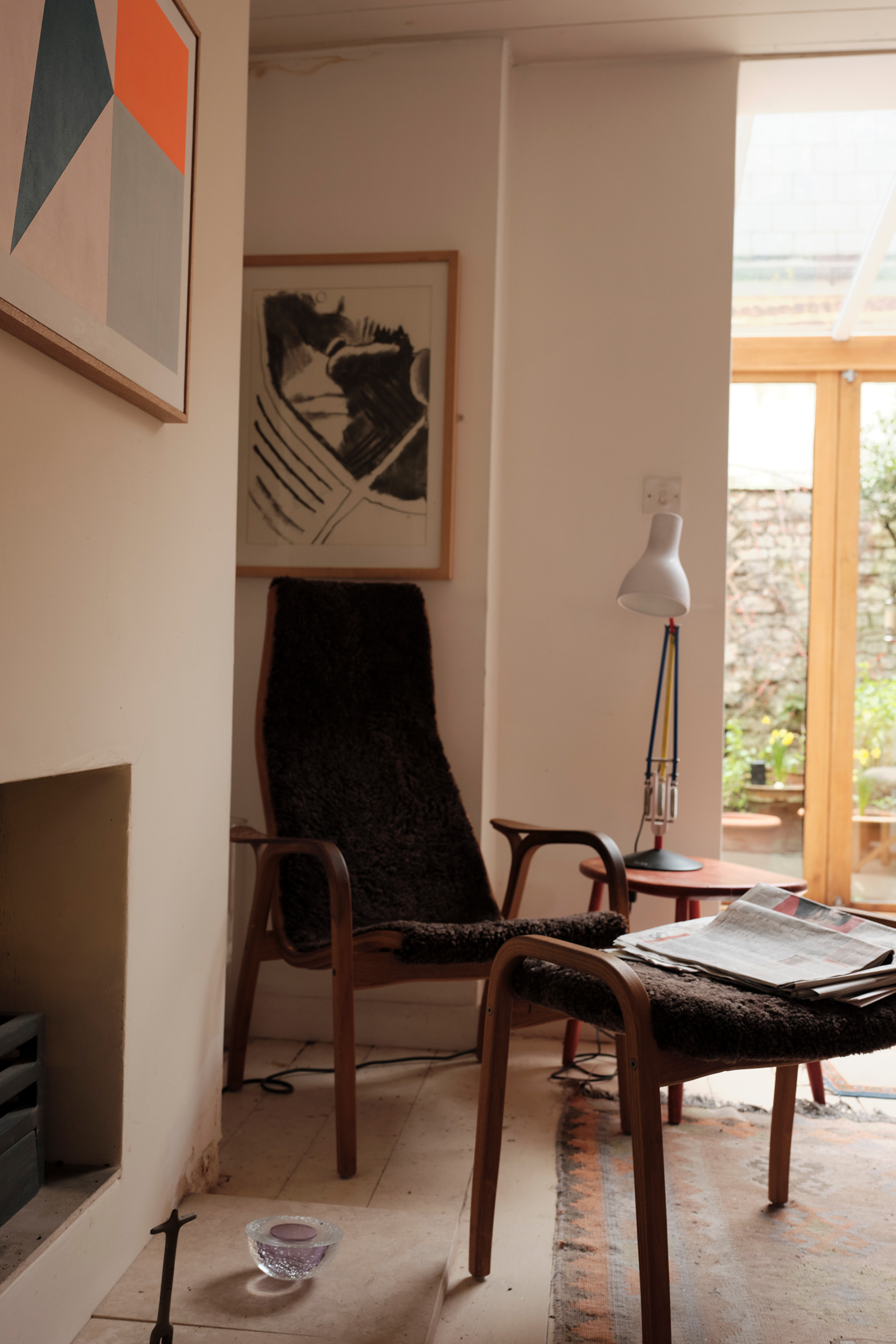
Artist in residence: almost every work on the walls is by a former student at the Royal College of Art
And while she is still best known for the work she did with Kinneir, from the road signs to the signage at Gatwick airport (what she calls the “heavy stuff”), the piece of work she is personally most pleased with is surprisingly modest. It’s her entry in the 1972 calendar competition run by the paper manufacturer Wiggins Teape (it eventually won third prize). Calvert created three-dimensional letters and numbers out of multi-coloured acetates, stuck them down on a white board, and allowed the sunlight to shine through them on to the surface. In winter, the lower sun casts longer colourful shadows. “You get all this overlap of colour coming simply from light and time,” she says. “The idea of time passing and light is quite something. It’s what we’re all about.”
What does she think that particular piece says about her as a designer, as a person? “Oh,” she says, a smile playing on her lips, “that I’m an absolute genius.”
Margaret Calvert: Woman at Work (Thames & Hudson, £60) or buy a copy for £54 at observershop.co.uk
Newsletters
Choose the newsletters you want to receive
View more
For information about how The Observer protects your data, read our Privacy Policy