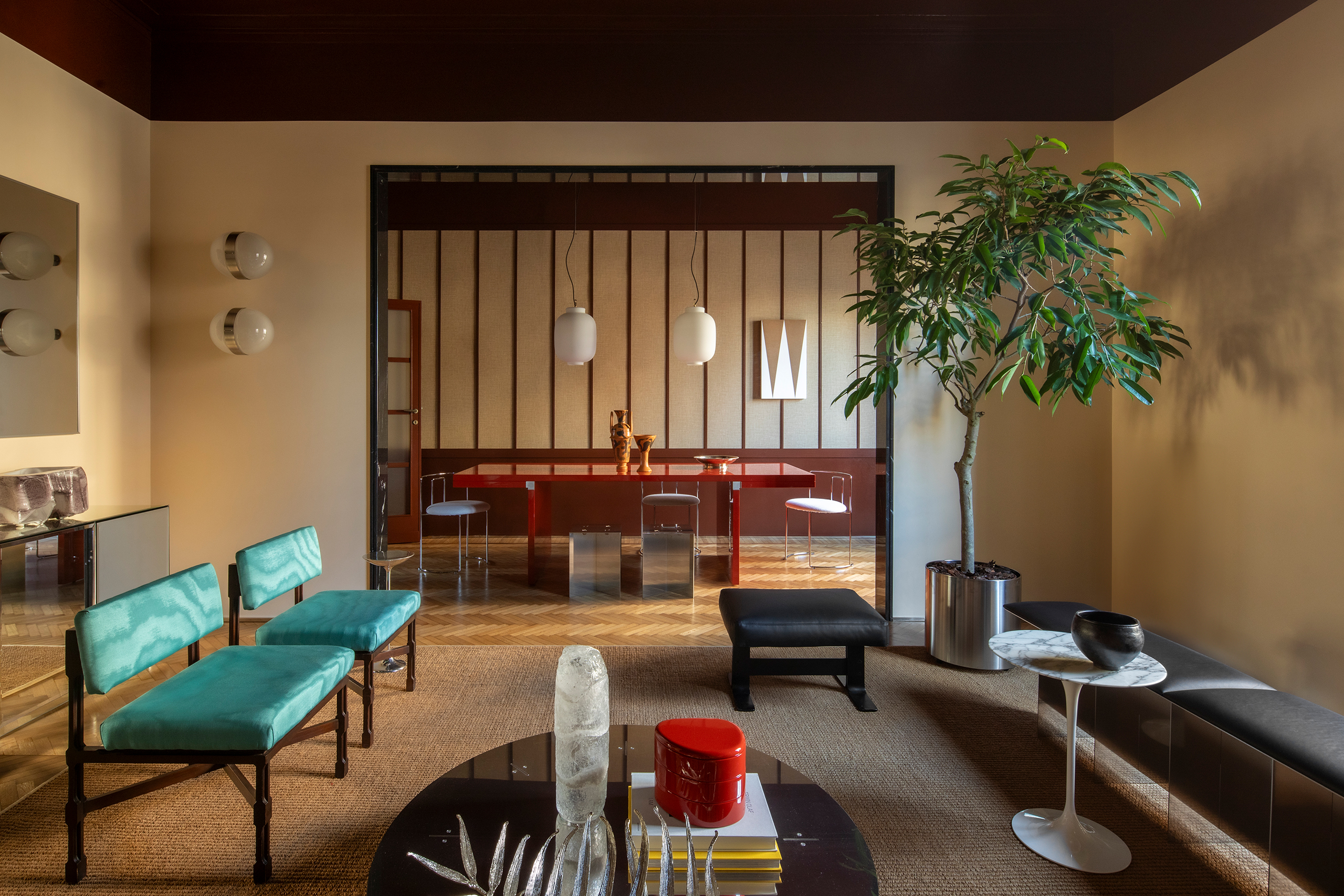



If Milan is famous for nurturing some of the 20th century’s most celebrated names in design, then its current generation of creatives is fully embracing that legacy. The home of interiors consultants Francesco Cristiano and Christian Frascaro is a case in point, an ode to great Italian taste, where works by Gio Ponti, Carlo Scarpa and Vico Magistretti mingle with contemporary touches to achieve a balance of history and homeliness.
Situated by Milano Centrale station in the up-and-coming Ponte Seveso area, the apartment is in an imposing 1930s building designed by the architect Giuseppe Martinenghi. When Cristiano and Frascaro first visited in 2022, it was a soulless, white-walled and poky two-bedroom flat. But they instantly saw its potential. “After a second in the house, Francesco said, ‘This is it,’” Frascaro recalls, as he sets down espressos and little pasticcini on a marble Eero Saarinen side table. “We immediately made the offer. Two hours later we’d drawn up the project, the shopping list, even the colours.”
The renovation took just four months, testament not just to the pair’s decisiveness and project management skills, but their compatibility, too. “Usually with Italian couples, one likes the mountains and the other likes the sea,” Cristiano says. “But we agree on nearly everything.”
Having met and clicked over their shared love of design 13 years ago, the couple enjoyed successful careers in fashion and design before turning their attention to joint interior design projects. Their first was in Frascaro’s native Puglia, the second in Milan. When images of the latter spread over social media, they started to search for a space to fully showcase their abilities.
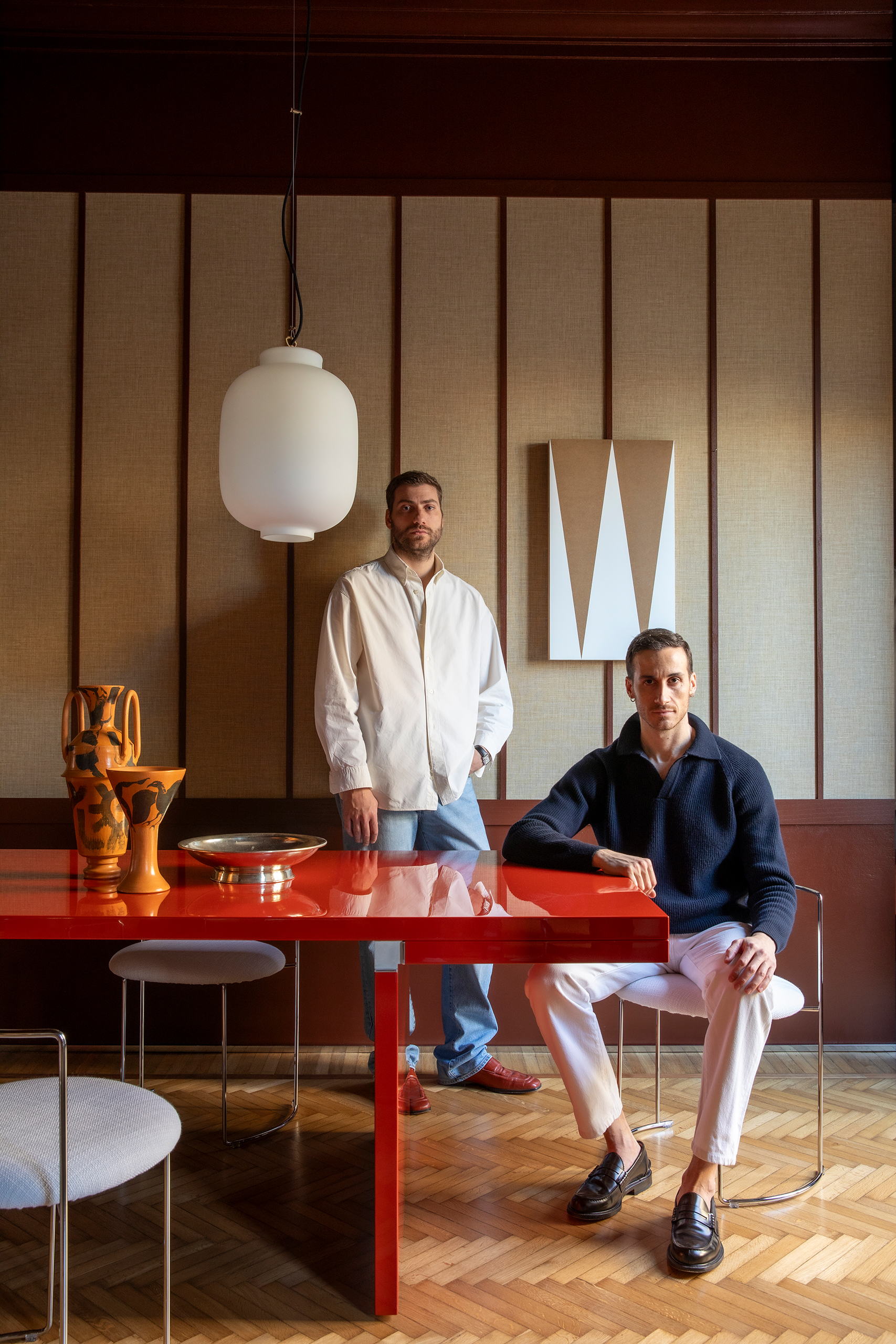
Francesco Cristiano and Christian Frascaro at home
To begin, the couple considered the flat’s square footage rather than its existing floor plan, and then they started ripping out walls. It soon became clear that an unexpected part of the house would become its star. “For most people, the corridor is deemed unimportant, but for us, it’s where the ‘wow’ factor comes from,” Cristiano says, guiding me into a cocoon-like space softly lit by lamps designed by Sergio Mazza for Artemide in the 1960s and painted chocolate brown.
The marble-clad corridor was inspired, he explains, by the floors that Gio Ponti designed during the late 1950s for Villa Planchart in Caracas. Comprising patchworked black, white and yellow marbles alongside green onyx, it was one of the most time-consuming and expensive aspects of the project. A painstaking three-step process of selecting the right marble, positioning and polishing was required, but it was worth the time and expense. “It looks great from every angle,” Frascaro says. “Everybody thinks it was already there.”
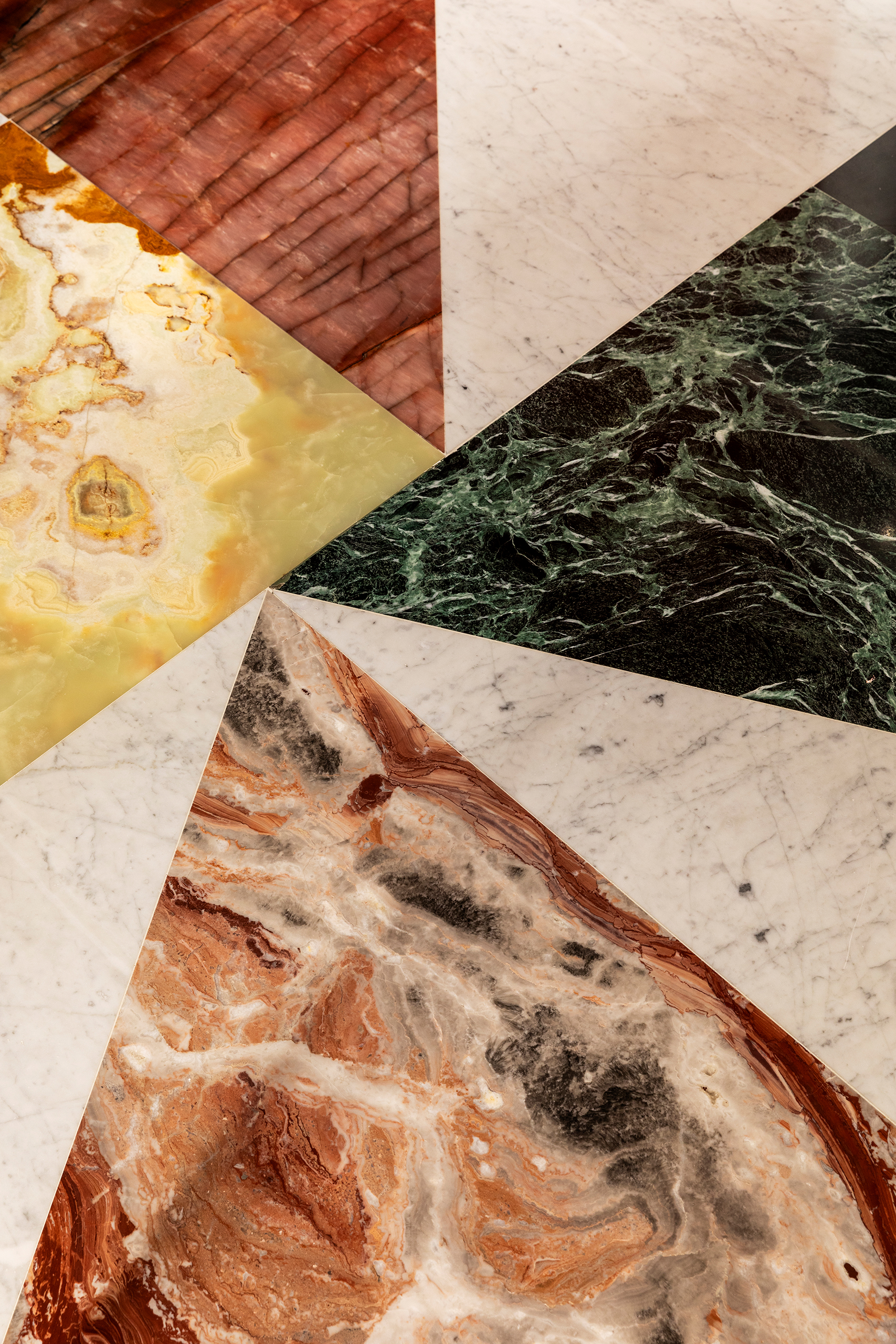
‘It looks great from every angle’: polished marble in the hallway
The same care was taken in restoring the original wooden parquet, which is typical of old Milanese flats. It was completely sanded back and revived by specialist artisans using traditional techniques, including staining the wood by hand. Honouring the past in a contemporary context plays a part in every room. Nowhere is this clearer than in the kitchen, which has lemon-curd walls, an homage to the traditional cucina colours of the pair’s grandmothers’ kitchens. It contrasts eye-catchingly with the industrial stainless-steel worktops from Spotti Kitchen Studio.
The couple’s bedroom is tucked away behind a secret door close to the apartment’s entrance. It is deliberately the smallest room in the apartment, Cristiano says, because “We just need to sleep there and we prefer to have a larger living space.” Two more Sergio Mazza lamps light the buttery yellow walls, the colour reflecting in the mirrored built-in wardrobes which the couple designed themselves.
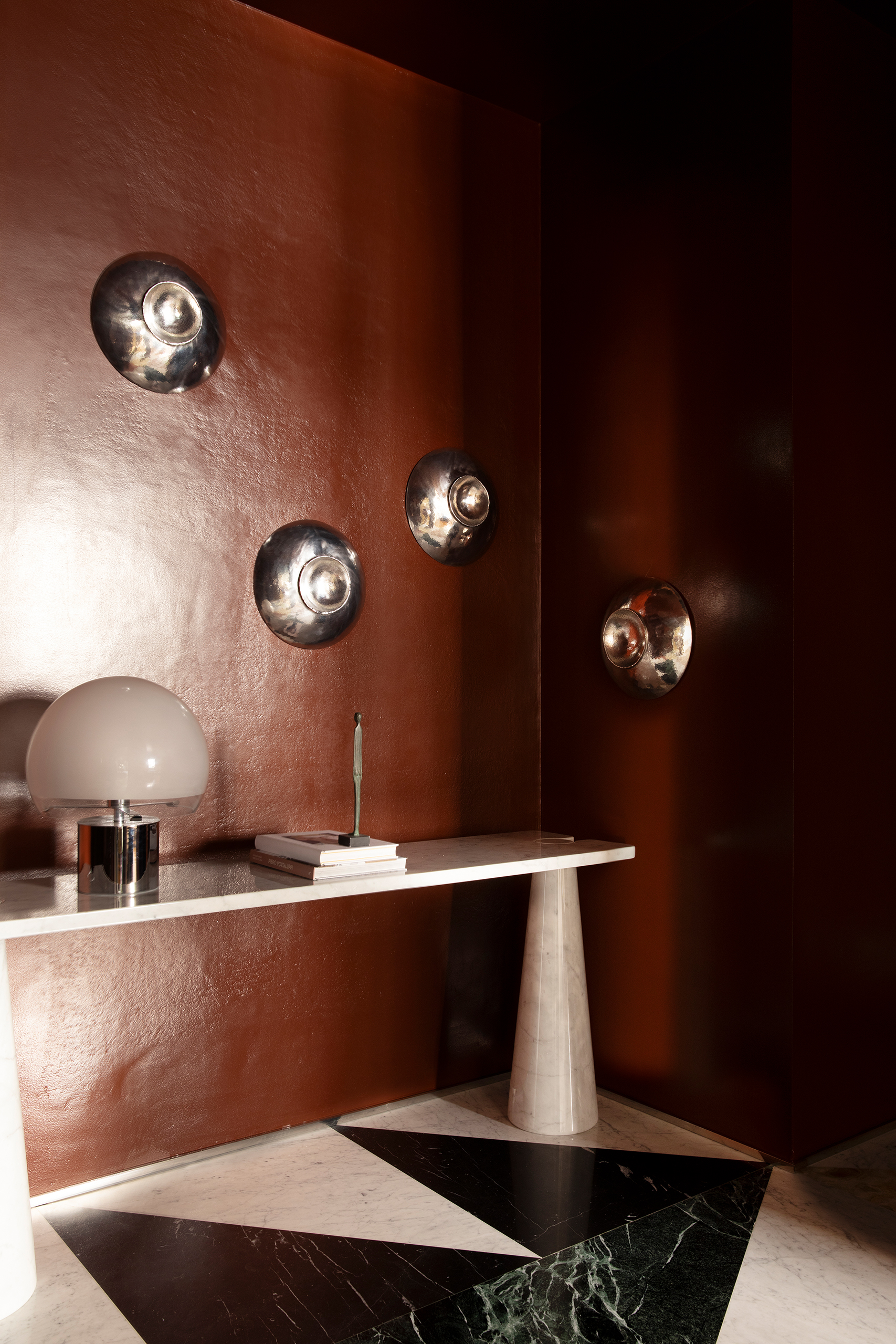
Filippo Salerni sculptures in the hallway
Meanwhile, in the bathroom, the three-piece suite is an original from the Torena series that Antonia Campi designed for Richard Ginori in 1970, which the pair bought before they even had a space to put it in. Famous for their ribbed surfaces, Campi’s ceramic sculptures are highlighted here by the soft glow emanating from vintage Vico Magistretti wall lights. The original doors around the flat – reminiscent of “old Italian school doors,” Frascaro says – were restored and reset with the exact matching glass, which the couple had to “become detectives” to source.
However, the open-plan living space is where the most work took place. Originally two rooms, the central wall was demolished and an arch installed to create a Japanese-inspired dining space complete with a glossy red Carlo Scarpa Orseolo table from 1972 (a reminder of the interiors of the restaurant where they had their first date).
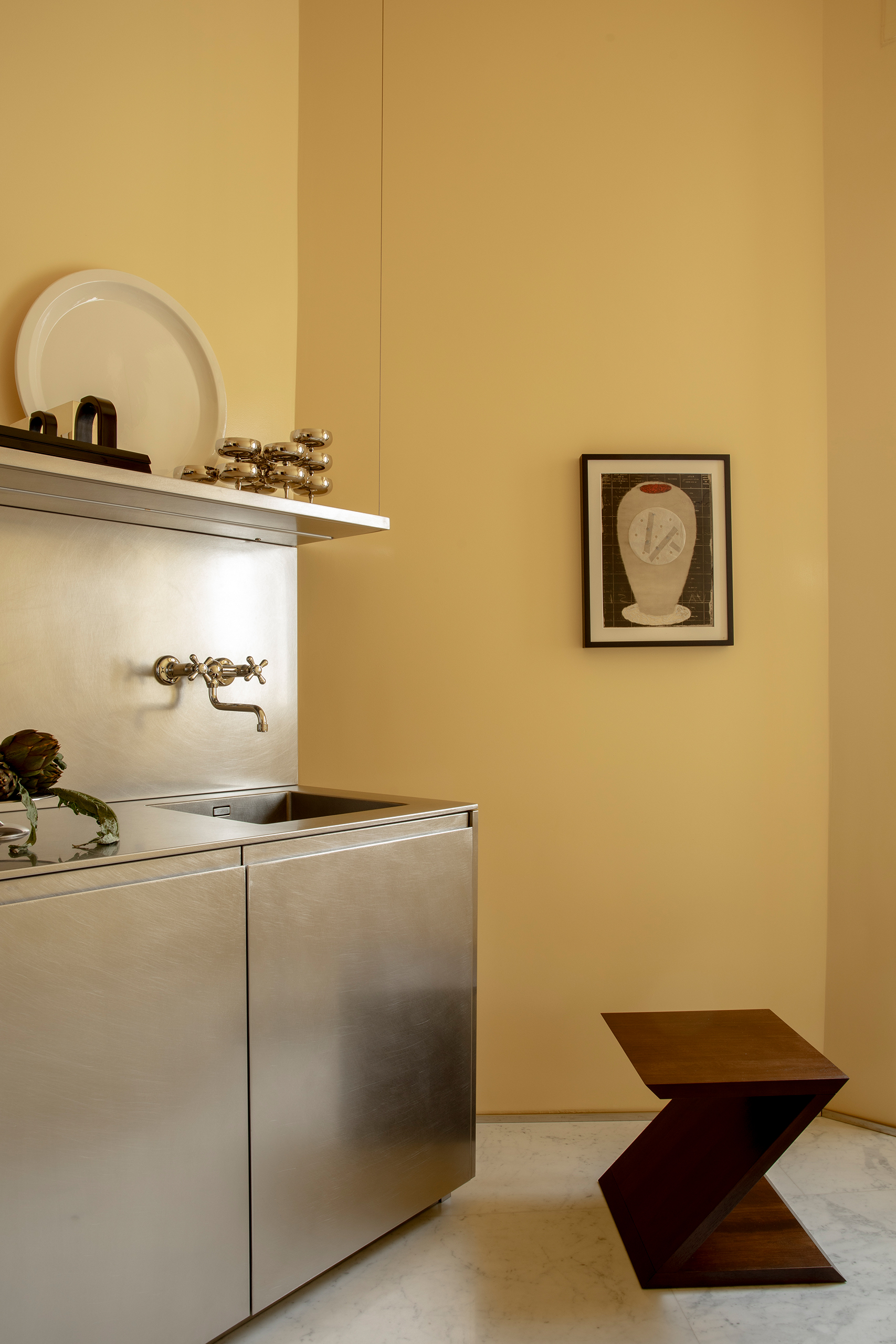
Armani Casa’s walnut Remy stool in the kitchen
The pair chose to use vintage furniture because “we didn’t want to create a showroom effect in the house,” Cristiano says. Shelves are filled with mementos from their travels, from Marrakech to Pantelleria. “Everything here reminds us of a moment.”
This sums up the approach they took to the renovation as a whole. They have created and curated a space that celebrates the building and the design history of Milan. Yet, ultimately, it is still a space that works for them. “We don’t want it to feel like a hotel,” Cristiano says. “It’s our home,” Frascaro adds, “and coming home should feel like a cuddle.”
Newsletters
Choose the newsletters you want to receive
View more
For information about how The Observer protects your data, read our Privacy Policy