
As the sun slips into a lilac horizon, lights flicker through a narrow gap cleaved from steep, hot-white rocks, creating the Cycladic impression of a fjord. For one night, this rocky bay on the northern curve of Kimolos – only accessible by boat – is the island’s surrealist stage for one of its outdoor cinema screenings, Kalisperitis. Hundreds of tiny storm lanterns have been threaded on to old fishing lines and strung up over smooth stone, as well as dotted inside caves.
“I try to never miss a screening,” says Nausika Georgiadou, my captain for the evening and the force behind Skinopi Lodge, a secluded clutch of stone villas on nearby Milos where we have come from. “It takes my breath away every time, and I’ve been about 100 times,” she adds, perching on a striped Kilim rug, as we wait for The Opera to roll. The only thing beyond the screen is the sea.
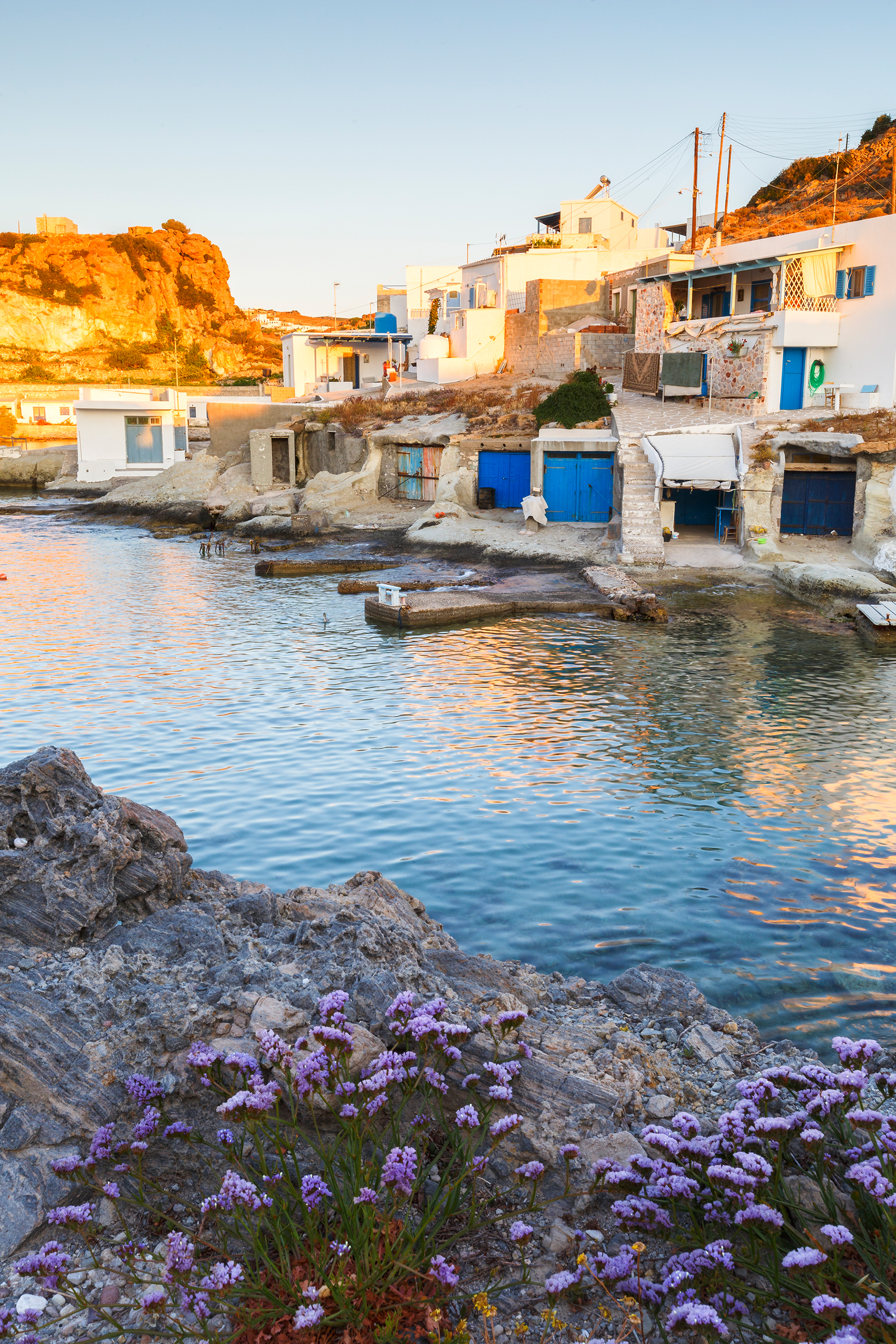
Water board: boat houses in the fishing village of Goupa
The cinema, which has popped up in various locations around Kimolos since 2014, is the passion project of Fotis Marinakis. A “visionary and a real romantic” as Georgiadou describes him, he moves mountains each summer to assemble these free screenings with two others from Kimolistes, the island’s volunteer team who also pick litter and meet to mark the island’s walking trails.
For such a tiny island, its annual film festival is a gargantuan feat. Only advertised on social media, it draws a mix of locals and water-borne Greeks from nearby islands – as far as Serifos for this one. A manifestation of Kimolos’s iron-strong community spirit, it is not made with tourists in mind – fitting for an island that still flies under the radar.
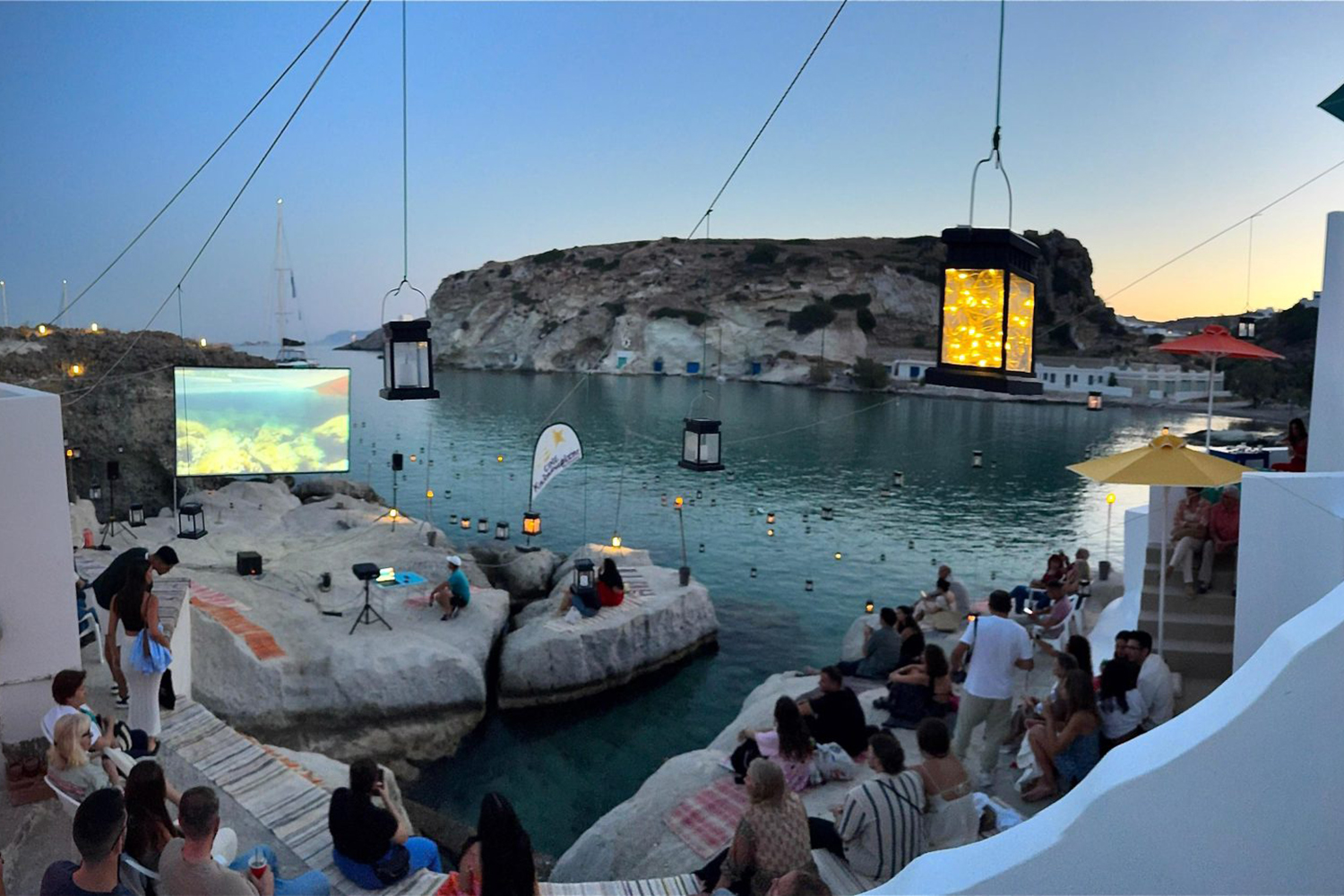
Up in lights: a free screening as part of the Kalisperitis film festival
When I first moved to Athens, I heard hushed talk in the city of a slow island idyll, with the ruins of a medieval castle and alabaster beaches. Inhabited since the late Neolithic period, volcanic Kimolos takes its name from the Greek world for chalk (kimolia), its unique rock formations glowing so silver in the sun that it was nicknamed “Argentiera” (meaning silvery) by the occupying Venetians. Its season is short and sweet, while routines remain intact and unhurried: fishermen still mend their nets in front of salt-licked magazia (boat houses carved into rock), grandmothers gossip on porches and cook in outdoor kitchens; and kids play football in the main square at night.
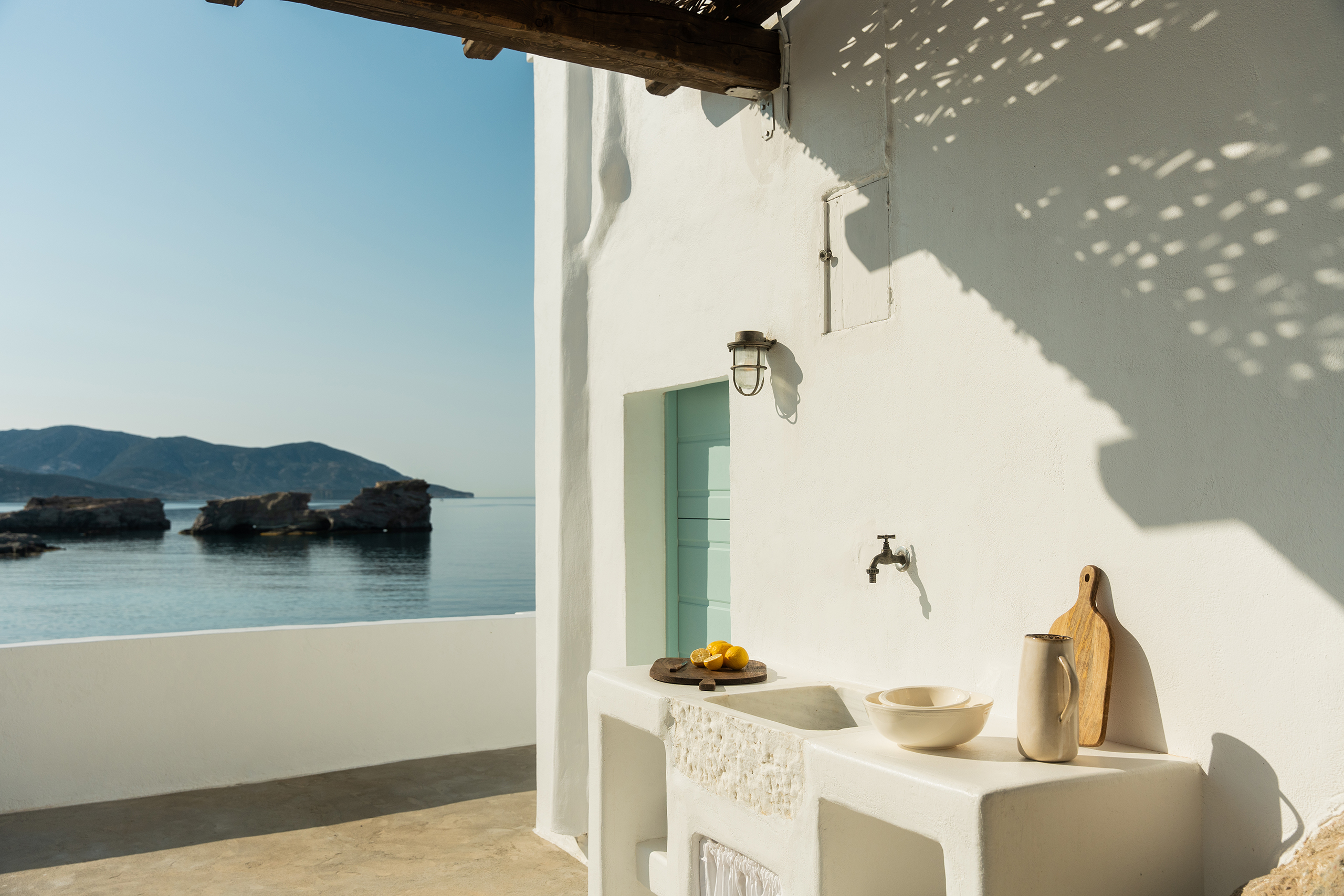
Mint condition: pale green and white are the traditional colours for houses here
It helps that Kimolos is hard to reach. There is no airport and a small ferry plods back and forth over the nautical mile between Pollonia on the northern tip of the bigger and busier Milos; while boats from Piraeus are infrequent and sluggish. These days, I arrive here from Athens under my own steam, lured by Poleyegos, an uninhabited speck opposite. Its cliffs are rich with a minerality that creates a force field of electric blue water around it that makes for a dazzling swim. Afterwards, we would tie up in the island port, Psathi, following the scent of grilled fish past whitewashed buildings to To Kyma. There a handful of tables sit so close to the water that diners go for a swim between bowls of whipped tarama and sea urchin salad. At locals’ bar Lostromos, coffees turn into tsipouro under the watchful eye of an arthritic golden retriever, before speeding back to base.
For such a tiny island, its annual film festival is a gargantuan feat, not made with tourists in mind
For such a tiny island, its annual film festival is a gargantuan feat, not made with tourists in mind
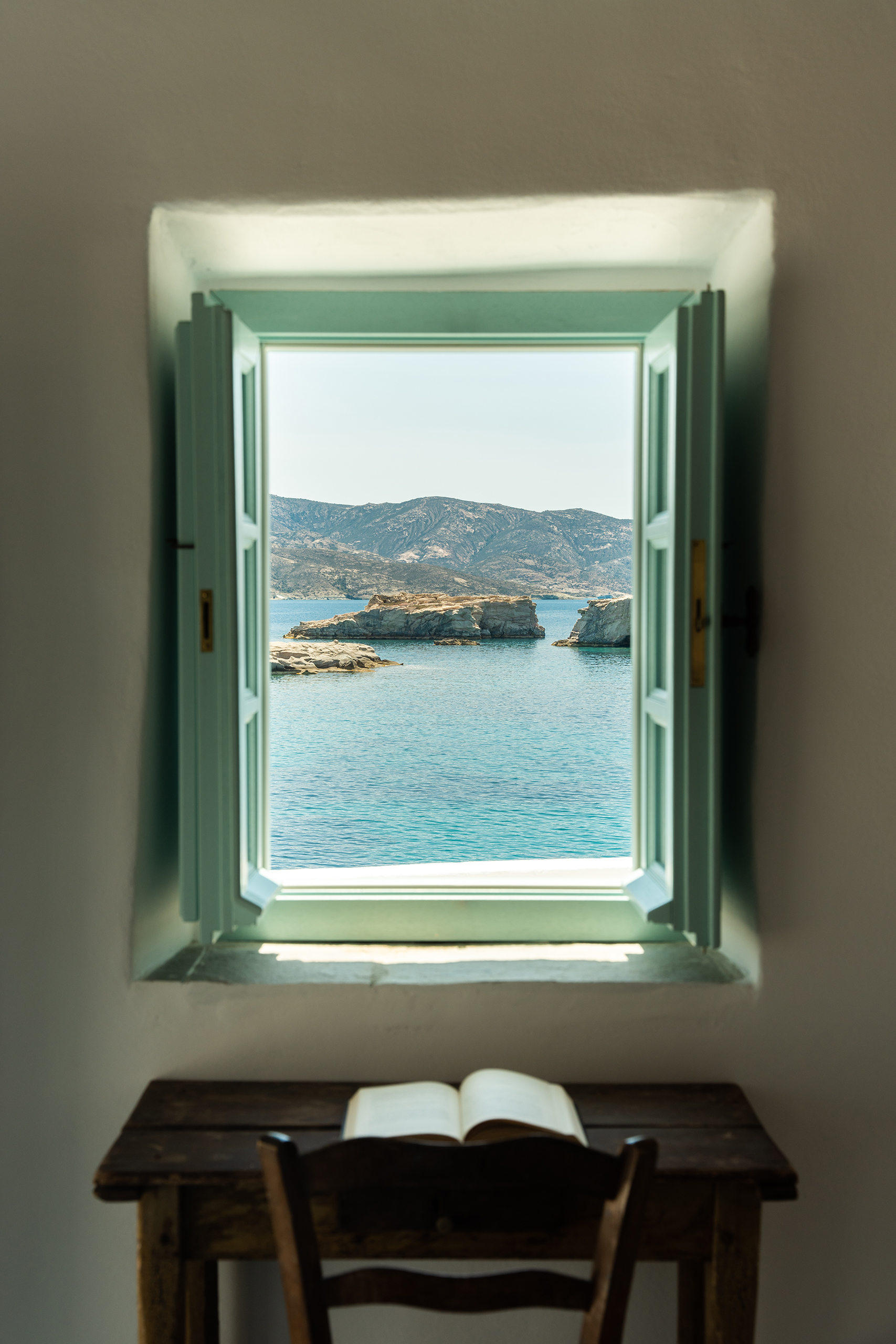
“For me, Kimolos is a hidden gem of the Cyclades, still untouched,” says Athenian entrepreneur Angelos Ismailos, who renovated a fisherman’s house last year at Kara-Goupa – one of the island’s striking rocky inlets – as part of his ongoing Thavma Cyclades project. “Thavma means miracle in Greek, and I think these fisherman’s houses are miracles,” explains Ismailos, who first came to Kimolos as a child with his family. As with each house in the growing collection (there are three more on Milos), Thavma Kimolos has been sensitively restored to honour its character. Original woven ceilings are intact, while fresh spearmint Cycladic-style doors open from each of the small rooms on to a vast, wraparound veranda revealing views of the island of Polyegos and the endless Aegean.
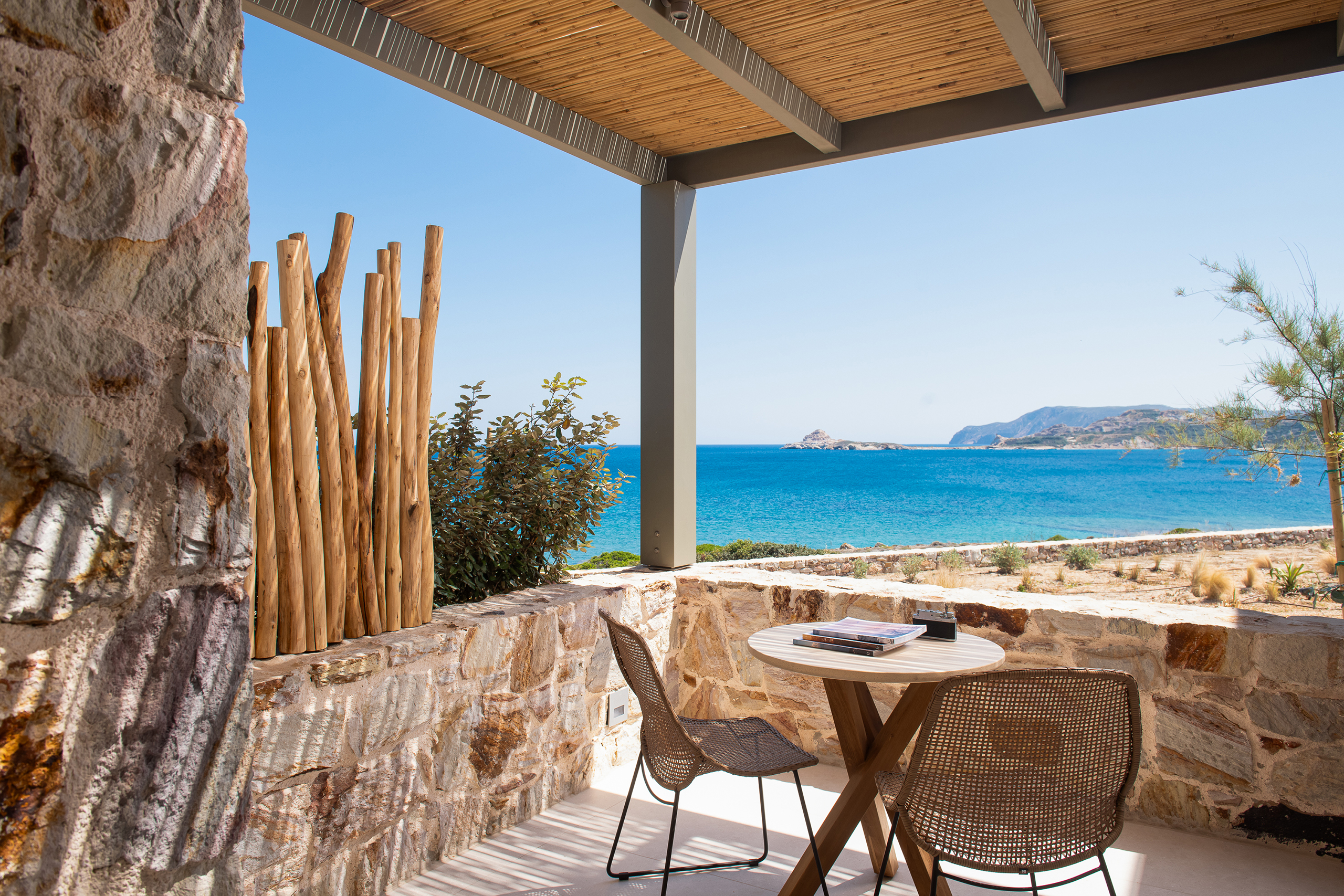
Aegean genius: a force field of electric blue water surrounds the island
The house is a joint project with architect Lito Karamitsou, who spent her summers on Milos with her hotelier mother, Nausika Georgiadou. When designing the house, the idea was to create somewhere that guests would want to spend the whole day: “I kept thinking of this woman who grew up on Kimolos and used to stay in her grandmother’s house at Goupa. She would spend her summers just swimming, eating local peppers stuffed with rice, then swimming again, before eating something more.”
Children play on the sandy beach, while parents linger over tall glasses of ouzo and calamari
Children play on the sandy beach, while parents linger over tall glasses of ouzo and calamari
Over the course of three days, I do just that. Reading and diving, with short breaks to fetch ladenia (a local tomato-topped pie) from the bakery in town.
Beneath Thavma, couples lounge on cushions outside a magazi, converted by the owner of Lostromos. While around the corner at Goupa, Chroma Suites has converted another fisherman’s house with turquoise doors, canary-yellow shutters and orange umbrellas – plus front-row views of the bay’s distinctive elephant-shaped rock.
Newsletters
Choose the newsletters you want to receive
View more
For information about how The Observer protects your data, read our Privacy Policy
Also new in 2025 was Espera Suites, the island’s only boutique hotel to date. Its sloping stone walls are inspired by Chorio’s medieval kastro, while rooms are arranged to feel like a little village. “I want guests to feel as I did when I first came to the island,” explains owner Panagiotis Pareskevopoulos, a first-time hotelier who fell in love with Kimolos’s feeling “of the good old Greece” over a decade ago. This summer there will be a roster of visiting chefs and sound baths on some of the island’s most beautiful beaches.
Near to the hotel is Kalamitsa, one of the island’s best tavernas. Run by the second generation of the Ventouris family, it is the embodiment of the classic Greek summer: children play on the sandy beach in front, while parents linger over tall glasses of ouzo and calamari.
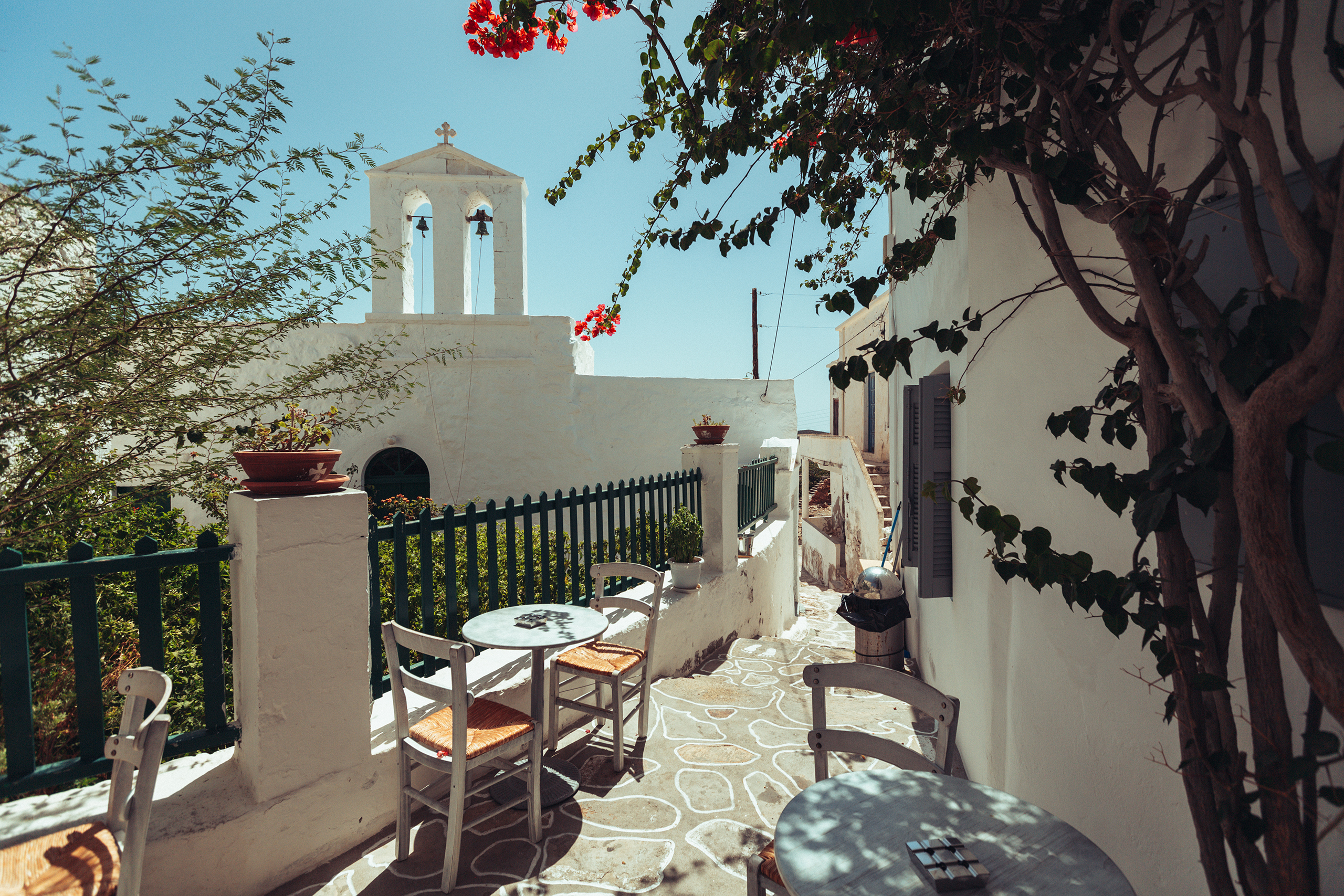
At night, the action moves into the island’s hilltop capital, Chorio, one of the loveliest towns in the Cyclades. Cars are parked outside its boundary and cobblestone paths wind past the 19th-century Church of Panagia Odigitria, which dominates the skyline with its blue dome. Old sailors meet at O Kampos for bottles of Peloponnese beer, Mena. Tables are set up along the street at Kalo Kardia, known as “Bohoris”, groaning under the weight of goat cooked in the oven; while more rounds are ordered at Brachera’s rooftop near the castle ruins. At Farma Tou Samplou, Antonis Antivahis keeps his butcher-come-grocer’s open late, selling Kimolian capers, sour cheese and meat so well regarded that certain Athenians are known to have it sent by boat to Piraeus.
In May this year, new ferry routes will connect the mainland (from Lavrio and Piraeus) to Kimolos in three and a half hours, bypassing Milos and shaving more than three hours off the current journey. As things speed up, the island’s cast of characters hopes that its visitors will continue to slow down.
Photographs by Getty Images