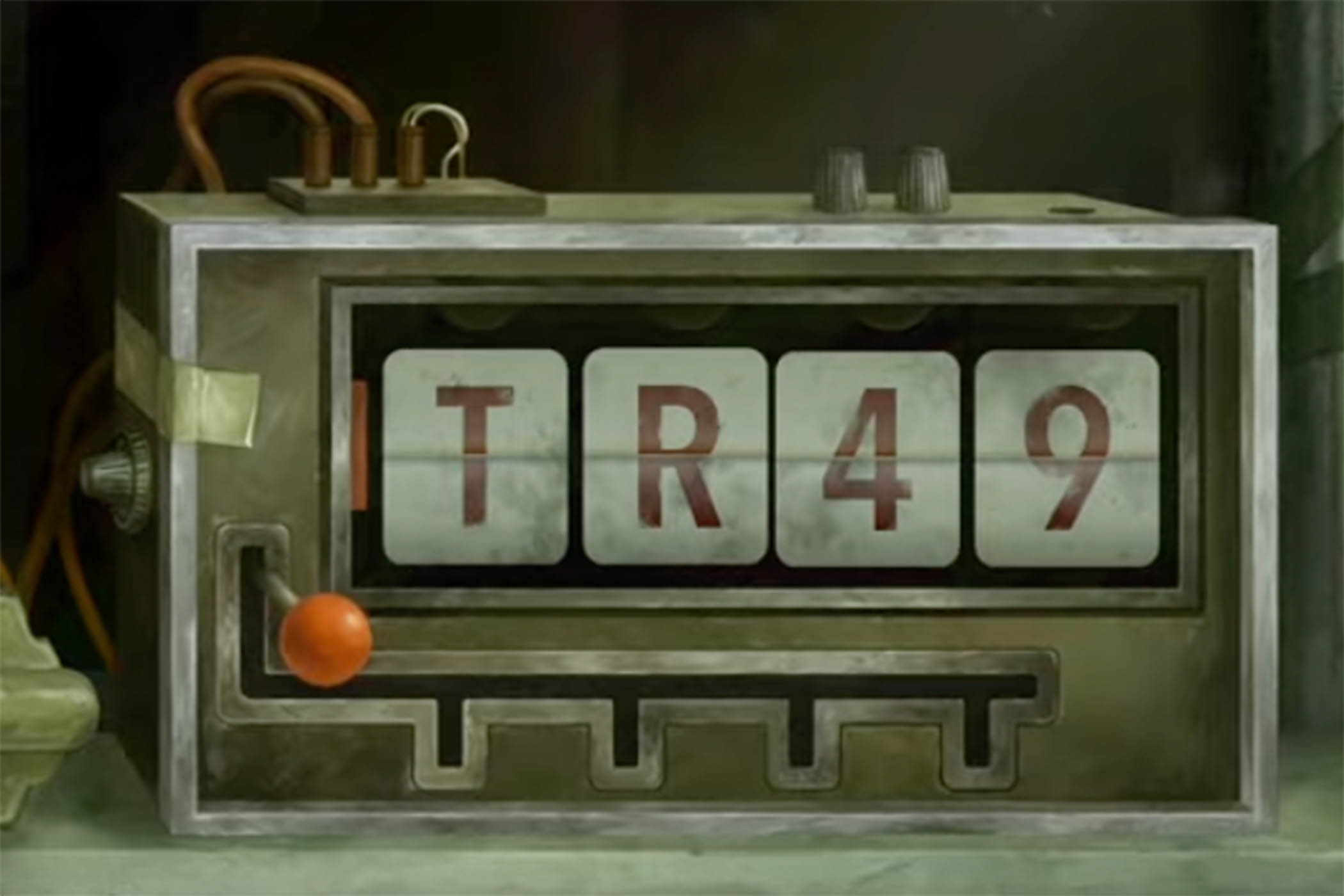


The mathematician and video game writer Jon Ingold cannot be sure, but he suspects that his great-uncle worked at Bletchley Park alongside Alan Turing and the other wartime codebreakers. When he was a child, Ingold inherited a metal box from his uncle. It felt homemade and had an unusual lock: one catch used two letter dials; the other, two numbers.
During the making of The Imitation Game – the film in which Benedict Cumberbatch played Turing – Ingold was invited to Bletchley Park to consult. The actor wanted to ask a mathematician questions that might help him better inhabit the role. During one lunchbreak, Ingold went exploring. In a hut filled with photographs – props, perhaps, or originals, he wasn’t sure – he found an image of men and women gathered around a complex-looking machine. Scrawled in one corner was a code, in precisely the format of the lock on his uncle’s box: TR-49.
Is the story true? Perhaps. Ingold did study maths at Cambridge, and IMDb does list the film among his credits. His great-uncle worked for one of the military intelligence services. Yet the game-maker – best known for 80 Days, the Bafta- nominated adaptation of Jules Verne’s novel – has a talent for mythmaking. And TR-49 channels that instinct into a game steeped in wartime paranoia and intellectual secrecy.
It opens in a musty basement beneath Manchester Cathedral. There you approach an old contraption of glowing valves, thick wires and scorching pipes. It is, you soon discover, a computer, into which some forgotten operator has uploaded a trove of documents, letters and books: a kind of proto-Wikipedia. These pages are accessed not via the click of a mouse, but by entering codes, each formed of two initials and two numbers, typically corresponding to a year of publication.
You begin with a single document and work outwards, deducing new codes that lead to fresh names, references and crosscurrents. Gradually, a literary-mathematical scene comes into focus: clever writers, rival publications, philosophical disputes and romantic entanglements, all wrapped in questions of faith and meaning. Pleasure comes from making those connections and from correctly matching the game’s 50 discoverable documents to their elusive codes.
If this archival sifting sounds austere, the game supplies another layer of drama. As you work at the terminal, a voiceover offers hints about where to search while slowly revealing the speaker’s own perilous circumstances. The interplay between the story you reconstruct in the files, and the one unfolding in real time is ingenious and, in interactive storytelling terms, radical.
Elegantly designed and confidently paced, TR-49 allows players to determine the order of their discoveries without ever feeling shapeless or indulgent. Inkle remains one of the most interesting studios working in games today, exploring the limits and possibilities of its chosen patch of design. TR-49 is another big achievement in a body of work that ranks among the medium’s most intellectually exhilarating.
Photograph by Inkle
Newsletters
Choose the newsletters you want to receive
View more
For information about how The Observer protects your data, read our Privacy Policy