As I arrive at Theatr Clwyd in Mold, Flintshire, the afternoon sun streaming through the glass walls of its foyer, a scattered group of people with Down’s syndrome make their way towards the exit. Ahead of me is a play area for children, to the right a lift in a shaft made of cross-laminated timber, a sustainable material chosen instead of the reinforced concrete usually used for this purpose. There’s a health and wellbeing room looking into a not-yet finished “sensory garden” that will awaken, as its designers Studio Bristow put it, “curiosity and play”.
Further into the building there are rooms in which to host workshops for people with dementia or other mental health needs, Changing Places toilets for people with disabilities, and “relaxed” facilities for those who might find the unmodified sounds, sights and smells of a theatre stressful. Later in the theatre’s main auditorium I will see a production of Under Milk Wood staged by a Welsh theatre collective, Craidd, that features deaf, disabled and neurodivergent artists. Some might call the theatre’s attention to access, diversity and sustainability woke. I’d call it a mark of a high degree of civilisation.
The original theatre, completed in 1976, is the creation of a previous generation’s concept of the public good. Commissioned by the then newly formed Clwyd county council, it is part of a mini-Brasília of civic buildings – including offices, law courts and a library – rising up a slope above the town, designed by the county architect Robert Harvey in an approximately brutalist style. The theatre originally shared its block with an educational technology centre, and eventually took over those spaces.
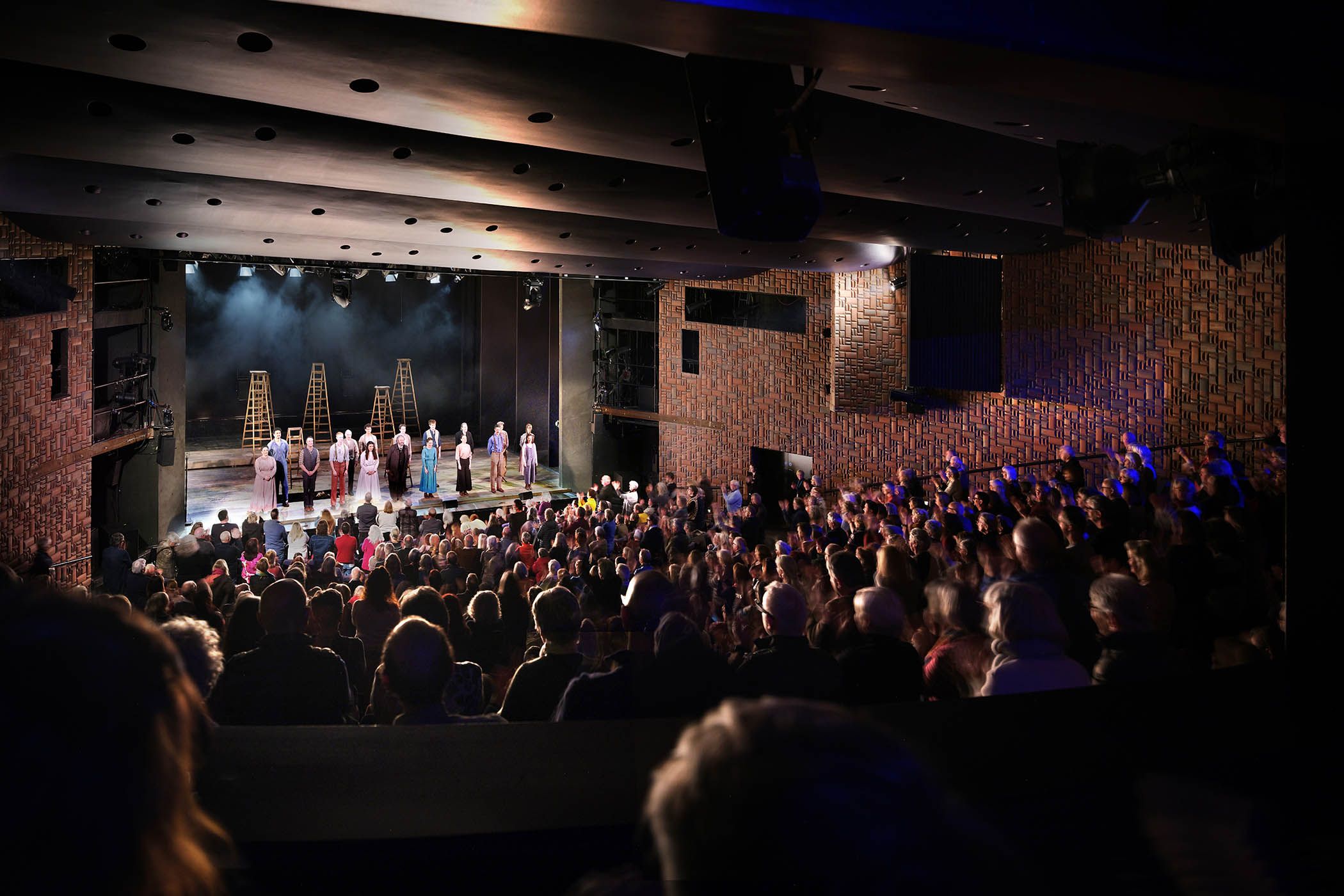
‘A high-70s cave’: the respectfully refurbished auditorium with its ‘tapestry of orange-brown bricks
Now it has been expanded and made over in a £37.8m construction project by the builders Gilbert-Ash, led by Theatr Clwyd’s executive director, Liam Evans-Ford, and designed by the architects Haworth Tompkins. Over the past 35 years, the last of these have become maestros at remaking theatrical spaces with and in the shells of older buildings: Bristol Old Vic, the Liverpool Everyman, the Royal Court in London. But this project is different from anything they have done before,owing to the fact that the original Theatr Clwyd, a blocky brick structure that rises from the green countryside like a power station, is not like any other performance venue.
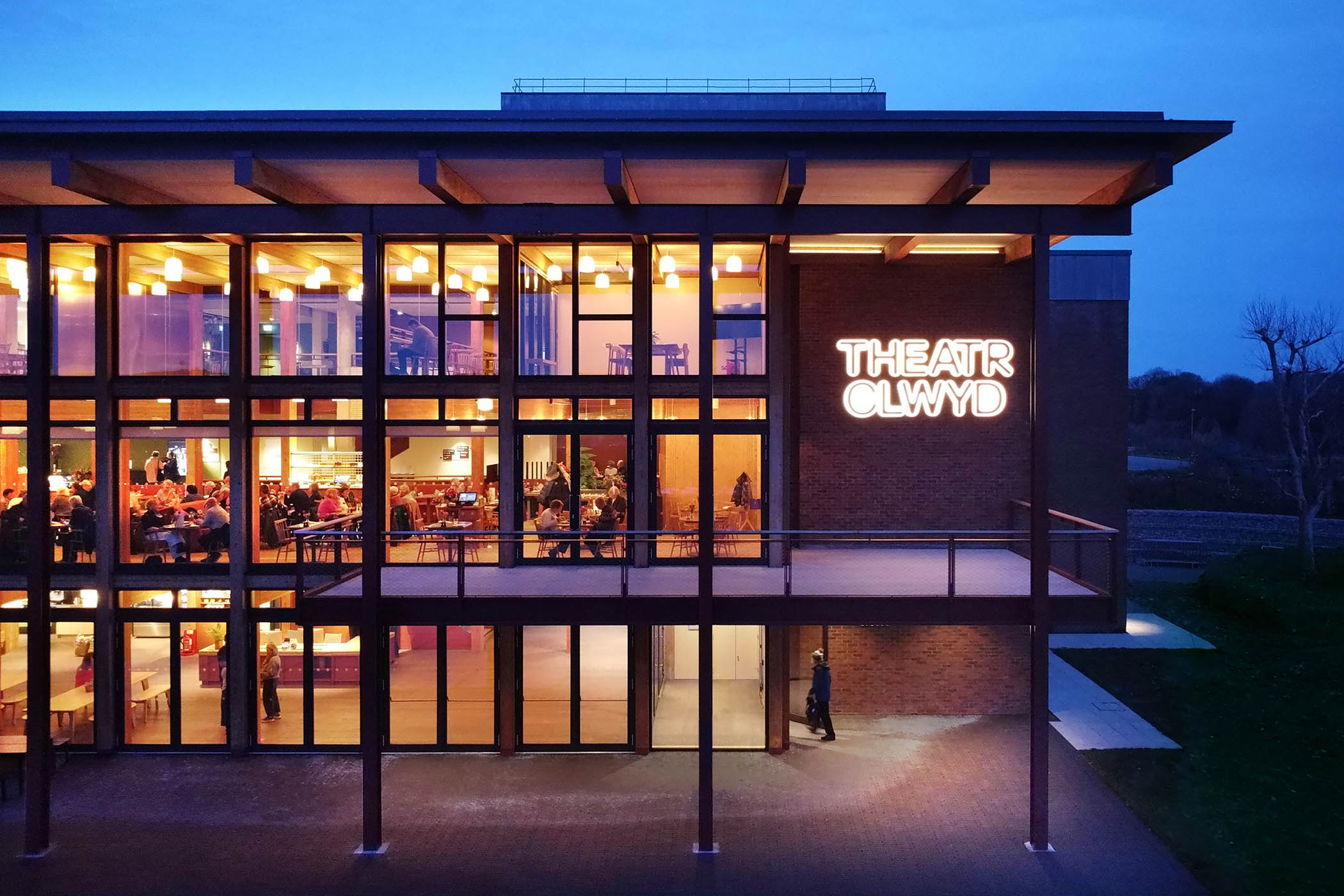
Haworth Tompkins have here made a building of layers, in which a three-storey portico, supported on slender steels in earthy red, stands in front of the timber-framed foyer of the same height. Behind that, they have carried out a “deep retrofit” of the old building, which means editing out its faults, enhancing its strengths, fixing its worn-out fabric and making a warren of rooms and passages into a coherent whole. Spare and restrained at first sight, the new-old building gets richer as you go inside.
It is a framework of activity that serves local communities, as well as audiences who might travel from north-western English cities, and runs both day and night. At its heart is the original main auditorium, respectfully refurbished, a high-70s cave whose curved walls are patterned like a tapestry with orange-brown bricks – a work, it seems, of woven clay. There’s also a studio theatre with flexible seating, a cinema, rehearsal rooms with high ceilings, a set-building workshop and spaces that can be used for revenue-earning conferences and weddings. In the foyer, there’s a restaurant and cafe run by the acclaimed locally raised chef Bryn Williams, served by kitchens equipped to match his ambitions.
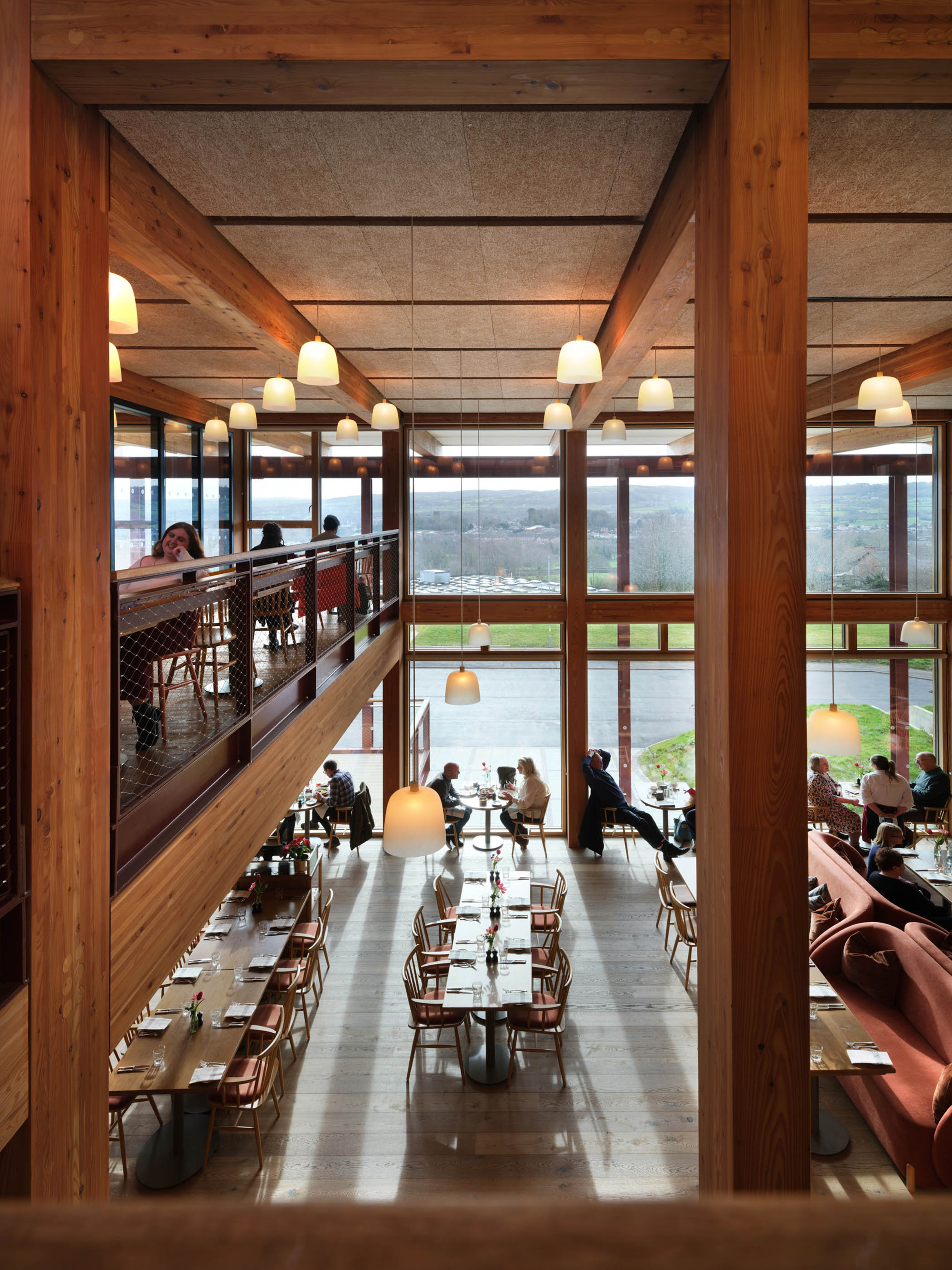
The timber-framed foyer housing a cafe and restaurant
It’s a little city connected by what the architects call an internal “street”, running at first-floor level from one side to another. Its inner life plays out against a magnificent surrounding panorama, captured by windows and glass walls, of the Clwydian Range of mountains. The building’s spaces run from the dark and inward-looking auditorium to the light-filled foyers.
The predominant material of the new work is timber, which plays off the aged concrete of old, as well as some fragments of studiously preserved tilework. These interiors are enriched by touches of luxury, such as copper walls here and there, and by a series of artworks specially commissioned by studio three sixty, who also provided design consultancy for the new building. A large events room is lined by floor-to-ceiling curtains by Sauda Imam, a recent graduate from the Royal College of Art. They take you into an imaginary landscape, inspired by both Wales and her native Nigeria, of deep green mountains, golden trees and turquoise water beneath a pink sky. The curtains are festive, fascinating and a little moody. And they’re in the spirit of the whole endeavour, which is to do its good works, not with box-ticking worthiness but – in the architecture, the food, the art and the performances – with skill and delight.
Photographs by Philip Vile
• This article has been amended since publication. An earlier version omitted to credit the role of studio three sixty in the design
Newsletters
Choose the newsletters you want to receive
View more
For information about how The Observer protects your data, read our Privacy Policy