
Seventy million years ago, Los Angeles was a shallow sea. Where Teslas now cruise down Wilshire Boulevard, giant aquatic reptiles stalked their prey. The basin so teemed with life that by the Miocene period the bodies of its dead had putrified into a bed of tar. It’s still there a thousand metres below the street, but some of it sits above the surface: a shiny black pool on the corner of Wilshire and La Brea, in a park just outside the Los Angeles County Museum of Art (Lacma), that gleams in the hot California sun. (La brea is the Spanish word for tar.) When I was a kid we used to ogle it after trips to the museum. I’d poke sticks in the gooey stuff where it bubbled up through the turf, the residue of a prehistory that refused to remain buried.
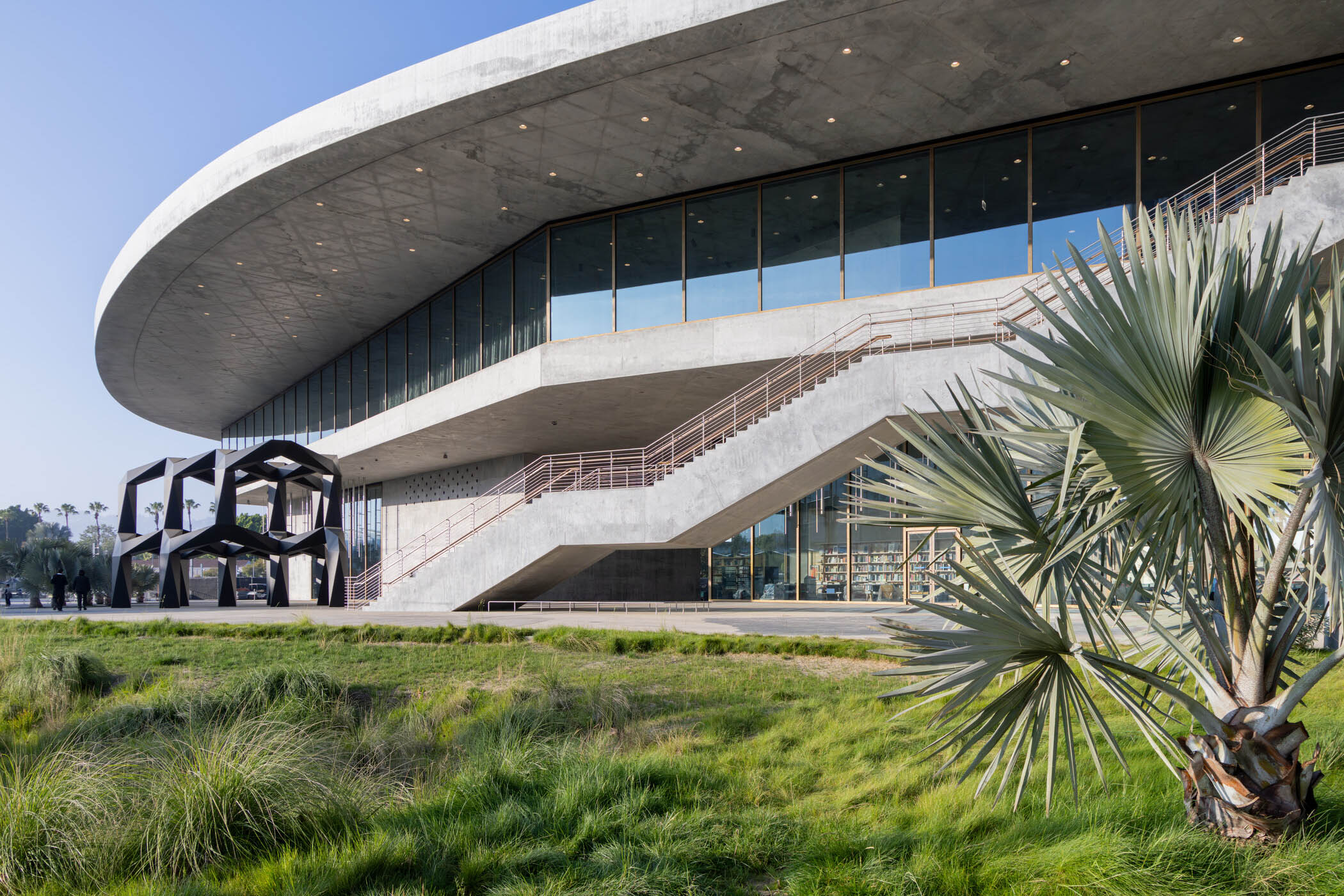
That tar pit inspired the architect Peter Zumthor’s designs for a new building to house Lacma’s permanent collection. With a structure like a massive amoeba oozing across the site, it was streamlined over the years, but Zumthor still calls it his “black flower”. A single floor sandwiched between two enormous, 110,000sq ft concrete plates joined at their edges with glass, the building floats 30ft above ground and bridges Wilshire, LA’s main thoroughfare, virtually ensuring it will appear in car commercials and high-speed chase scenes. At a cost of $720m (£533m), it replaces a hodgepodge of structures dating from Lacma’s founding in 1965 to a 1986 expansion. It has been 20 years in the making.
It opens at a delicate time for the city. LA is one of the host cities for the Fifa World Cup, and will hold the Olympics in two years’ time, but is still recovering from an environmental catastrophe. In January 2025, the hills above the tar pits burned. From Altadena to the Pacific Palisades, dozens of artist studios and high-value artworks were destroyed. Flames scorched the gardens of the Getty Villa. On Instagram, a friend shared Ed Ruscha’s 1965-68 painting of Lacma’s original campus on fire as if it were a prophecy.
The wildfires never got close to the museum. But critics of Zumthor’s project felt the damage had already been done. Local reaction to the design was fierce: Architectural Record called it “the blob that ate Wilshire Boulevard”. In the Los Angeles Times, Carolina Miranda described it as “a small-city airport terminal”. I was aghast at the idea of bridging Wilshire – had Zumthor never been beneath a freeway overpass? Preservationists lamented the decision to tear down the existing buildings. Worst of all, the new galleries would occupy all the buildable land onsite while reducing space for Lacma’s permanent collection – made up of some 150,000 objects – and eliminating storage and offices, forcing the public institution to rent facilities across the street.
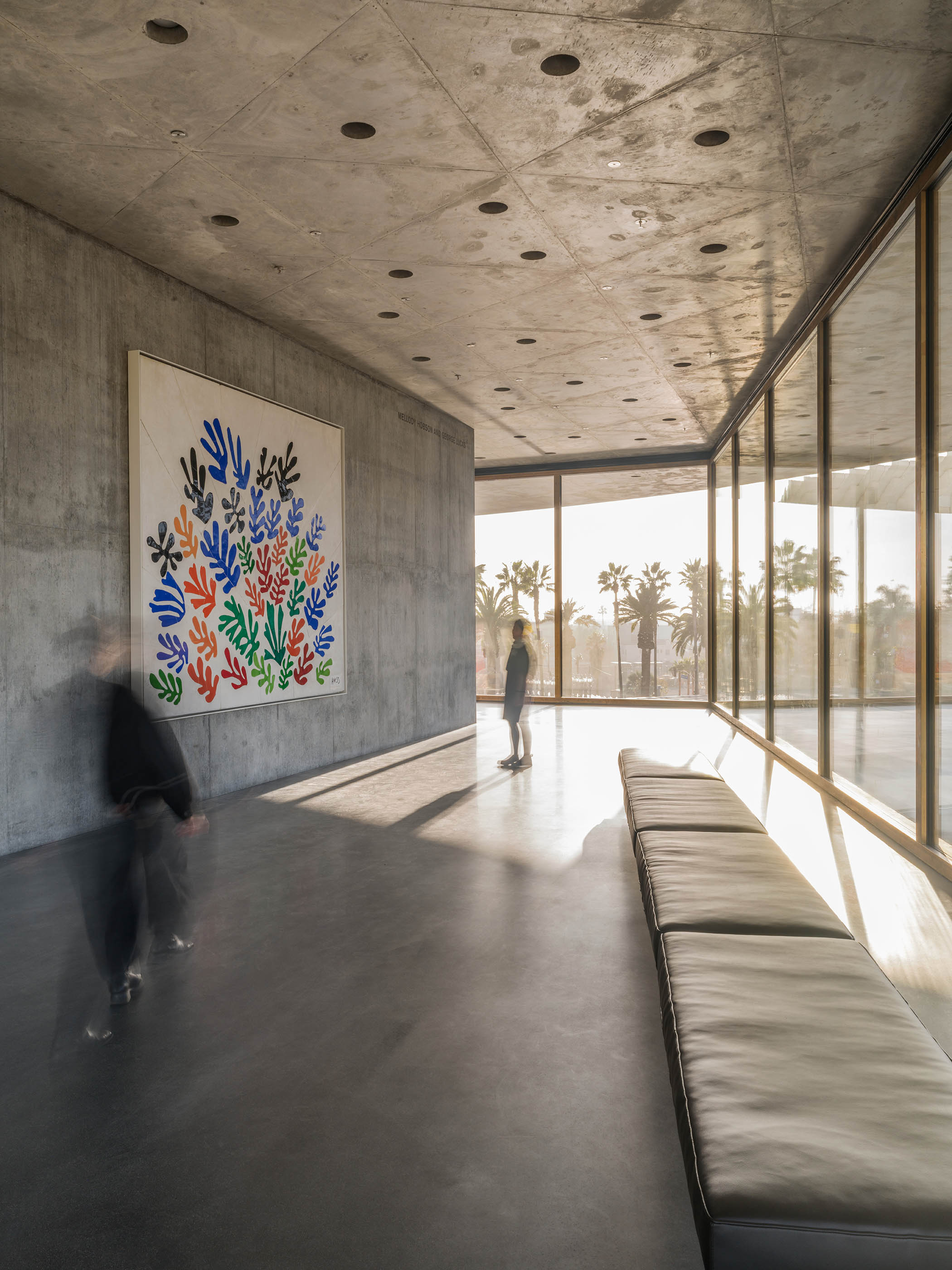
A Matisse hangs in the sparely curated LA gallery
But as the press gathered last week beneath the colossus, many critics seemed to have changed their minds. The prevailing mood was one of shock and awe. Even at noon, the underside of the building was full of light, and its curves ensure that it keeps changing at every angle. From the outside, it has the spirit of a building by the Brazilian modernist Oscar Niemeyer. Somehow Zumthor has managed to make 65,000 cubic metres of concrete feel buoyant.
The plaza itself, which extends beyond the building’s broad overhang, is also all concrete, with hardly a bench or a succulent in sight. This seems unlikely to change, since a monumental drawing by the Mexican artist Mariana Castillo Deball has been incised into its surface. The museum plans to use this space for public performances and sculptures, though it is closed off from the street by a high fence.
Within this enclosure, Michael Govan was glowing. The building has been a singular ambition since he was appointed Lacma’s director in 2006. A young, trim 63 with coiffed grey hair and a firm handshake, Govan came to LA from Dia, a New York-based foundation that collects minimalist art, where he wooed donors by flying them to land art sites in his prop plane. He earlier made his mark on monumental museum projects, from Mass Moca to the Guggenheim Bilbão. He told the New Yorker in 2020 that he “literally came to Lacma to tear the whole thing down”.
In 2020, director Michael Govan admitted he ‘literally came to Lacma to tear the whole thing down’
In 2020, director Michael Govan admitted he ‘literally came to Lacma to tear the whole thing down’
I first met Govan sometime after the Miocene period, when I was an intern in Lacma’s membership department. The offices were located in the Art of Americas Building, since torn down to make way for Zumthor’s “flower”. My shared desk was in an underground chamber lit only by a thin glass brick clerestory. I was told we were lucky – at least we had windows. Govan’s office was another exception, bordered by a triangular lightwell improbably planted with bamboo. When I mentioned this to him, he laughed. “I had to put buckets out when it rained.” He explained that collectors refused to donate art if it meant it would be installed in the old buildings. “We called it ‘Leakma’,” he said. Just as rain sometimes trickled through the roof, tar would occasionally spurt from the fountains and clog the drains. In 2013, a review found it would cost at least $246m just to patch up the old campus.
Govan chose Zumthor personally, without a public bidding process. They had previously collaborated on a pavilion at Dia for the sculptor Walter De Maria, which was never completed. Zumthor, who won the Pritzker architecture prize in 2009, is best known for designing atmospheric buildings with unusual functions: a thermal spa in Vals, Switzerland; a memorial in Norway to witches burned at the stake. His style is brooding and ascetic. But Lacma was a challenge of an entirely different order, both in terms of its scale and public mission.
Govan told me last year he had two requirements: the galleries needed to be on a single floor and built from concrete. “I wanted no hierarchy, like Los Angeles,” he said. “With no up and no down, no front or back.” The single, meandering floor allows art from various departments to be grouped thematically rather than by region, making it impossible to, say, place European painting at the front and Asian textiles at the back. It’s a radical idea for an encyclopedic museum, that legacy of the colonial 19th century.
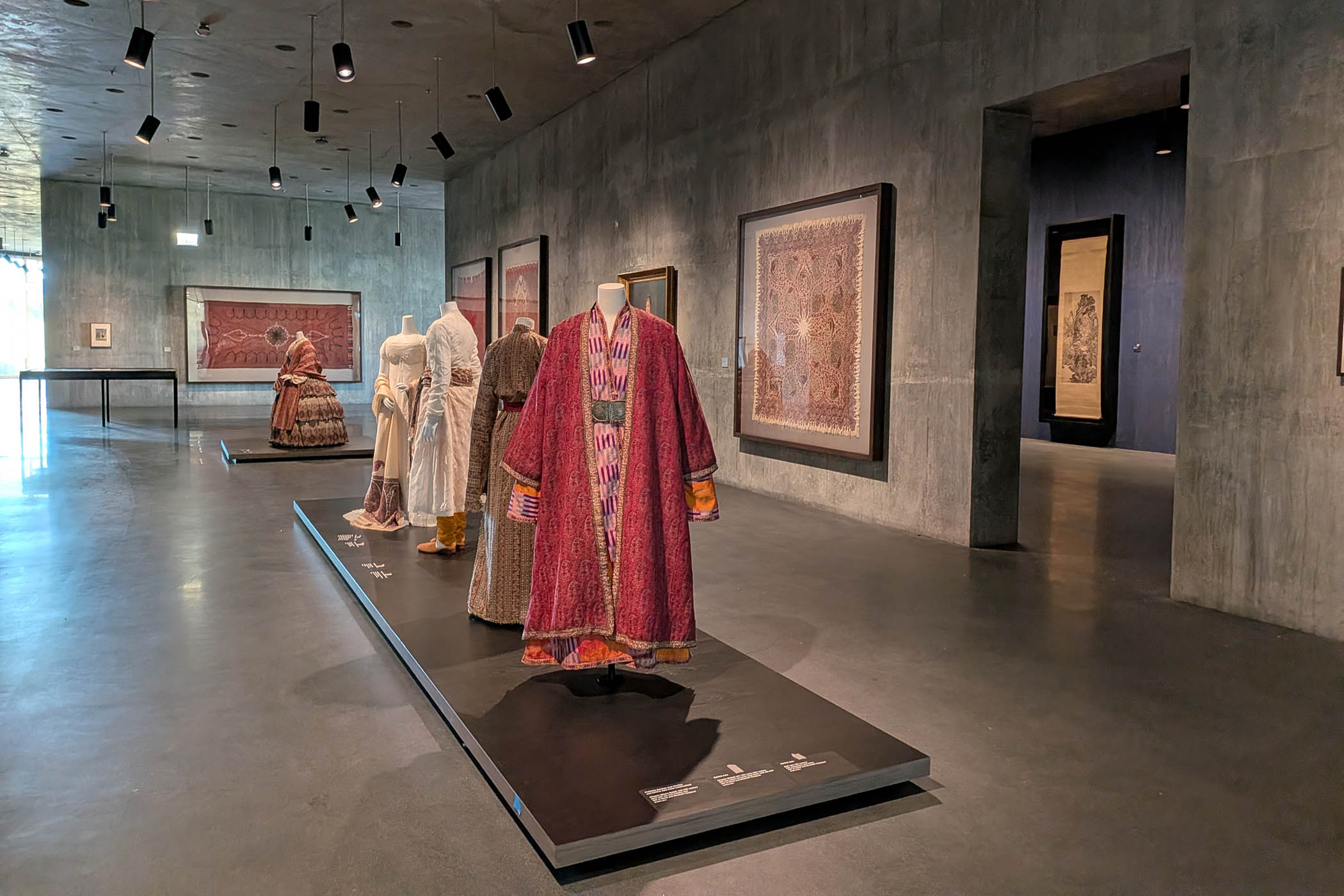
A Victorian hoop dress is installed alongside the Kashmiri textiles that inspired it in one room
The strategy also places a great deal of trust in Lacma’s curators – and they have delivered. Between galleries loosely inspired by each of the world’s oceans, there are many clever straits. June Wayne’s trippy lithograph White Tidal Wave II (1972) shares space with Hokusai’s The Great Wave off Kanagawa (1830-31). Diego Rivera’s painting Flower Day (1925) keeps charmed company with Mayan ceramics. A Victorian hoop dress from Scotland has been installed alongside Kashmiri textiles that inspired its paisley pattern. Focused galleries of Dutch still life and Chicano photography ensure this does not feel like an endless scroll. (That may also be because the works are sparely installed, with 1,700 on view – 1% of the collection.)
The choice of concrete, on the other hand, is more conservative. The building’s interior walls can never be changed, so curators are restricted to the number of works they can group together. Art must be drilled directly into the concrete, already visibly patched. The contrast between dense concrete and translucent glass poses other problems. Interior galleries are almost inscrutably dark; sculptures by Light and Space artists of the 1970s, meant to refract the California sunshine, feel as if they have been sealed in a tomb. Sprawling perimeter galleries offer views of Wilshire Boulevard, the Santa Monica Mountains and the tar pits, but they are unsuitable for light-sensitive textiles, drawings or photographs. Chrome-plated mesh curtains have been hung to mitigate this, but aren’t enough to prevent glare. As I tried to study a glass-protected triptych by Francis Bacon, hung a few metres from a window, I found myself staring at my own reflection.
These concrete spaces become an echo chamber. When I sat down to interview Zumthor and Govan in one of the perimeter galleries, I asked Zumthor about the material challenges of the building. He seemed not to hear me and removed one of his shoes to fiddle with the laces. Govan shouted the question back to him. “Steel would have been better,” Zumthor replied. “But I insisted,” Govan added. Later, he said: “We wanted to build a building that would last 300 years.”
LA may not be around that long if humans keep pouring so much concrete. It’s the second-most consumed substance on Earth after water, contributing as much as 8% to global CO2 emissions. To ensure the building wouldn’t crack during an earthquake or sink into the tar sands, four times the typical amount of concrete used in a large building was poured into its foundations, at an estimated cost of $180m. Zumthor acknowledged that such expense wouldn’t have been necessary with a more flexible material such as steel.
Windows on the north side of the galleries look out on to the Pavilion for Japanese Art, a postmodern folly completed by Bruce Goff in 1988, the only building that predates Govan’s directorship that is left standing. Just past it, you can see the tar pits glistening darkly. Few Angelenos are alive to remember the days when much of the city was covered in oil derricks and asphalt pits, or even when oil barons such as J Paul Getty and Armand Hammer were donating foundational sums to Lacma. Now, that mineral wealth may be LA’s ruin. Against this backdrop, Zumthor’s building resembles a fossil. Its cracks are already beginning to show.
Photographs by © Tony Smith Estate/Artists Rights Society (ARS), New York, photo © Iwan Baan/© 2026 Succession H. Matisse / Artists Rights Society (ARS), New York
Newsletters
Choose the newsletters you want to receive
View more
For information about how The Observer protects your data, read our Privacy Policy