
Broadgate, a 1980s office development near Liverpool Street station in the City of London, was built to last. Its blocks, designed by the skilful Peter Foggo of Arup Associates, were faced in hard igneous stone that could survive almost for ever. Yet the original buildings have mostly gone, replaced by larger and more profitable development. Broadgate, considered exemplary in its time, was not destroyed by weather or decay or age, but by the logic of property markets: more money could be made with new structures, so the old ones had to go.
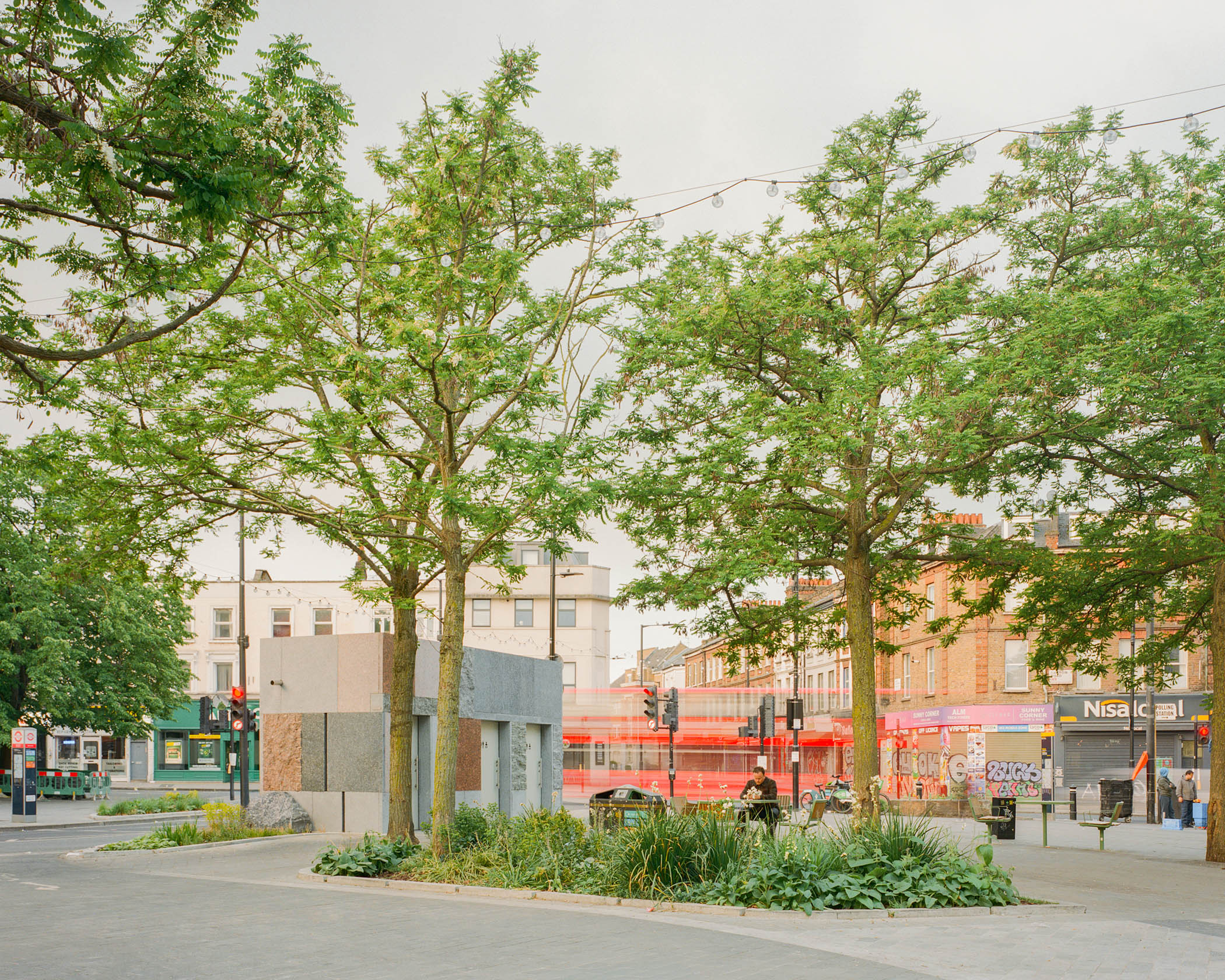
Some of its fabric, though, has found a new life. A block of public toilets has just been completed a few miles away, whose outer wall is made of stone salvaged from Broadgate. It is located on an irregular piece of land in Maida Hill, west London, formed by the intersection of several roads. The stone has moved, says Eddie Blake of the latter’s architects Studio Weave, “from private corporate architecture to public convenience”.
Studio Weave has worked with the engineers Webb Yates and The Stonemasonry Company to realise a small project with at least two big ideas. One is that these essential buildings should be dignified structures that enhance their surroundings. The other is that the existing fabric of cities can be “urban quarries”, vast reserves of high-quality materials that can be mined for use on new buildings. This approach minimises the environmental costs of extracting and processing the stuff of construction. It also enables, says Blake, “cost efficient public luxury”.
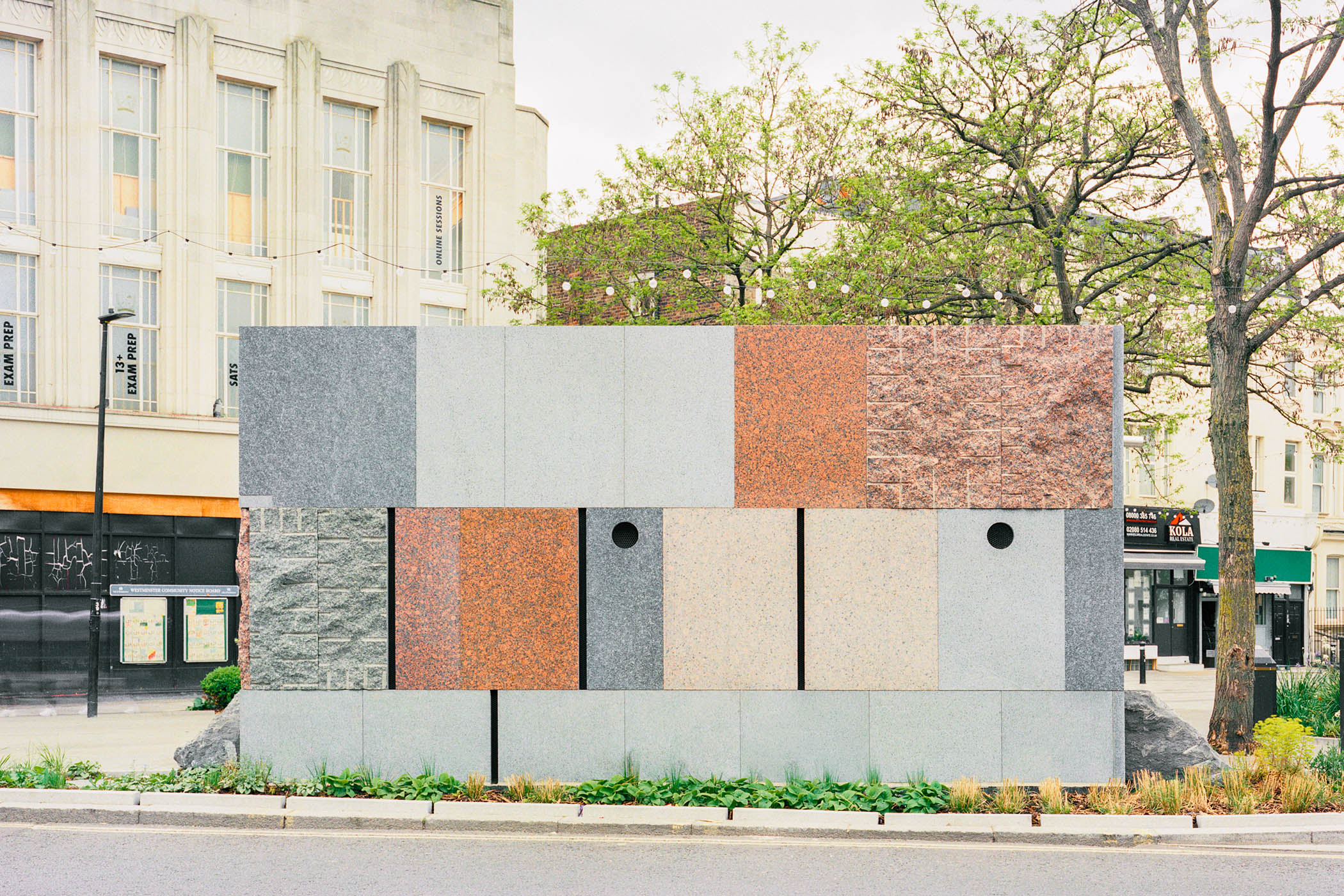
‘The stone is a patchwork of pink Finnish granite and grey Norwegian larvikite’: the toilets in Maida Hill, west London
The new block is a simple, practical rectangle, its location and dimensions determined by the need to avoid buried pipes, cables and the underground shell of the Victorian toilets it replaces. Its height is four metres, the tallest it could be without requiring the costly and lengthy processes of getting planning permission. It consists of an efficient prefabricated box made by the Swedish company Danfo, that comes with all fixtures and fittings built in, with the stone wall around it. The latter is structural, meaning that it holds itself up much as masonry has since ancient times; it’s not cladding hung on a frame, which is now the more usual practice.
The stone is a patchwork of pink Finnish granite and grey Norwegian larvikite, both formed of magma that cooled hundreds of millions of years ago into a close-packed grain speckled with crystals. Some of the stones are polished, some not, some left rough as tree bark from the process of splitting them into smaller sections. They come in high and wide pieces arranged in three horizontal bands. At the same time the pieces are thin – 8cm – which gives the structure a solid-yet-teetering ambiguity. It has some of the qualities, simultaneously, of a Mycenaean palace and a house of cards. It could actually withstand, I’m told, the impact of a truck. Hidden steel pins between the slabs help to keep it stable.
It has some of the qualities, simultaneously, of a Mycenaean palace and a house of cards
It has some of the qualities, simultaneously, of a Mycenaean palace and a house of cards
In places there are vertical gaps and round holes for the purposes of ventilation, which also give you a sense of the structure’s thickness. A couple of boulders are built into the fabric, big enough to sit on. It’s an unusually orderly pile of stones, a precision cairn, that visibly runs gamuts of weights and textures. Blake likes to compare the project to Edwin Lutyens’s Lindisfarne Castle in Northumberland, for the way a shaped object rises out of rough rock. It’s a possibly preposterous comparison (“everyone smiles at me as if I’m a bit mad,” he says) but outsized ambition is one of this modest building’s charms.
It doesn’t stand entirely alone, but forms part of an open space that has been reshaped and replanted by the landscape architects and planners LDA and the garden designer Tom Massey. Although Maida Hill is close to the legendary property hotspots of Notting Hill and Maida Vale this particular meeting place, which is popular with street drinkers, is much less posh than either. The aim is to make a space which, according to Blake, will encourage social rather than antisocial behaviour.
The provision of accessible toilets is an obvious public good, especially for people with disabilities or health conditions, who are pregnant, have small children. For this reason the Green party in London have been campaigning for better provision, while the Labour administration who ran the City of Westminster until the recent local elections set about building a series of new amenities, of which the Maida Hill project is one.
Both they and the mayor of London, who also funded the toilets, are keen to announce their contribution with a plaque fixed to Studio Weave’s building. But, really, this architectural nugget shouldn’t be a one-off – what if every public convenience where this good? Its principles are not too hard to replicate. It might even succeed where the mighty Broadgate buildings did not, and become a building for the generations.
Photographs by Lorenzo Zandri
Newsletters
Choose the newsletters you want to receive
View more
For information about how The Observer protects your data, read our Privacy Policy