
The largest – and slightest – sculpture in Anish Kapoor’s new show comes right at the start. A colossal red inflatable, the shape and colour of a beef tomato, fills up the space, squeezing the visitor to the sidelines. The impulse is to prod its squashy surface as you edge past, but of course it bounces back, massively impervious. That’s the news from the Hayward: spectacular scale before tiny little people.
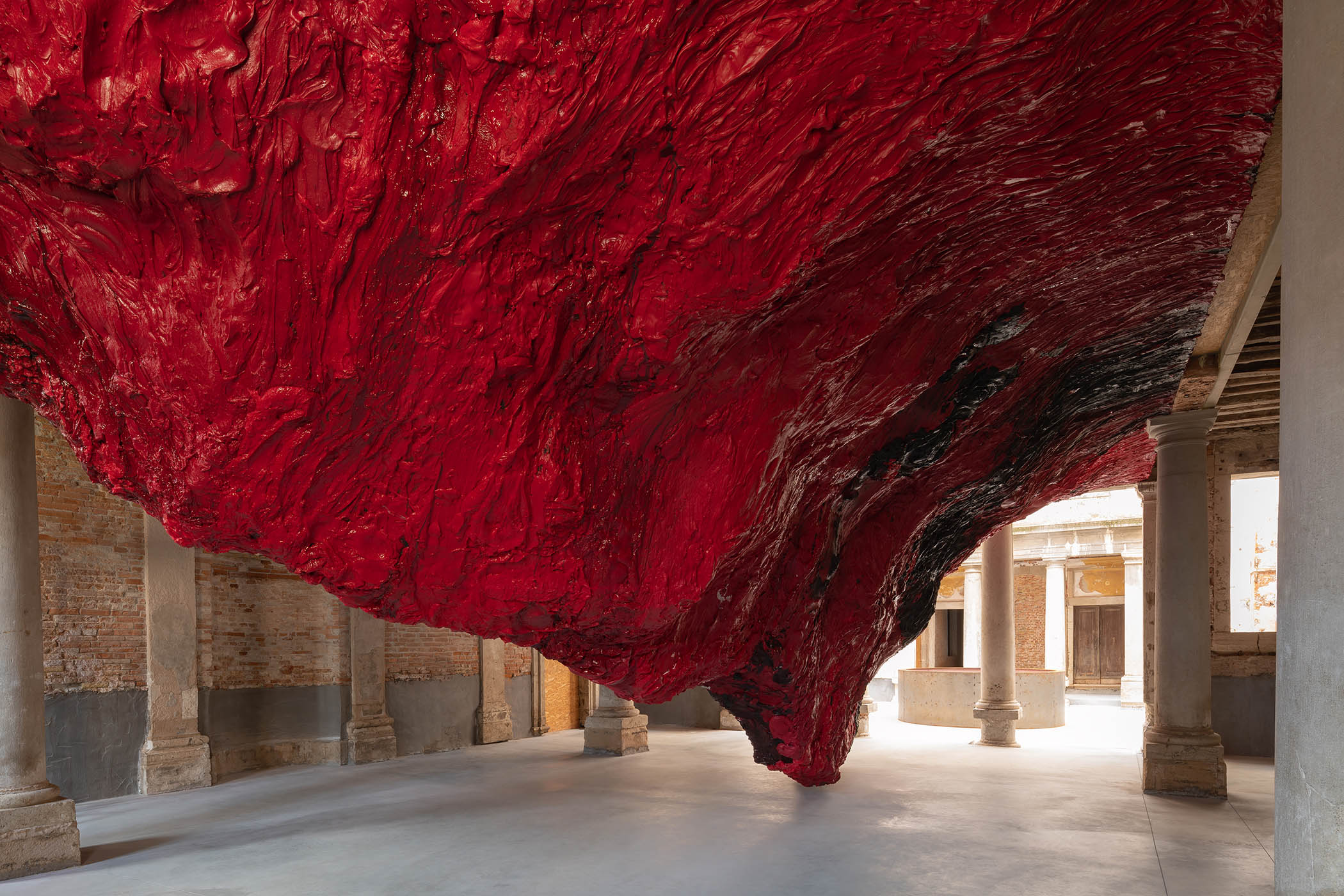
Upstairs, a craggy mountain of solid colour appears to hang upside down from the ceiling, a mass of crimson interspersed with glistening black that threatens to drop and fall upon the human race. Or so one deduces from its title, Mount Moriah at the Gate of the Ghetto. Moriah is where God challenges Abraham to sacrifice his own son, a terrifying test of faith. Kapoor – and this is one of his gifts – induces you to walk right round the mighty object, unable to take it all in at once, or to discern its full meaning. At a distance it is more flesh than mountain. Close up, its surface is so evidently worked in lavish strokes of paint as to baffle interpretation. Is it pigment or is it sculpture?
Enormous polythene bags of offal – blood-red, liver-dark, streaked white like bacon – dangle from the walls. Pierce these transparent membranes and the outsize guts would tumble out; and isn’t skin all that holds our innards in? These bags too are self-evidently created out of great pileups of paint, applied to a silicone form: more fetching raspberry ripple, up close, than dead flesh.
Kapoor’s actual paintings are awful. A selection of his kitsch vulval forms resemble Lucio Fontana slits heavily tarred with lurid oranges, browns and yellows. It is a perplexing sideline, considering his famous gift for mesmerising our eyes with pure colour: crimson, Yves Klein blue and his exclusive Vantablack, the world’s blackest black, absorbing all but a fraction of light. There is no blue in the Hayward show, which is predominantly red, with many of Kapoor’s illusions in Vantablack.
These remain tremendous: flat black shapes on the wall or floor that expand into fathomless voids when you look within them, as opposed to at them; the velvety blackness beckons. Again, they compel you to walk back and forth, and side to side, swithering between two and three dimensions. At a certain angle the voluminous depths suddenly disappear, and the surface reverts to flatness once more. It is almost impossible to work out when, or how, this happens. These works in contrast are conceived on a human scale – a door, a window, a hatch – the visitor kept just at arm’s length by discreet barriers. They are inexhaustible wonders.
But wonders for the eye not the spirit; the artist is not touching the void, no matter that his titles – Paradise, Descent into Limbo – might aim to encourage a sense of the numinous. It is the same with his mirror-bright sculptures in polished stainless steel. Look into these and you vanish, or appear much larger, or smaller, closer or more distant. In one work, cut deep into a wall, you are reflected in all these different ways and appear to levitate, too, in the space of the White Cube gallery.
The vast steel sculptures stationed on the terraces outside invert and condense the London skyline or turn the harled concrete of the Hayward’s exterior walls into animated tapestries. These come alive, over and again, every time your fellow visitors, miniaturised, happen by and look in. But so it is with reflective convexities. One of these enormous forms rises like a twisting wave. Its grandiloquent title is Tsunami.
Kapoor can produce far greater magic with his mirror distortions. These works feel like a product line he has had to include because of its global popularity. At 72, Sir Anish is so well known as to have prodigious expectations to meet. Perhaps that is why the big red balloons (there are more) feel like a retread of his big red inflatable Leviathan, shown at the Grand Palais in Paris in 2011, or an exact repeat of Blinded By Eyes, Butchered By Birth, its hysterical title in São Paolo.
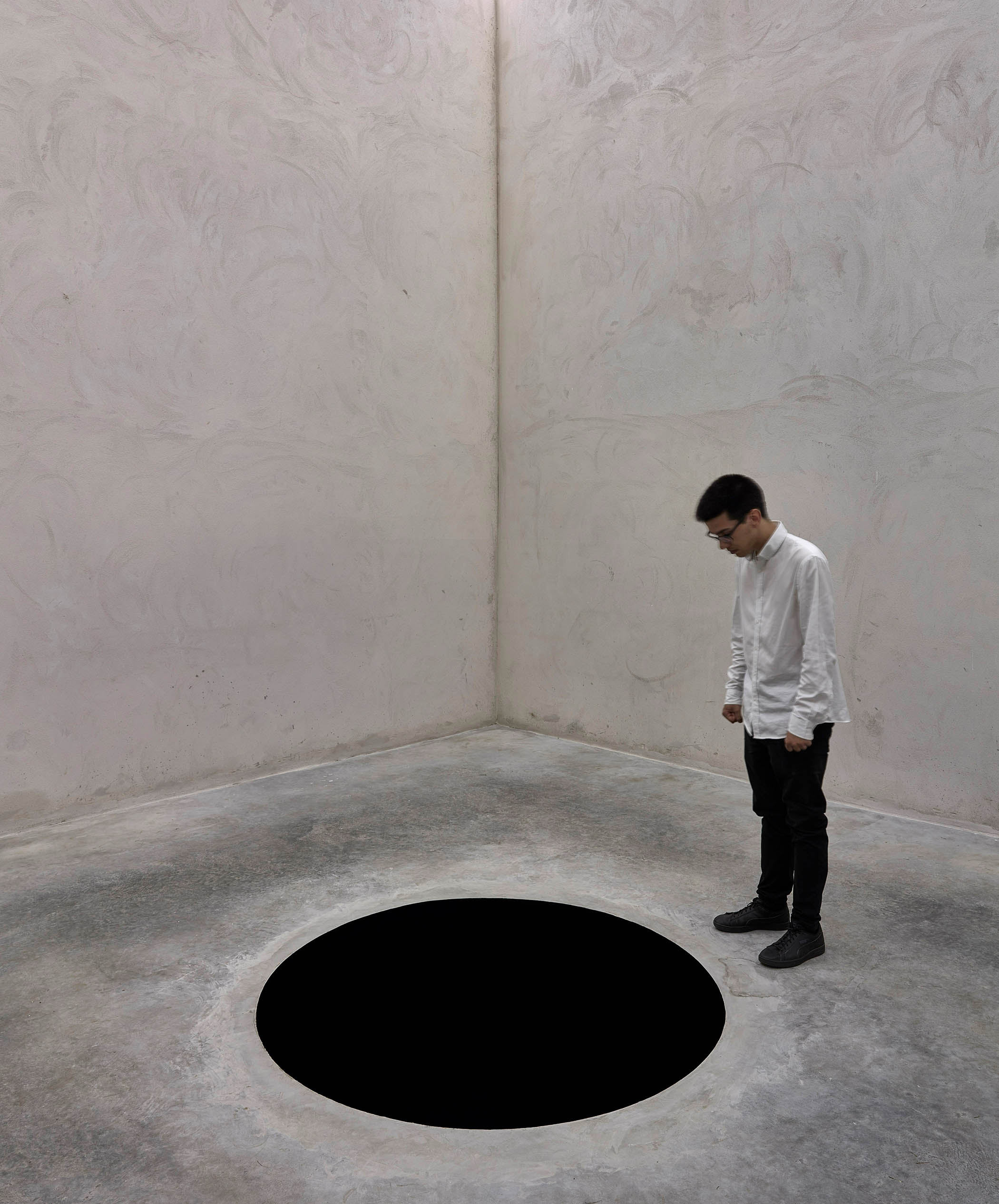
Descent into Limbo, 1992.
The worst works in this show are the innards unbound: vast writhing forms invoking inflamed intestines, gargantuan gallbladders, guts and organs bleeding out. The method is as with the bagged variety, but this time the viscera are heaped on something like abattoir floors, with channels for the blood to run off, which of course it cannot. This grand guignol, with all its careful casting and its controlled brushstrokes, is peculiarly inert. Any chance of an idea or a metaphor – let alone the powerful connotations of the titles, Ritual Expiation I, II and III – is conclusively stymied.
Anish Kapoor is himself so eloquent (increasingly more than his art) that there is always a quotation somewhere in a wall text to reinflate his ideas. The latest work in the Hayward exhibition fills an entire gallery with a massive red landscape of rocky terrain and rising paths, recalling the sandstone monolith Uluru, in central Australia, “the most religious place I have ever been to”. The colour is spellbinding. “I try to make a condition of colour, not a painted surface,” is Kapoor’s perfect account of the effect, “in such a way that its redness occupies the whole space of your vision.”
Kapoor’s sincerity is not in doubt, with this work, but once again it affects the eyes above all else. Look, look! Everything depends upon optical sensations; this is a show of art, after all, but all this intensity never quite resolves into profundity. There may be visitors who find the divine in those spacey holes and in this winding red landscape – careful, warns a notice, not to get the pigment on your clothes – but what do you get at the top of this gallery-filling installation with its crags and dips and mounting paths but a great big doorway-shaped void? Another Anish Kapoor!
Anish Kapoor is at the Hayward Gallery, London, until 18 October
Photographs by Attilio Maranzano, Filipe Braga ©Anish Kapoor. All rights reserved, DACS, 2026
Newsletters
Choose the newsletters you want to receive
View more
For information about how The Observer protects your data, read our Privacy Policy