
Wagner collared the term “total work of art” to describe opera, especially his own. The South African artist William Kentridge, 71, comparably protean in his own aesthetic world, has a more gutsy definition: “a drowning excess” in which we are confronted by music, text, set, historical setting. Brain and senses are overwhelmed; we take in what we can.
That thought was uppermost during Kentridge’s multilayered new staging of L’Orfeo (1607) for Glyndebourne, a co-production with Greek National Opera and the New York Metropolitan Opera. This is the first time Monteverdi’s favola in musica – story in music – has been staged at the East Sussex festival. The Orchestra of the Age of Enlightenment (OAE), conducted by Jonathan Cohen, was in the pit, as accomplished exponents of this score as any.
Glyndebourne has a distinguished record of working with visual artists. In most cases this relationship has focused on the programme cover, or sculpture in the grounds (Howard Hodgkin, Anish Kapoor, Grayson Perry, Chris Ofili and others). The exception is David Hockney, whose crisp, picture-book designs for Stravinsky’s The Rake’s Progress were first seen in the old theatre in 1975 and are still in use. It was fitting, a quiet passing of a baton, that a new relationship with a world-class artist should begin days after Hockney died.
Just as his Rake doubtless maddened as much as it delighted when first seen, so Kentridge’s L’Orfeo will split responses. Does the visual ingenuity, so rich, bold, confrontational and obsessive, serve the music? Or does it interpose itself too vigorously and create a discrete work of art by Kentridge? The answer is both. My discontented neighbour had to listen with their eyes shut. At the curtain, with Kentridge fans out in force, the cheers rang out, but enthusiasm for the musicians was if anything louder.
It’s as if Kentridge is driven to represent on stage every flickering response in his head in unstoppable homage
It’s as if Kentridge is driven to represent on stage every flickering response in his head in unstoppable homage
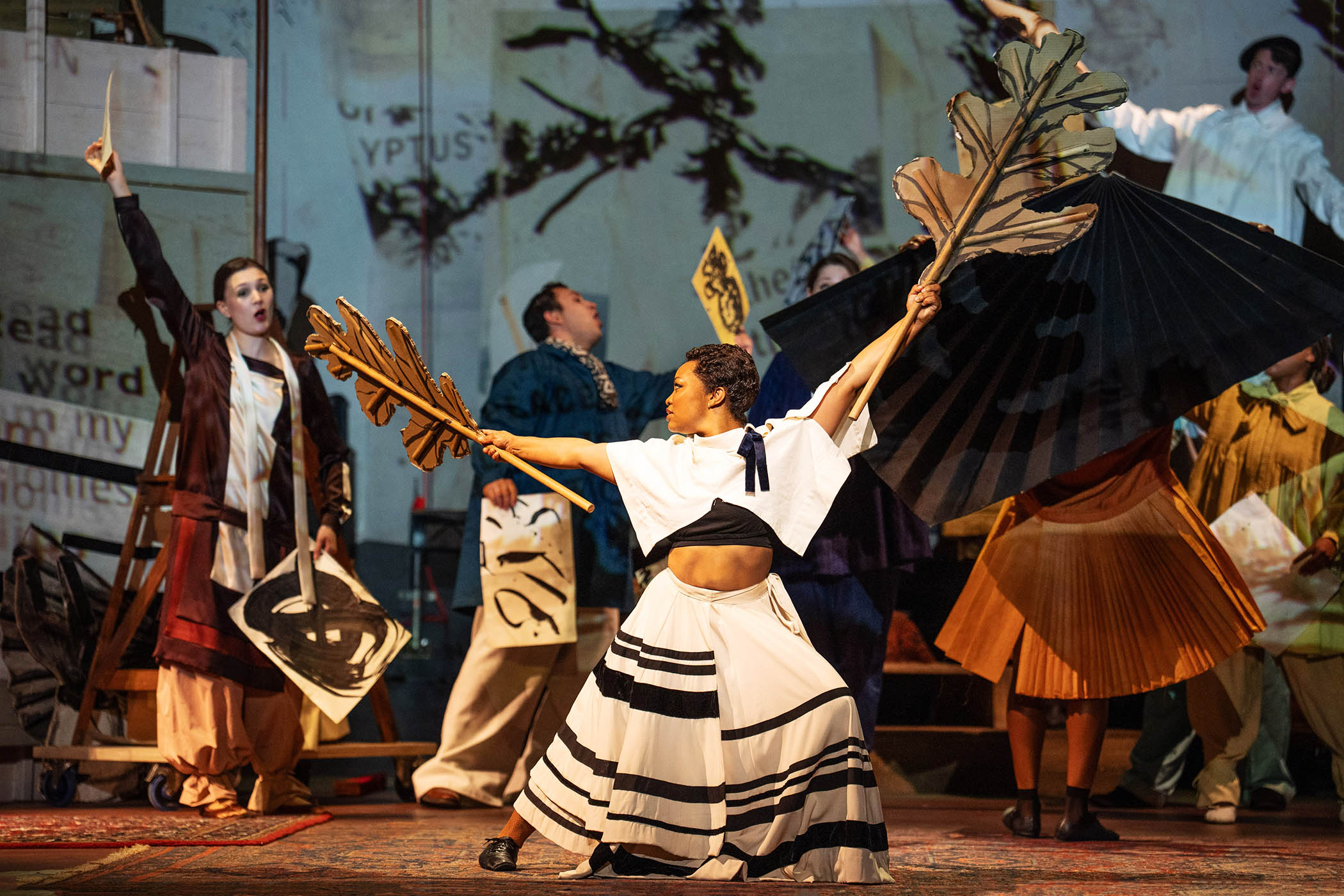
This artist was never likely to settle for a supporting role. Instead, he engages, full throttle, with Monteverdi’s masterpiece. It’s as if Kentridge is driven to represent on stage every flickering response in his head in unstoppable homage, aided by his regular team of set designer Sabine Theunissen, costumes Greta Goiris, lighting Urs Schönebaum, video Janus Fouché. His hallmark layering, whether visual, chronological or psychological, is key.
We travel between early 17th-century Italy, where the pioneering Monteverdi in effect established operatic form, to 20th-century Switzerland, where, in 1923, the poet Rainer Maria Rilke published his 55 Orpheus sonnets. Why Rilke? Because his version of the story of the musician who tried to rescue his lost lover from the underworld has long intrigued Kentridge and gave him a framework.
The setting is a crowded Bauhaus studio with a disparate arty community – the well-drilled chorus – hanging out. A backdrop in perpetual motion traverses bleak industrial landscapes, pastoral abundance, leafless decay. Orpheus is, loosely, Rilke in jacket and tie, straw hat tipped on the back of his head (not a good look). La Musica/Euridice is Rilke’s artist wife.
Both Krystian Adam, the Polish tenor singing the title role, and Francesca Aspromonte, the Italian soprano as the prime mover, La Musica/Euridice, are experienced in these parts and it showed. Euridice, though, has only a few lines to sing. Here she is also portrayed as a dancer (Roseline Wilkens) who variously morphs into a charcoal drawing, or sits, unreachable, inside an illusory mirror.
The central moments – Euridice’s death, Orfeo’s backward look on entry to the underworld – were effectively directed, but the orchestration colours the mood and, with keen and meticulous detail, defines the harmony for the singers. You always know whether you’re in the fields of Thrace or in Hades. The wheezing snarl of the “regal”, a type of reed organ, is downright hellish. The OAE – like all baroque ensembles, but not quite the case with a modern orchestra – have to be versatile in adapting to different instruments.
This performance also makes use of the rarely played “lirone” (Emilia Benjamin) – invented by a pupil of Leonardo da Vinci in 1505 – in which three strings are bowed simultaneously, creating a soft halo of sound: ideal for lulling Caronte, keeper at the gates of hell, to sleep in Act III.
Newsletters
Choose the newsletters you want to receive
View more
For information about how The Observer protects your data, read our Privacy Policy
Two piccolo violins – tiny violins tuned higher – add brilliance, but there is another reason for that brightness of sound: the orchestra is tuned to “Venetian pitch”, nearly a semitone above what we now regard as normal. That seems to intensify the impassioned, vibrato-free clarity of the Messenger, sung by the Australian mezzo-soprano Xenia Puskarz Thomas. Other roles are deftly taken, with some luxury casting in cameos, such as the young German bass-baritone Florian Störtz as a shepherd.
We last see Euridice swirling and twirling, skirts billowing in the manner of Loie Fuller’s serpentine dance. Is she erotically embracing the snake that killed her with its bite? And does Orpheus truly want her back or is he more interested in her as a muse for his art? Mythology has limitless meanings. This production, in all its irrepressible and wild extravagance, asks us to think again about this ancient story.
Those who craved less would have welcomed the semi-staging of Debussy’s Pelléas et Mélisande, which opened the 77th Aldeburgh festival. The director was Rory Kinnear – a coup for the festival, before he gets caught up in James Graham’s new play, The Standard of Living, just announced. The forest was the orchestra itself: the BBC Scottish Symphony Orchestra conducted by Ryan Wigglesworth.
They gave a spellbinding performance, as raw and shocking as this work should be, of an opera revered by composers – and by the rest of us too. Singers came and went through the throng of players, at times singing from their midst. Props were minimal. Maeterlinck’s symbolist play on which the opera is based may refer to “water”, “tower”, “castle”, but who knows where we are or who anyone really is. No surprise to find that Samuel Beckett learned from Maeterlinck.
Sophie Bevan’s properly repressed and tender Mélisande, Jacques Imbrailo’s impulsive Pelléas, and Gordon Bintner’s assured, terrifying Golaud led an excellent cast. Sarah Connolly was in fine voice as Geneviève, Nicolas Testé compassionate and world-weary as Arkel, Beth Sterling touching as the alarmed and put-upon child Yniold.
Two of the young singers in small roles, Fabian-Jakob Balkhausen (Doctor) and David Kennedy (Shepherd), had earlier in the day taken part in a masterclass with the international superstar soprano Lise Davidsen (another Aldeburgh coup). Her perception, gentleness and sense of humour gave immense insight, both into how a young singer can improve with a shift of vowel or longer breath, and into Davidsen’s own mighty powers as a performer.
The only thing lacking in this crammed week was a horse. Fortunately, one was to hand. Oliver Leith’s Garland, to a text by Charlie Fox, was reviewed here at its world premiere last year at Bold Tendencies. This “processional” work, for solo soprano (Patricia Auchterlonie), vocal consort (Exaudi), mixed choir and large ensemble, was given two further performances at Bold’s Peckham car park home (conductors Jack Sheen and Naomi Woo).
Last time the horse, which makes a serene clippety-clop appearance at the end, as well as the shopping trolleys, chinking bottles, melodious scaffolding poles and more, understandably stole attention. On a second hearing, the contours of the music came to the fore, strange and luminous. This confirmed Leith as a composer to follow closely.
L’Orfeo, Glyndebourne, East Sussex; until 25 July
Photograph by Richard Hubert Smith