First, you blow up the balloon. But you need to leave a certain amount of slack at the end – probably 3in, or thereabouts. The head needs roughly 2in. Twist to make the ears – 3in, each side. The neck: 1in. Then the legs: 3in. The body is about 4in, the back legs also. After all that, the pre-emptive slack should account for the tail – and you’ll have a balloon dog.
I know how to make a balloon dog because I didn’t believe that Jeff Koons could still actually make one from scratch. And the first chunk of our interview is spent listening to him meticulously laying out its measurements. To be fair, I was being cynical. Of course Koons knows how to make a balloon dog: in 2013, Christie’s sold his 12ft-high, orange stainless steel Balloon Dog for $58.4m to an anonymous telephone bidder. Balloons are sort of his thing. He can also make a swan, a rabbit, a flower and, as the Museum of Cycladic Art in Athens is eager to publicise, an enormous mirror-polished, balloon-inspired response to the Palaeolithic statuette known as the Venus of Lespugue.
The Observer has been invited to the Greek capital to witness its unveiling alongside an impressive collection of other prehistoric “Venus” statuettes – some of the oldest cultural artefacts in existence, depending on how you look at it. Humankind, archaeologists hypothesise, developed culture by anomalous biological mutation and, for some inescapable reason, that culture marched determinedly towards Jeff Koons.
In character, Koons is a bit like one of his sculptures; very clean and polished. I’m acutely aware that I’m eventually going to have to ask why he had dinner with Jeffrey Epstein in 2013 at the sex offender’s New York townhouse. As he speaks, Koons unconsciously spreads his hands flat on the surface of the table.
My Koons weekend had started three days before our interview, on Thursday night with a live Q&A, surrounded by Greek high society. This is the first time I’ve seen Koons in the flesh. He’s wearing a trademark suit, and I get a good view of his head, which extends from his shirt like that of a curious turtle, bearing the somewhat uncomfortable-looking smile of a scandalised politician.
“We’re so honoured,” the proceedings begin, “that Jeff Koons, one of the most famous artists of our time, is here tonight … Welcome, Jeff.”
The talk plays out strangely. Koons speaks slowly and methodically. In conversation with the museum’s scientific director, Prof Panagiotis Iosif, he expounds on diamonds, sperm, membranes (he often talks about membranes), balloons, animal intestines, meaning, Bob Hope, Raphael, multiple universes, and why he loves coming to Greece because of the islands, museums, food and mythology. All the while, a slideshow rotates behind him with pictures of artefacts that look invariably like dicks.
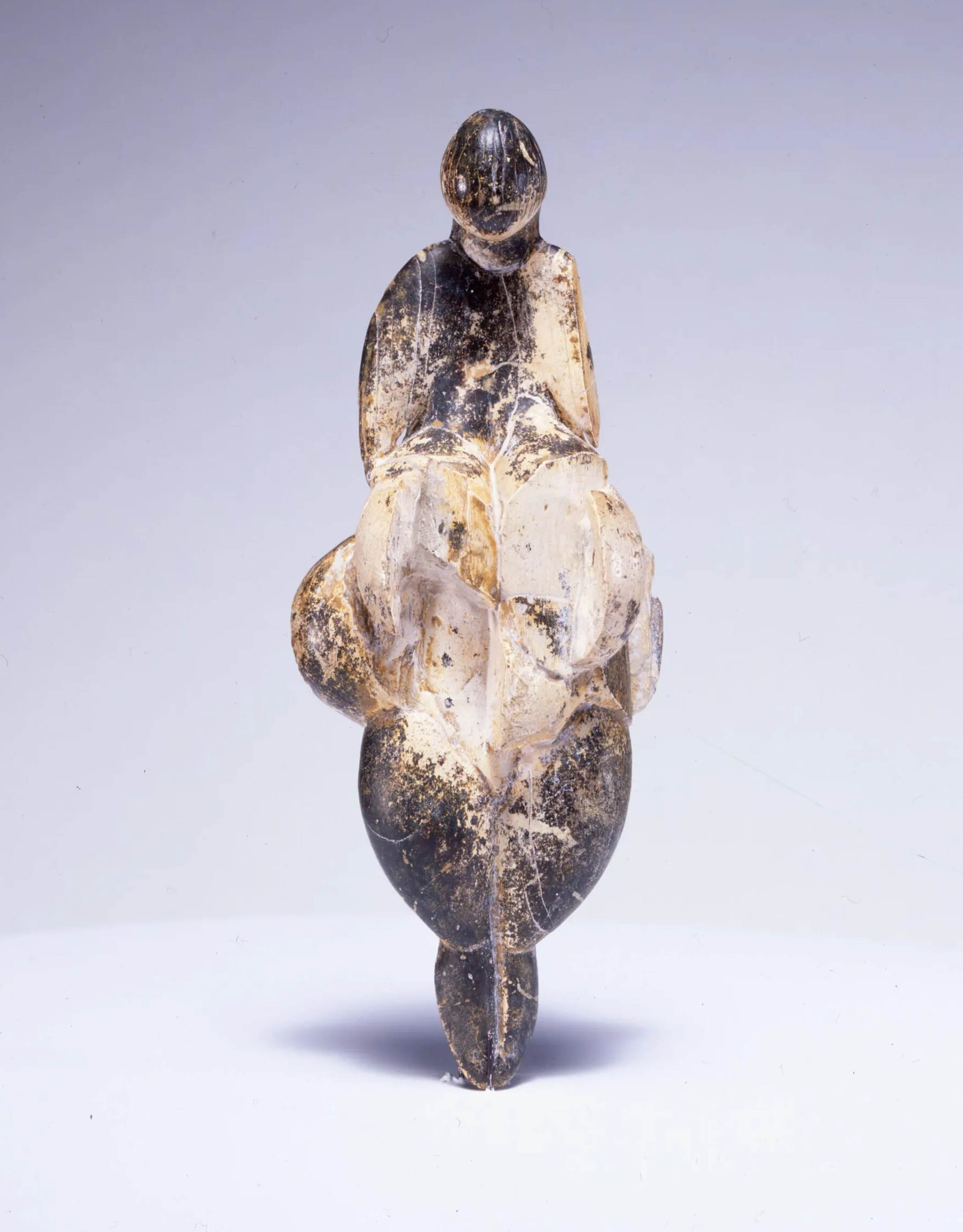
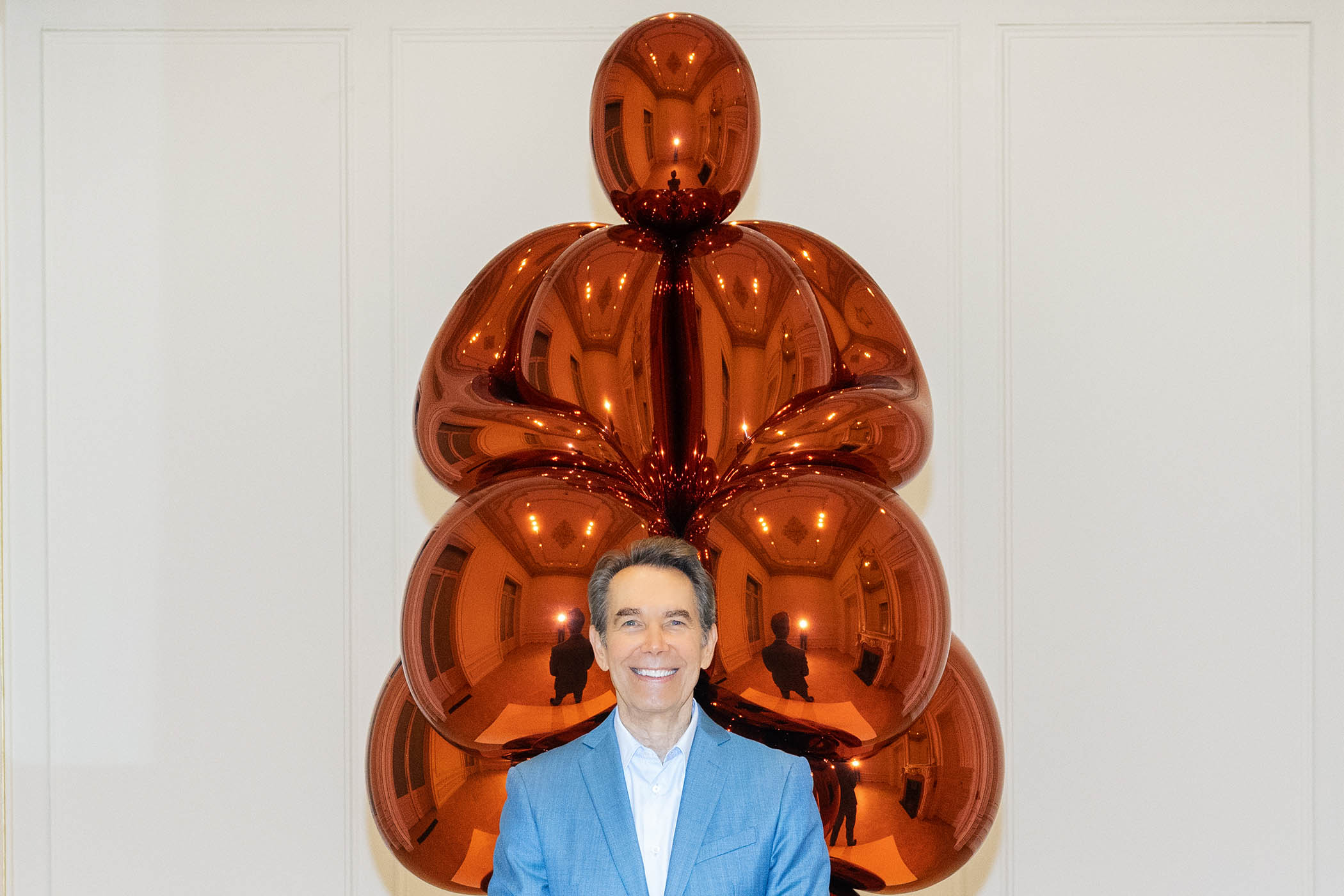
Main picture: Jeff Koons in Athens with his Balloon Venus Lespugue (Orange) and, above, the original, from circa 23,000BC
Having explained his work countless times over the years, Koons has come out with some interesting quotes. He once said: “If I think of the word beauty, I think of the word vagina … or ... the ass.” This was in response to his 1989 Made in Heaven series, which featured large staged photographs of him penetrating his then wife Ilona Staller – better known by her pornographic film star name, Cicciolina. Two years ago, he made history by installing what is reportedly the “first authorised artwork” on the surface of the moon. The work was made up of 125 miniature moons, each with their own corresponding NFT (non-fungible token). Koons explained the work in a video by saying: “I wanted to bring meaning to the dialogue.” Exactly which dialogue he’s referring to is unclear.
Not everyone likes Koons. Famously, the late critic Robert Hughes compared him to “a blow-dried Baptist selling swamp acres in Florida”, an emblem of “America’s singularly depraved culture”. For Hughes, as for others, Koons embodies the excessive rise of the art market since the 1980s. “Over the last 25 years,” an aged Hughes explained in 2004, “I’ve been amazed at the rise in prices and the sheer volume of the art market … This alienation of the work from the common viewer is actually a form of spiritual vandalism, a cultural obscenity.”
Hughes died the year before Koons managed to break the world auction record for a living artist with Balloon Dog, a record he broke again in 2019, flipping his 1986 stainless steel rabbit sculpture (titled Rabbit) for $91.1m. Koons has said that Rabbit symbolises the playboy, fantasy, resurrection, the orator, a politician and, somewhat confusingly, a “masturbator, with a carrot to the mouth”. The buyer turned out to be Steve Cohen, the billionaire hedge fund manager who owns the New York Mets baseball team. In 2013, Cohen’s hedge fund agreed to pay $1.8bn in fines for insider trading.
Newsletters
Choose the newsletters you want to receive
View more
For information about how The Observer protects your data, read our Privacy Policy
Koons, who funded his artistic origins as a commodities broker on Wall Street, is often asked about money. On Friday, the museum throws a press conference for the Greek media. “Your art is often considered to be a kind of investment,” says one journalist to Koons, in a rare departure from softball flattery. “How do you respond to this criticism that often arises that your art is measured more in financial terms?”
Before Koons can answer, the museum’s art adviser, Aphrodite Gonou, jumps in to defend him, inferring that the question should instead be directed towards the “people who actually acquire the work”.
Fortunately, one such person pops up on the front row. “If I could answer, as a collector,” says Antonio Phokion Potamianos-Homem, treasurer of the Mantua-based Sonnabend Collection. “It’s wonderful that Jeff is able to fund high prices, and that obviously helps generate an art market. But that’s not a new phenomenon ... You should go to Scuola [di Grande] San Rocco [in Venice] and have a discussion about Tintoretto and the ownership of that space ... So art and money are invariably linked, but the appreciation of art should be independent of the money.” At that, Potamianos-Homem receives a hearty round of applause.
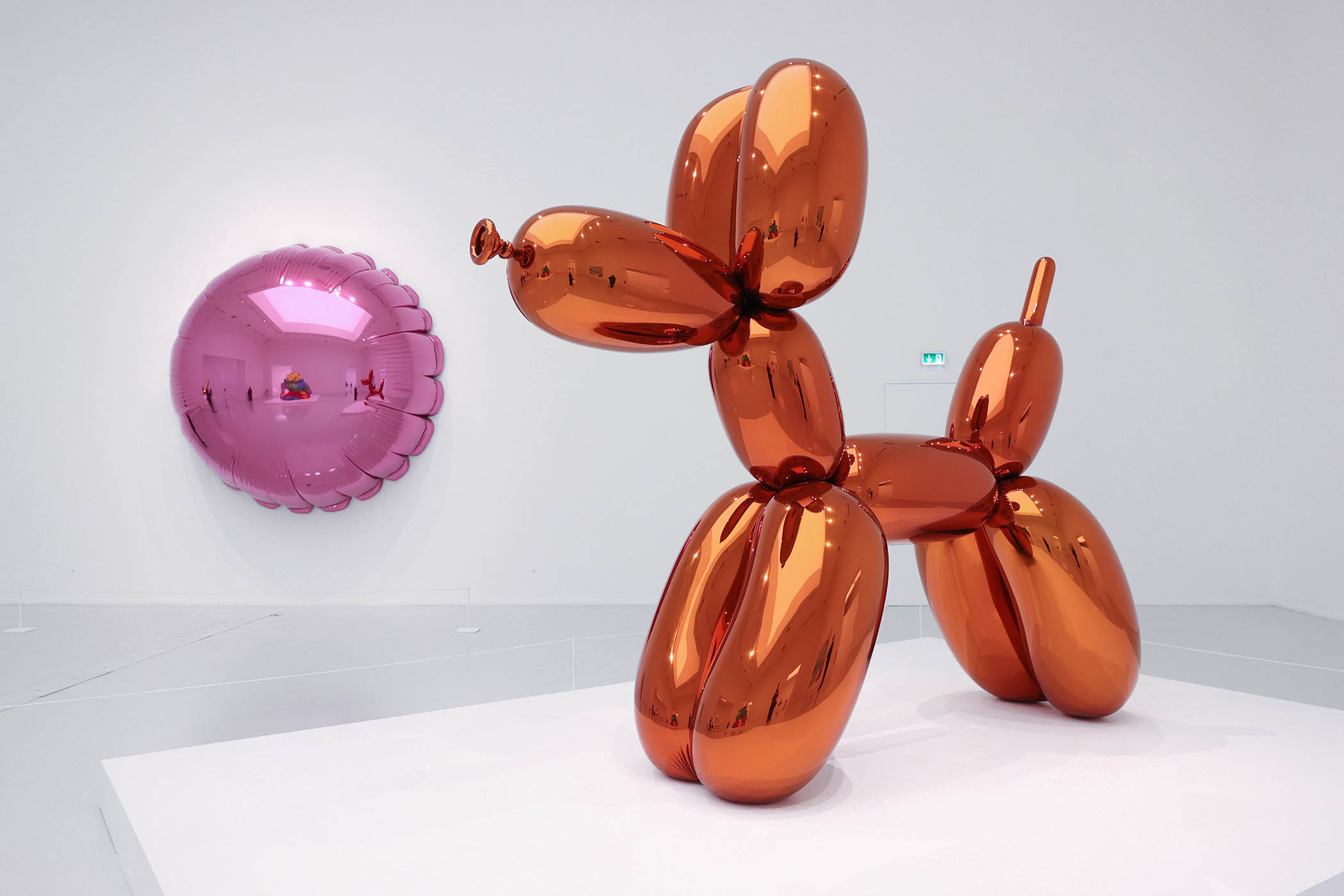
Jeff Koons’s Balloon Dog (Orange), pictured here at a 2021 exhibition in Doha, sold for $58.4m in 2013
After the press conference, Koons shakes hands with people. Koons has shaken hands with lots of people during his career. I watch him interact, his smile rising, fading, rising again. The critic Matthew Collings once described his “pleasant cartoon-like face” as “part classic American handsome, part Mad magazine”. On his way out, Koons wanders towards me and I ask him how he’s finding Athens, and we shake hands too, and he mumbles something forgettable about his hotel. Then he’s gone.
Later that night, the museum is packed out for the launch party. I’m told that Kimberly Guilfoyle, the US ambassador to Greece, who was once engaged to Donald Trump Jr, was rumoured to have been invited but she hasn’t turned up. There’s a DJ upstairs and Koons-style mirrored blocks with canapes laid on top of them. As the evening continues, the mirrored blocks become stained with smears of cheese and flakes of chocolate. Koons makes a brief appearance to greet people and have his photo taken in front of his work.
When he leaves, the exhibition space empties out and I’m standing alone in front of his big orange balloon Venus, looking at multiple reflections of myself in the folds of its voluptuous convex body. Archaeologists are still unsure which way up the Venus of Lespugue is supposed to be, but Koons has given his artistic response a definitive head and added an orifice between its thighs.
The work does have a certain heft. I orbit around it and see myself drowning in polished orange, reflected in both arse cheeks simultaneously. I’m reminded of a poem by John Ashbery, Self-Portrait in a Convex Mirror, a response to a painting of the same name by the Italian mannerist Parmigianino. The poem discusses dreams, and how they fill us up with empty space where our ambitions were supposed to be. It reads: “Fed by our dreams, so inconsequential until one day / We notice the hole they left.” Suddenly, I feel quite sad, so I leave to down what turns out to be an irresponsible amount of alcohol in a bar around the corner. This does not cure the sadness.
Koons is keen to start early, so I arrive early, but the interview doesn’t begin early, so I sit in front of his Venus for a good half an hour, feeling the guilt of my hangover and thinking about what I’m going to ask. I want to ask him if this is all an act, this Warholian persona – could it actually be real? Or are there two Koonses, two Jeffs? The Venus gives nothing away; she is tranquil in her daydreams.
“Well, there’s only one of me,” Koons says when I finally get to ask. “I try to be as generous as possible with my understanding of why I’m doing what I’m doing. One of the things I’ve found in life is that what people find the most shocking is honesty.” Koons says people often accuse him of performing some sort of gag.
What’s the gag, though?
“The belief system that I have,” he answers. “How could I love the concept of beauty in simple things? How could I love a little chachka? And find beauty in it? I find extreme beauty in it.”
I orbit myself around the Venus, drowning in polished orange, reflected in both arse cheeks
I orbit myself around the Venus, drowning in polished orange, reflected in both arse cheeks
The word chachka derives from the Yiddish “tshatshke”, meaning trinket – what we might, nowadays, call kitsch. The theorist Walter Benjamin was relatively kind to the concept of kitsch, which his modernist contemporaries such as Theodor Adorno and Clement Greenberg all seemed to despise. In his 1925 essay Traumkitsch (or Dream Kitsch), Benjamin conceived of a new kind of human; one whose inner life is completely suffused by mass-produced consumerism in an age where children no longer clasp objects but snatch at them. Benjamin calls this new human subject, “the furnished man”.
Koons realised his own artistry in his father’s furniture shop in York, Pennsylvania. I wonder if he ever really left; he speaks about art in slightly stilted, flamboyant terms of an interior designer, or someone showing off their loft conversion – things are often “fantastic” and “tremendous”. Koons dislikes the term kitsch outright. But the term is so often used in conjunction with his work, I ask him to define it. “Erm, kitsch is a word,” he begins, “and it’s a discriminating word. So I really don’t like the word … It’s a derogatory term that’s used for the benefit of hierarchy.”
It’s strange to hear Koons speak out against hierarchy, when he’s existed at the glitzy pinnacle of the art world for such a long time, employing dozens of assistants, many of whom, according to the Artnet website, his studio laid off in 2019 without explanation or severance pay “beyond their last day’s wages”. Koons says he now employs about 50 people and wants his studio to be smaller: “Because I want freedom.”
I ask him why so many people ask him about money. Koons fires the question back at me. So I tell him it’s probably due to his history on Wall Street and that he twice broke the sale value record for a living artist at auction. “I think,” he responds, “that the art world expanded so rapidly. And people don’t feel comfortable talking about art because they feel as though there’s something they’re supposed to know about art.”
But has this stratospheric rise in the art market been good for art production?
“Overall, it’s fantastic,” he says. “If you look at the history of art, it has always been supported … maybe by an emperor, or by principalities, by the church – somebody’s always supporting it. Artists have always needed that support to be able to make the things, to have the materials … My generation just wanted to participate … It was fantastic that we were able to not have second jobs and to be able to do the things that we’ve been able to do, but our motivation was never about the money.”
I want to know if there’s anyone he wouldn’t let his art be sold to. He tells me he’d have to consider whether that person “aligns politically”, or if there’s sanctions placed on them. Koons is “sure” that people who are under sanction have tried to buy his work in the past, “but I have galleries and people that would handle something like that”. Koons sidesteps my question as to whether he’d want a balloon dog in Trump Tower, telling me: “The balloon dogs have already been placed.” I follow up with whether he’d give the White House one if it wanted it, but Koons doesn’t want to get into politics.
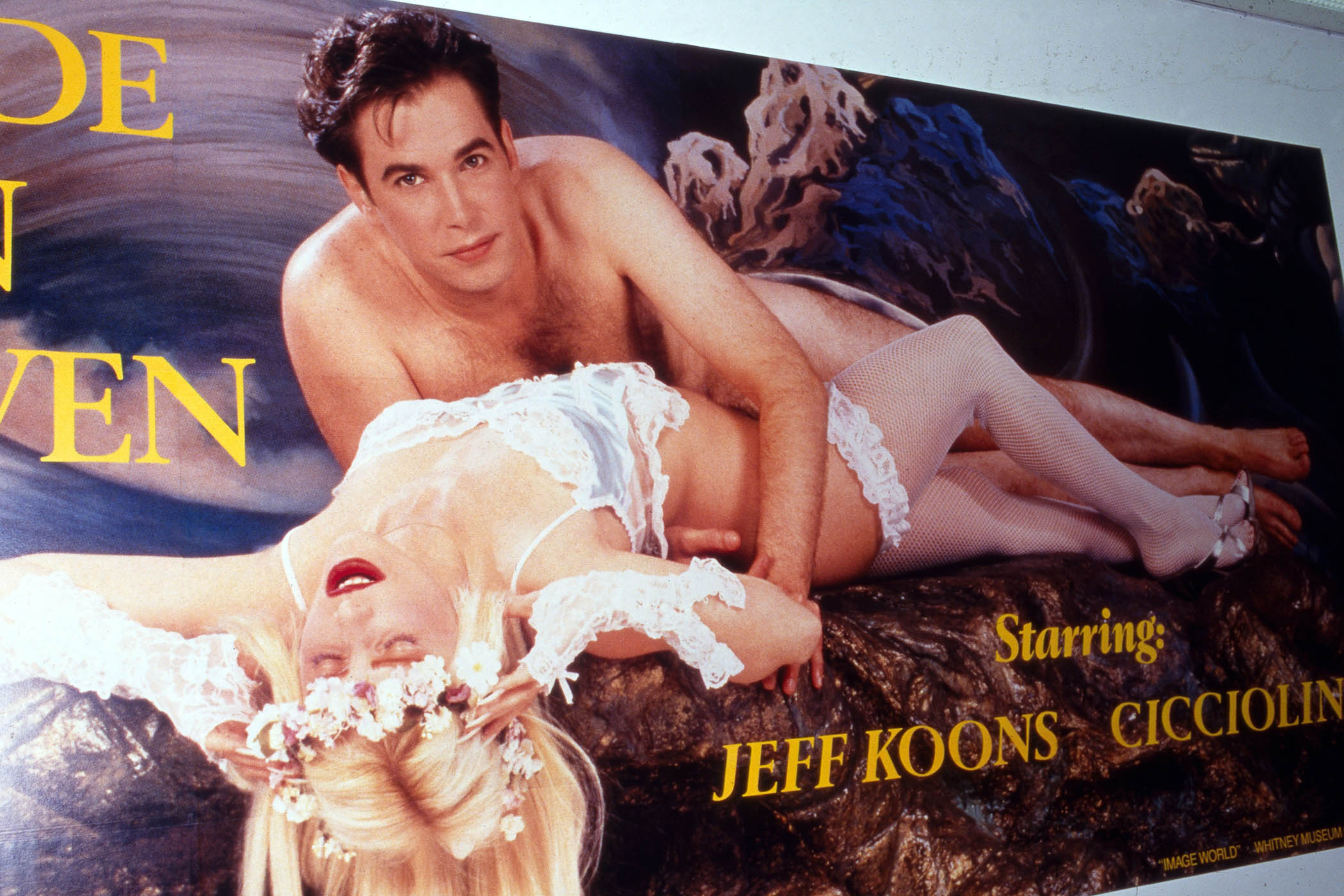
An advert for Koons’s Made In Heaven film from 1990, featuring his then wife Cicciolina
These are some of the many things Koons doesn’t want to tell me. He doesn’t want to tell me about his dreams. Nor does he want to tell me whether he still speaks to his ex-wife, who left the US with his son, Ludwig, leading to a lengthy custody dispute. Ludwig, now in his 30s, is living in New York and the pair communicate often, Koons says; Ludwig has even launched his own NFT project, “Koonimals”, which you can buy using the ethereum cryptocurrency. Nevertheless, the custody dispute prompted the artist to co-found the Koons Family Institute, a subsidiary of the International Centre for Missing and Exploited Children; a fact that doesn’t set him up well for the next – and, I’m already guessing, final – thing he doesn’t want to tell me about: his dinner with Jeffrey Epstein.
“If anybody has ever looked into that information, you can understand the irrelevance of that question,” he says back to me, maintaining scrupulous eye contact.
The information is this. According to emails released by the US Department of Justice, on the 4 September 2013, Koons emailed Epstein’s personal assistant, responding to a dinner party invitation confirming, “... yes Justine [Koons’s second wife] and I are coming tonight”. This was five years after Epstein had pleaded guilty to charges that included soliciting prostitution from a minor. According to earlier emails from Epstein’s assistant regarding the dinner, Woody Allen was also invited, as well as someone referred to as “this girl”, whose name is redacted.
Responding to reporting by the online art magazine Hyperallergic at the time this information came to light, Koons made a statement via his gallery, that “beyond attending the dinner”, he “did not have a relationship with Epstein”. His in-person response is just as vague. “You know,” he says, “I’m an urban person. I meet a lot of people, I interact. So there’s nothing I have to say about that.”
However, according to earlier reports from the Wall Street Journal, Allen and Epstein planned to visit Koons’s studio that same year. A subsequent message to Epstein from a redacted contact in 2014 references such a visit. “Rudy Ovchinnikova is back in town!” it reads. “Going to her bday tonight! Remember she came with us to Jeff Koons studio?”
When I push back, he tells me again that he has nothing to say, then he continues unprompted. “I’ll just say one thing … Everybody thinks that they know or knew who this person was. I did not know who this person was … Only some inner circle from Palm Beach or [elsewhere] really knew who this person was.”
After that, the interview all goes a bit stony and museum art adviser Gonou wraps things up with conviction. The press officer then comes in to ask brightly how it went and whether I’ll be staying for lunch; it seems I won’t and I retreat back to the hotel. At the time of writing, I still have my complementary silver Koons-branded tote bag. Though I can’t quite bring myself to wear it out.
Photographs by Paris Tavitian/ Museum of Cycladic Art, Cycladic Museum, Cindy Ord/Getty Images for Qatar Museums, Wolfgang Kuhn/United Archives via Getty Images