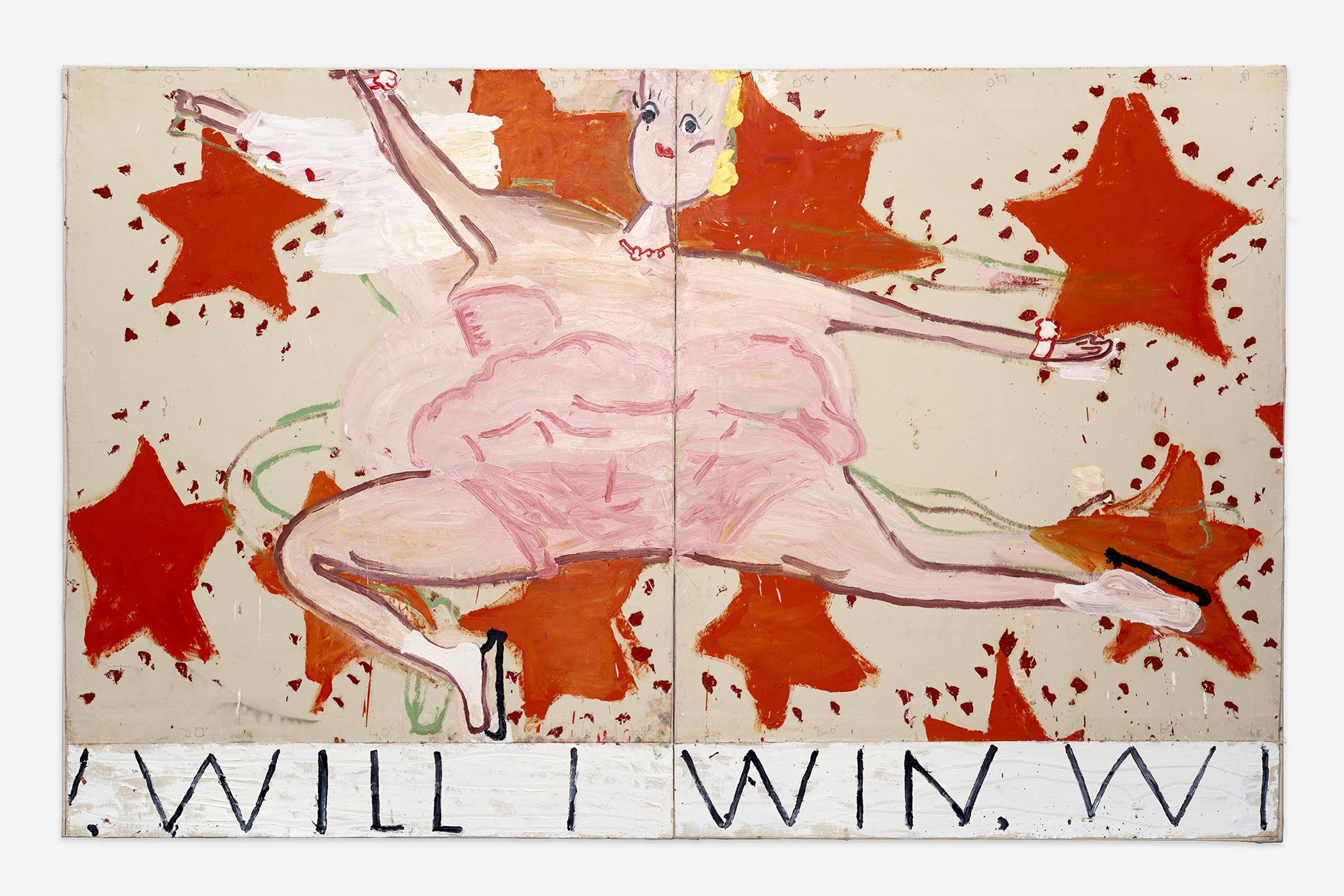
Rose Wylie is the first woman painter to have a solo show in the main galleries of the Royal Academy. It helps that her canvases are sometimes so enormous that it only takes about six to fill the grandest of these palatial spaces. Size matters in Wylie’s art. There are no small acts in these wilfully strange paintings.
The beak of a bird juts in from the right of a canvas, high above a rhyming triangle that points in the same direction. This is Wylie, the title suggests, in a pointy 1950s bra. She is so much smaller than the colossal beak as to imply a rapt fascination with the spectacle of this bird. Horizontal lines indicate that what was once a quick sketch on ruled paper is now immortalised at scale. The picture is irreducibly comic: two birds of wildly reversed sizes.
A wonky pantomime horse has all its bones and muscles meticulously labelled in a send-up of academic teaching traditions. The picture is called Irreverent Anatomy Drawing, like a burst of suppressed laughter at the back of the class. A player in a canary-yellow strip is shown in action on the field. He runs, he shoots, he scores: the sequence is played out on the canvas like escalating commentary. A footballer depicted like a cartoon memory: it could be last Saturday, or long ago.
Wylie, whose two art college stints – culminating at the Royal College of Art – were separated by almost 20 years while she raised children, will be 92 this autumn. She only became an RA at 80. All the works in this show suggest the perennial exhilaration of simply being alive with the gift of sight. Even the paintings in the opening rotunda, of doodle bugs falling over Blitz London, are lit up with wonder. In Hyde Park, dogs scatter at the violent noise and the young Wylie is right there among them.
These scenes appear as if painted by a child, the skies bright blue, the planes like big flapping birds. Except that a swastika is effortfully painted on one. And the date, 1944, is carefully numbered down the side in black paint as if by a schoolchild asked to show what happened.
This is how the planes might have looked to the 10-year-old Wylie and how she paints the memories still: down there with innocent eyes among the grass. Her paintings are prodigiously odd: ungainly, sudden in their gigantic closeups, unfiltered in their emphatic jubilation.
Great areas of canvas are empty, emphasising the abruptness of isolated memories. Words, numbers, dotted lines and diagrams reinforce the facts: this is my party dress, this is where we lived, here is Peter’s pet rat. The appearance of spontaneity is crucial, as if Wylie were here with us in the gallery, pointing it all out.
Why does she paint like this? The question irresistibly proposes itself with each new work. The motifs are always recognisable: elephant, bathing suit, duck, shoes, if not Nicole Kidman getting an award at Cannes, or Christopher Waltz in Quentin Tarantino’s Inglourious Basterds (Wylie is a fan). But the depictions are not remotely realistic. Something she once saw is reanimated on canvas. They are the visual equivalent of a child taking a doll for a pretend walk, in lively bumps, across the floor.
Each memory appears fused, moreover, with its original moment. A yellow omelette on a plate clearly made Wylie think of Van Gogh’s still lifes, so her picture marries elements of both. A nude sunbather has the pinkness of the goddess’s bare bottom in Velázquez’s Rokeby Venus. She coins strange new shapes: bulging profiles, square flowers, stretchy red stars. The paint is buttery, juicy, sometimes unmixed or gleefully laid on with her bare hands.
What’s great? A bird twitching on a bough, a hazel leaf backlit by the sun, a leaping frog. They are as awkward as they are joyous and bizarre. The Academy tries hard to solemnise these paintings into high art, but they shouldn’t have bothered. Some forms of humour just cannot be analysed.
Newsletters
Choose the newsletters you want to receive
View more
For information about how The Observer protects your data, read our Privacy Policy
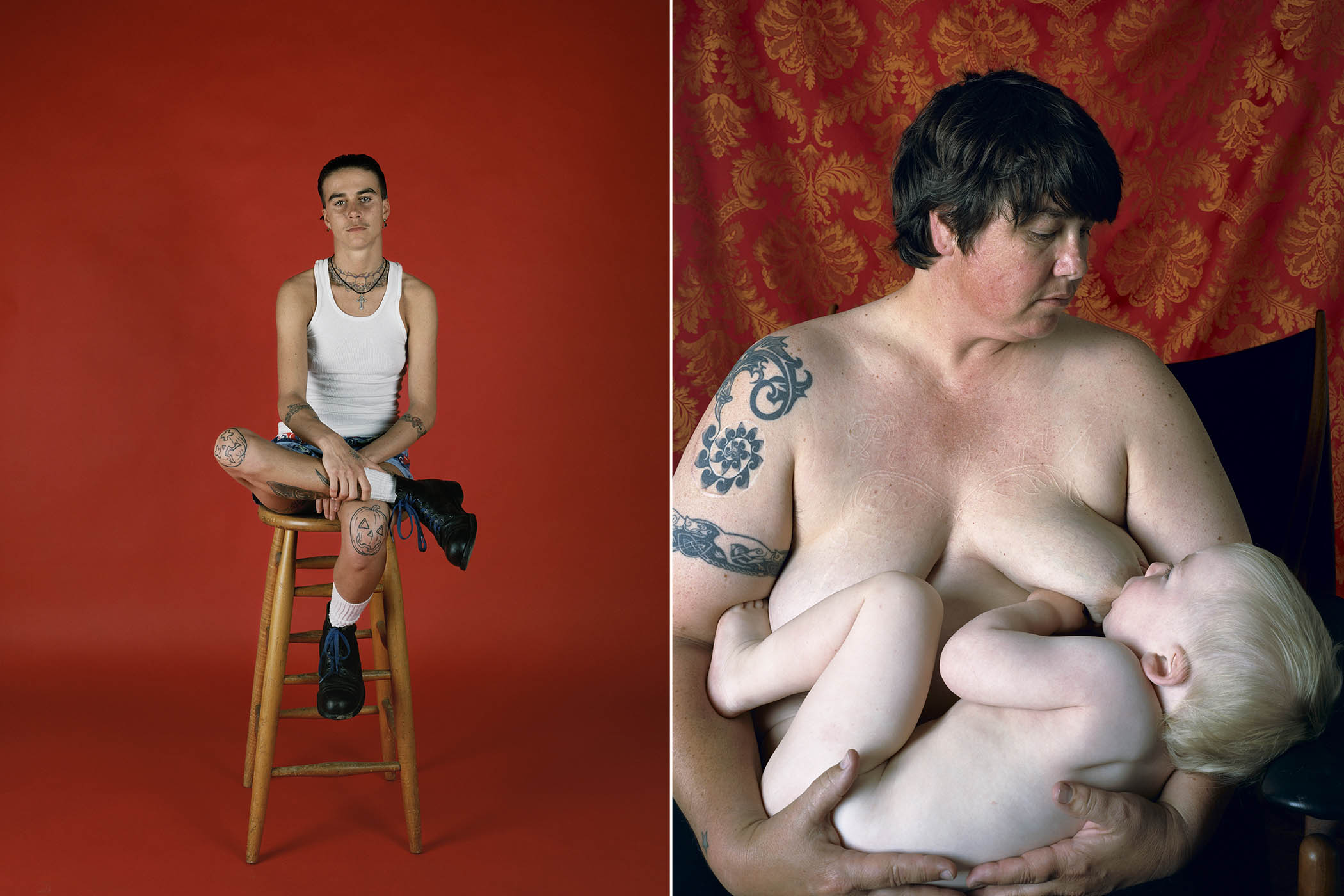
‘Colours have a chemical brilliance’: Left, Pig Pen shot in 1993; right, Catherine Opie’s self-portrait, nursing her son Oliver, 2004
Self-portraits by the renowned American photographer Catherine Opie show her tattooed and naked, breastfeeding her son Oliver. The scars of the word pervert are beginning to fade from her chest. She turns round and we see two stickwomen and a house cut into her back: the gay domesticity she longed for in 1993.
Butch, dyke, chapstick, femme: they are all here in Opie’s historic community of portraits. Lesbian households sharing children and sunny gardens. Big closeups of women with false moustaches, long before non-binary became a norm. Bisexual, pansexual and eventually transsexual Californians, all evenly lit against high-chrome backdrops. Some colours are borrowed from Holbein, to throw the figure forward; some have a chemical brilliance to take the sitter outside time, though they often seem in advance of it. Pig Pen, in white vest and black DMs, sitting with tattooed knees crossed on a high stool, is a figure from the London streets right now, though this much-collected photograph was taken in 1993.
Opie’s famous trait is that she pays attention, she listens. There are gentle shots of American football players dwarfed by shoulderpads, surfers scattered in a becalmed ocean, children looking back at her without pose or guile. Some sitters are known – fellow artist John Baldessari, Daniel Sea from the TV series The L Word – and some have become familiar through her work, notably Oliver, seen here in a pink tutu in 2004.
Subject outweighs style: in some cases you wouldn’t necessarily know that Opie was the artist. A new photograph of Elton John and his family is cheerful, if haphazardly composed. What strikes most in this show is the documentary photography of political protest, above all a shot of the Sigma Nu frat house at the University of Southern California in the aftermath of a rally. The facade is entirely covered with legible signs voicing outrage at the drugging and raping of girls in this building. It could be 40 years ago, but in fact it is 2021. The rapists are named. The picture keeps the record.
Rose Wylie: The Picture Comes First is at the Royal Academy, London, until 19 April. Catherine Opie: To Be Seen is at the National Portrait Gallery, London, until 31 May
Photographs courtesy of private collection/Jari Lager/© Catherine Opie. Courtesy the artist, Regen Projects, Los Angeles and Thomas Dane Gallery.