Marilyn Monroe turned 100 last week. Somewhere in the next world, JFK is singing happy birthday to Miss America in return. How can she still be dead, this incandescent star extinguished by an overdose at 36? It seems from the National Portrait Gallery’s stunning commemoration that Marilyn is not gone, after all, but alive and glowing in every picture.
Marilyn beaming, laughing, jumping for joy in scarlet against cobalt for the Latvia-born photographer Philippe Halsman. Marilyn leaning eagerly forward in a black polo neck for Alfred Eisenstaedt, German-Jewish refugee. Marilyn dancing along a beach at 20, spinning, skipping, pirouetting for her sometime lover, the Hungarian André de Dienes. Then, all over again, before her sudden death, for George Barris, the son of Romanian immigrants, who caught the truth of her by the Santa Monica tide, she said, freckles and all.
Straight away the show reveals a profound affinity between Monroe and her studio photographers. They are all refugees from some terrible past. She suffered childhood abandonment and abuse, lonely stints in an orphanage, endometriosis, addiction and depression. They were escaping hunger, prisons and camps.
Bruno Bernard, who first spotted her on Sunset Boulevard at the age of 19, was left in a German orphanage by parents who could not feed him. He fled the Nazis for California and began taking photographs when he couldn’t get work in the theatre. It might almost be her story too, starting out in photography but longing to become an actor. Her face was her fortune from the start.
‘She wanted people to feel they’d got their money’s worth when they saw a picture of hers.’ Which is the spirit of this show
‘She wanted people to feel they’d got their money’s worth when they saw a picture of hers.’ Which is the spirit of this show
The first image in this show is, in effect, a self-portrait: Marilyn in a photobooth, before the trademark blond hair and luminous skin, before the hyper-arching dark eyebrows, though not before the glossy lips. You cannot help studying her teenage face closely for presentiments. There is the joyously open smile, showing her perfect teeth, the beautiful width of the eyes, that will be exaggerated by liner and false lashes, the perfect regularity of her features. A hairdresser comes along to lighten, lower and curl the hair and in no time a star is born, moment by moment, in these pictures.
She made a photograph like nobody else, before or since. Even as a child, she knows how to lean, turn, sashay or stretch like a cat, how to throw one arm in the air, tilt her head at a questioning, enigmatic or enchanting angle. A poignant Bernard pin-up shows her sitting on top of a huge wooden drum, legs very nearly slipping down the side, but not quite: disciplined while putting on a brave smile.
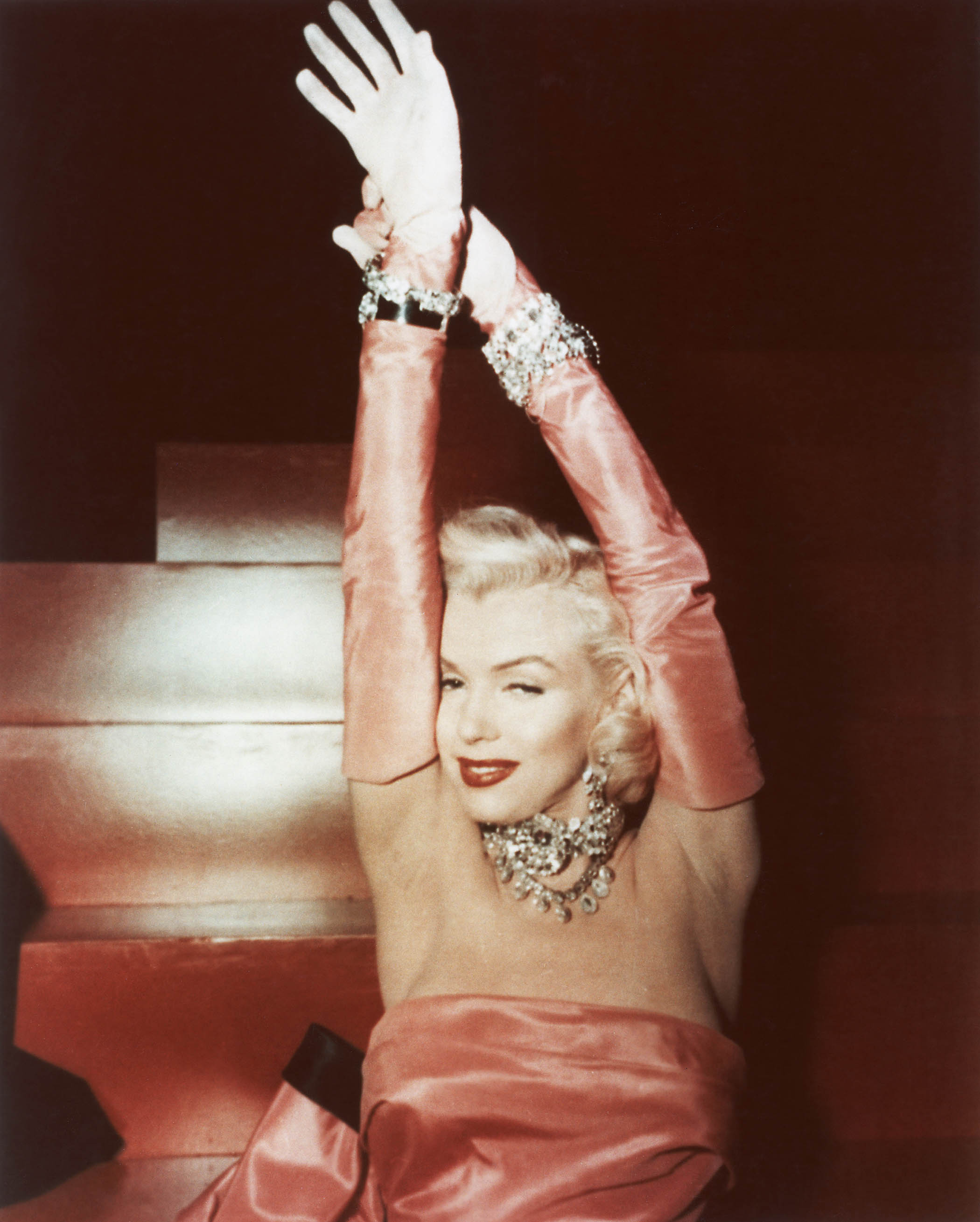
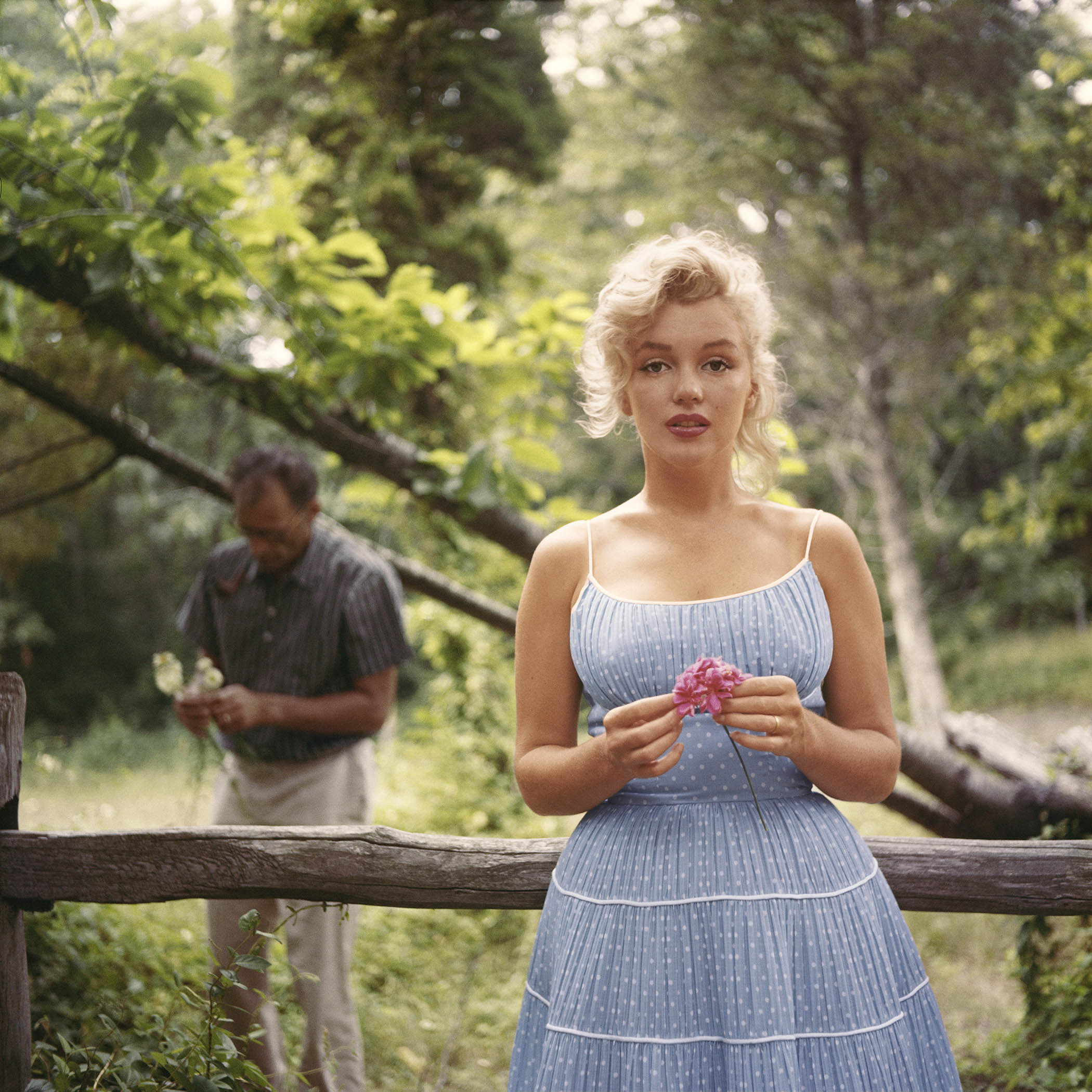
‘She made a photograph like nobody else, before or since’: Marilyn Monroe in a scene from 1953’s Gentlemen Prefer Blondes. Main image, photographed with Arthur Miller by Sam Shaw
Marilyn was acting for the camera long before she ever appeared on screen. She collaborates with each new photographer: more intellectual with Eve Arnold, more intimate with Cecil Beaton, more seductive with Sam Shaw. Dienes said she could perform every emotion, and you see it through this show: “Happiness, introspection, serenity, sadness, distress – I even asked her to show me ‘death’ and she threw a blanket over her head; that was how she interpreted it.”
You think you know her face but each new image overturns the last. Custom cannot stale her infinite variety. You see her finger-to-temple over a book; tensely concentrated in a morning headstand; laughing at some ogling juvenile lead. Glacially glamorous in furs or casually conversational in the back yard, she seems to raise every scene above its premise and to offer the exact opposite of Greta Garbo – an underground stream of joy without reserve.
That Monroe’s inner and outer life might not match is so well attested – too often by prurient biographers such as Norman Mailer and Anthony Summers – that it may seem as though every image in this show must be an act. If true, then how heroic. Monroe’s marriage to Arthur Miller in 1956 was doomed early on and Shaw’s photographs seem to prefigure the future. Miller doesn’t know how to be photographed at all. In every shot he is passive, sceptical, unimpressive, while she animates the moment – making the occasion, and the picture, worthwhile.
Miller, who left her during the filming of The Misfits, at least understood why this mattered. “She relied on the most ordinary layer of the audience, the working people, the guys in the bars, the housewives bedevilled by unpaid bills, the high school kids mystified by explanations they could not understand … She wanted them to feel they’d got their money’s worth when they saw a picture of hers.” Which is the true spirit of this show.
Newsletters
Choose the newsletters you want to receive
View more
For information about how The Observer protects your data, read our Privacy Policy
It wants the audience to see Marilyn’s heroism as well as her grief: her hilarious telegrams and wistful letters, judiciously quick film clips, painstaking interview notes and unfeasibly high Ferragamo heels. Here is the silver gown she wore in Gentlemen Prefer Blondes, so you can see how slender Marilyn really was, and here is her poor face corrupted by death, as memorialised by the painter Marlene Dumas, the hypostasis blue against swollen pallor.
Anything that isn’t her has to work hard for its place in this show. There are many tearful homages by pop painters such as Peter Blake and Pauline Boty, the latter dead in her 20s. There is Willem de Kooning’s awful 1954 portrait that incensed Miller and made Monroe look like a cock-eyed doll. Salvador Dalí’s Mao-Marilyn is a cheap hybrid of the world’s most mass-repro icons (c1972), made in conjunction, alas, with Halsman.
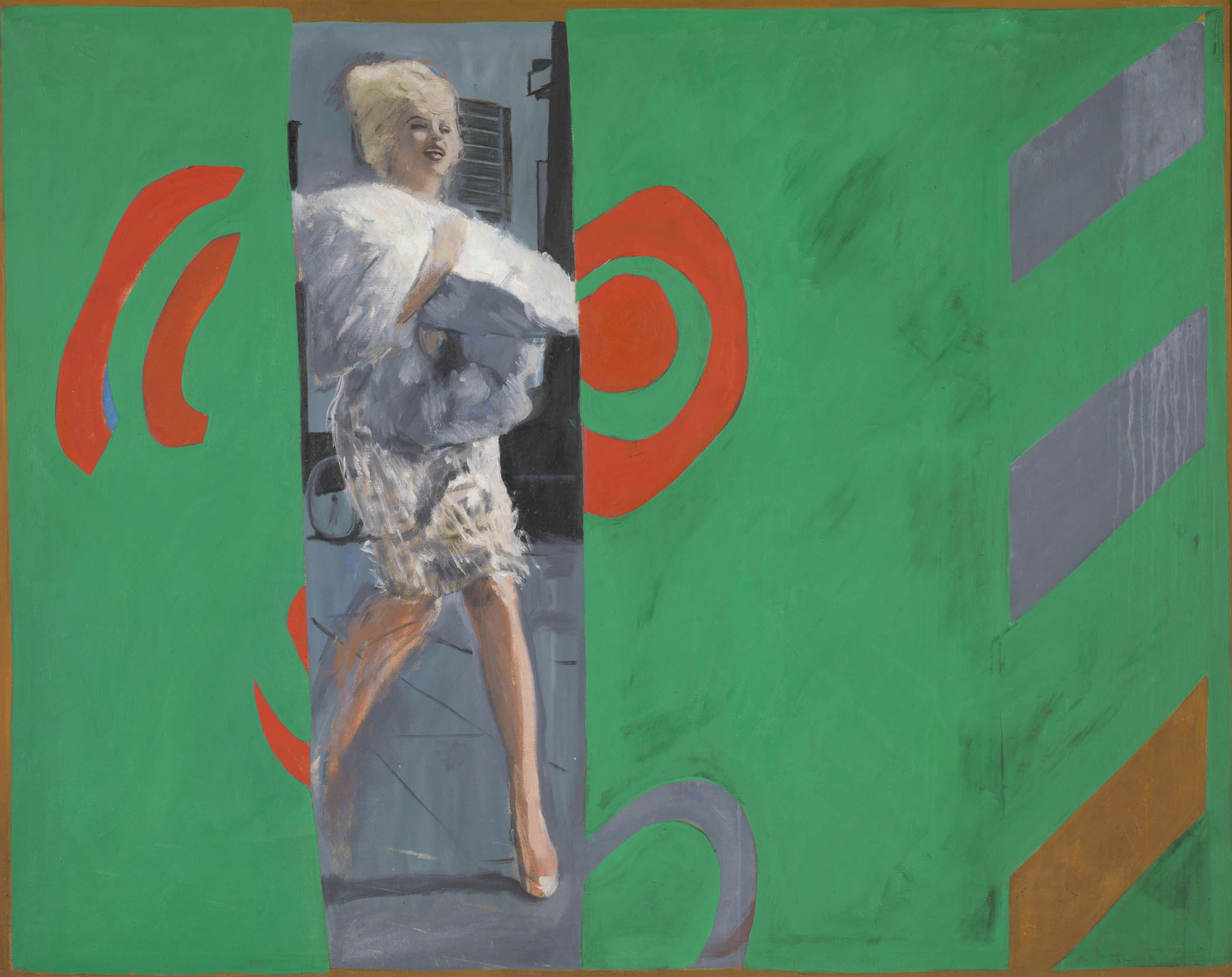
‘Anything that isn’t her has to work hard for its place in this show’: Pauline Boty’s The Only Blonde in the World, 1963
Plenty of photographers sold her out, though the most conceited is surely Richard Avedon, who kept on shooting as her face fell and thought he’d really “got her”. For hours she had danced, sung and performed Marilyn; surely she was just exhausted. Cartier-Bresson had it far better, with his small figure lost in a large room. “There’s something extremely alert and vivid in her, an intelligence … it’s a glance … that disappears quickly.” He compared her to an apparition in a fairytale.
Bert Stern’s final photographs for Vogue take the breath away. Most unforgettable is a portrait of Marilyn, pensive and oblique in a copious black dress, cinched at her narrow waist. It tells of such dignified resilience to come that all talk of suicide seems meaningless. And while the world woke to that shocking headline in August 1962 – photographs show people reacting all over the US – it still seems unclear what really happened, except for a fatally high combination of two different sleeping pills prescribed by a Hollywood doctor.
The arc of this riveting show is so perfectly conceived that nobody reaching the last galleries, where Monroe is fired from her final project, could fail to be intensely moved. She has for so long given her face to the world, and with such electrifying energy, that shots of her apparently asleep on the set invoke nothing but sympathy. “Please don’t make me a joke,” she begged her last journalist. “I don’t mind making jokes but I don’t want to look like one. I want to be an artist, an actress with integrity.”
That she could have been is apparent from the final images, taken by Allan Grant, and published in Life magazine on the eve of her death. She is quick with wit, balancing on the top of chairs, her dazzling face as sharp as her heels, talking of fickle fame and blowing a kiss to the bad times. Resurgent, trying it all again, performing one more role: whoever she was, Marilyn lives.
Marilyn Monroe: A Portrait is at National Portrait Gallery, London, until 6 September
Photographs by Shaw Family Archives, Hulton Archive/Getty Images, Tate