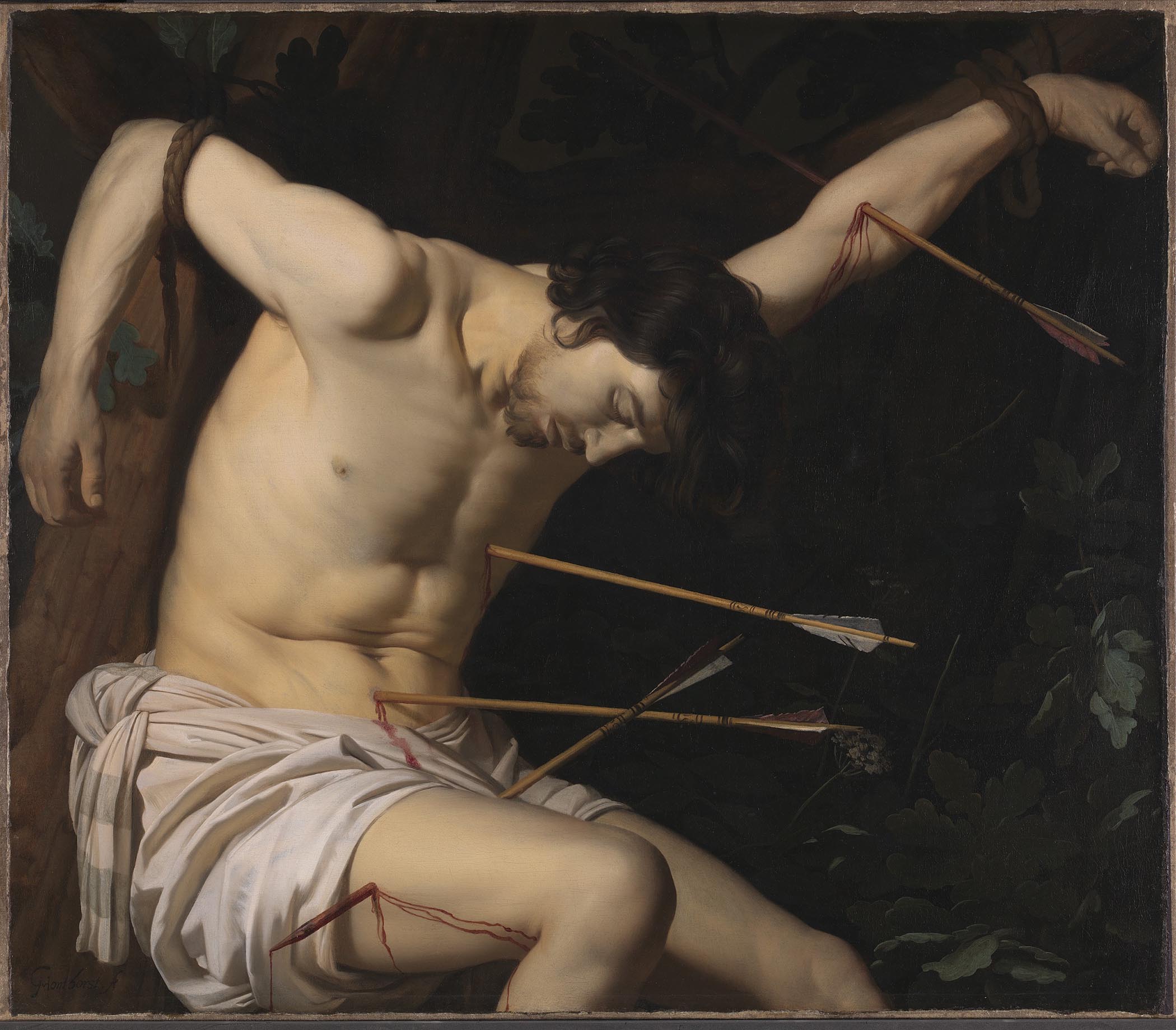

Sebastian of Milan is the third- century Roman soldier whose conversion to Christianity was punished with arrows. He is the beautiful youth familiar from so many painted martyrdoms. His pure white body, generally in low-slung loincloth, appears tied to a post and pierced with shafts – anywhere between two and a bristling 20 – while he raises his suffering eyes to heaven. To add an unthinkable insult to his injuries, Sebastian is patron saint of pin-makers and archers.
It is a curious truth that art rarely gives us his actual fate. For Sebastian withstood the arrows, somehow, and was nursed back to health by Saint Irene (the widow, not incidentally, of a third Roman saint). Baroque painters often show this scene: Sebastian laid out, nearly naked, as Irene delicately removes the shafts from his pale inner thigh. Recovered, Sebastian went to remonstrate with Emperor Diocletian (a stand-off imagined by Veronese in fresco in 1558) and was beaten to death, before being thrown in a sewer.
The ambiguous experience of seeing, or indeed probing, the wounds in Sebastian’s perfect flesh turned the saint – once worshipped as a protector against plague – into a homoerotic icon. Oscar Wilde used the pseudonym Sebastian after his exile. Derek Jarman’s 1976 film Sebastiane, its garrison of gay soldiers frequently filmed nude in the heat of Sardinia, their dialogue entirely in Latin, transformed Sebastian’s torture into a sadomasochistic ritual. The pacifist Christian who rejects the sexual advances of the garrison boss is penetrated by arrows instead. The film – or was it the saint? – became the emblem of bravery for a generation mown down by Aids.
Which is roughly where Ming Wong comes in. Born in Singapore in 1971, based in Berlin, Wong is the National Gallery’s latest artist in residence in a long line stretching back through Michael Landy, George Shaw and Alison Watt to Peter Blake and Paula Rego in the 1990s. Wong has looked hard at the 14 paintings of the arrowed saint in the National Gallery, from Crivelli to the brothers Pollaiuolo. But he is also a celebrated performer, who has played the male and female roles (like Alec Guinness in Kind Hearts and Coronets) in reinterpretations of famous films.
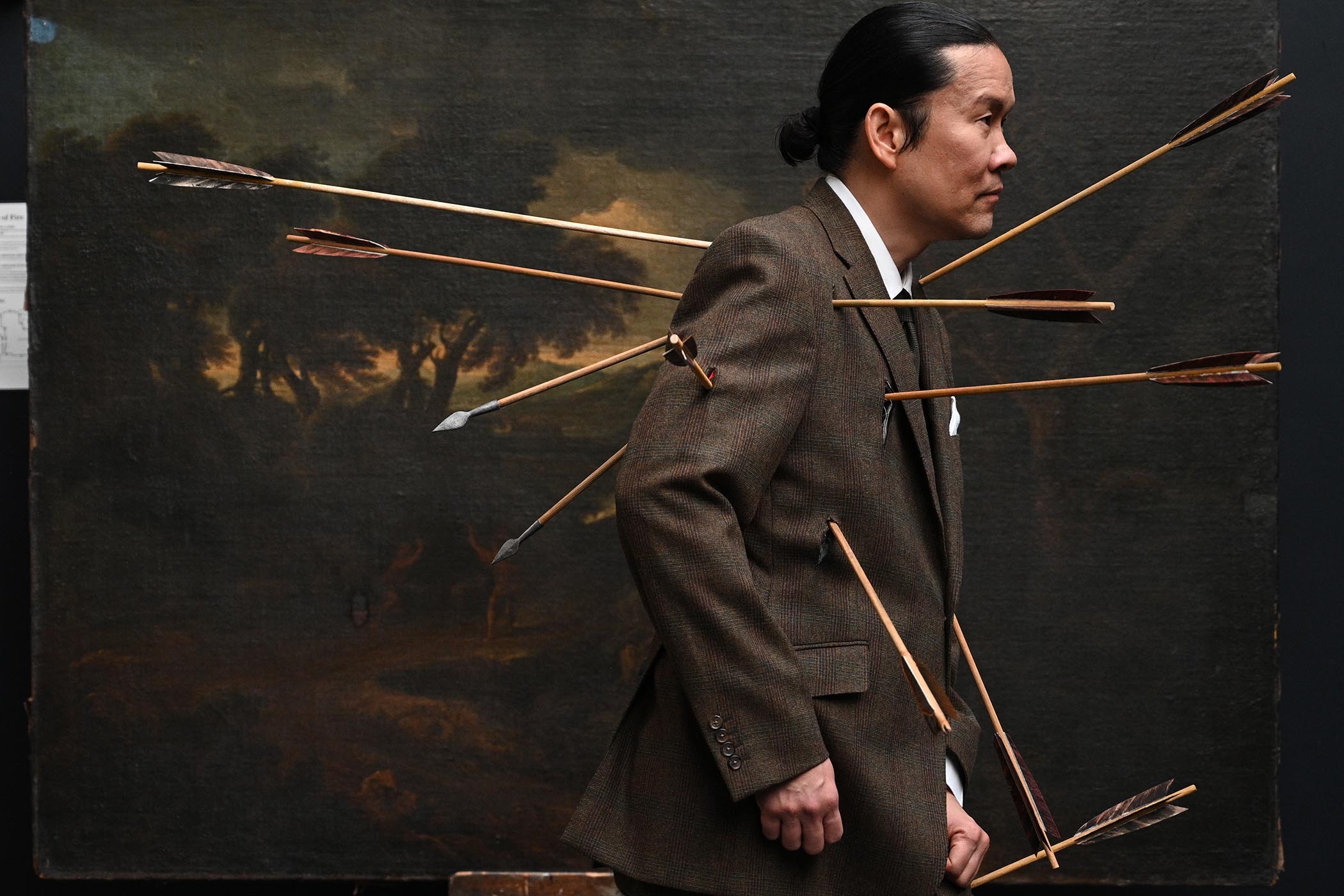
Ming Wong’s film shot at the National Gallery. Main image: Saint Sebastian is depicted by Gerrit van Honthorst, c1623
His 2009 restaging of a charged scene from Douglas Sirk’s 1959 film Imitation of Life – between a black maid and her daughter, who is light-skinned and passing as white – cast male Singaporean actors of Chinese, Malay and Indian heritage in the roles to renew the argument and bring that film into the present. Wong is doing something similar at the National Gallery with the film Dance of the Sun on Water, which reprises scenes from Jarman’s Sebastiane with contemporary performance artists, musicians, a drag king and a burlesque dancer, several of whom are British Asian. The film is regularly screened in its entirety in the National Gallery’s Pigott theatre, and in brief extracts in four galleries inside gilded picture frames the artist calls Medieval Televisions.
The film opens with some of Wong’s meditations on the museum itself: the way the paintings inhabit time, undisturbed and unhurried by night, constantly bringing the past into the present. Dressed as art historian Kenneth Clark, in tweed suit and polished shoes, he wanders the galleries after hours, moving from long-shot to closeup in the manner of Clark’s Civilisation.
This suit is pierced with arrows, which remain exactly in place as he moves, so you start to notice the strange stasis of all the Sebastians in the gallery. Even as soldiers take aim at him, other saints from the future turn up to inspect Sebastian’s wounds, or he goes back in time to appear at the Virgin’s side during the nativity. Wong’s monologue is in Latin, translated with subtitles on screen.
He says nothing about the Sebastian paintings, but the camera does, noting all the extraordinarily different interpretations of the saint. He is slight and blond, tense and muscular, tall, dark and handsome. He has the androgynous body of an ephebe, or the curvaceous torsions of a female martyr. Once Wong’s monologue yields to the re-enactment of Jarman’s film, played out in full costume – or lack thereof – in the hallowed galleries by night, it gradually becomes obvious that the performers have special resemblances to the figures in the paintings.
Some of what you see could almost be a send-up of Sebastiane. The swine speared in that film are parodied here with a cute toy pig; there is a silly little flying horse to match. It is hard to take seriously the awed response of one lovelorn soldier to the spectacle of Sebastian, played by a queer artist with evident breasts, sashaying sideways past Stubbs’s Whistlejacket. And it might have been hard to film the arrow scene against one of the neoclassical pillars outside without taking in the London buses around Trafalgar Square.
But this goes to Wong’s powerful theme, which is nothing less than time’s winged arrow. Today’s performers may be posing as the beautiful 1970s actors in Jarman’s film, repeating their lines, and their scenes, but what they resemble more closely is in fact the various Saint Sebastians in the history of art. Time hovers, slides, runs in both directions down the centuries: that is Wong’s proposition. We keep the paintings alive in our eyes.
Newsletters
Choose the newsletters you want to receive
View more
For information about how The Observer protects your data, read our Privacy Policy
Ming Wong: Dance of the Sun of the Water is at the National Gallery until 5 April
Photographs by The National Gallery/ Ming Wong