
In Everything Is Fake and Nobody Cares, the presenter Jamie Bartlett is having a good time. But is it Jamie? It could be his chatbot imitator Jimmy Botlett, who Bartlett creates towards the end of the first episode. Bartlett is using Botlett as an example of today’s AI fakery while investigating the blurred line between reality and make-believe. “Truth,” says Bartlett, “is replaced by emotion, narrative and performance.” Yet we don’t seem to care.
Bartlett begins with his namesake Steven Bartlett, the Dragons’ Den star and host of The Diary of a CEO, one of the most popular podcasts in the world. This Bartlett became famous because of his rags-to-riches story, which the Times’ James Hurley revealed as a mischaracterisation in 2023. Nobody was bothered. As Hurley puts it, resignedly: “Actually, it’s all right that you embellished your backstory, no one seems to mind and everything just carries on.” We also hear about Jay Shetty, another hugely successful podcaster. His monk-turned-mogul backstory was also exposed as a bit smudgy, to no effect.
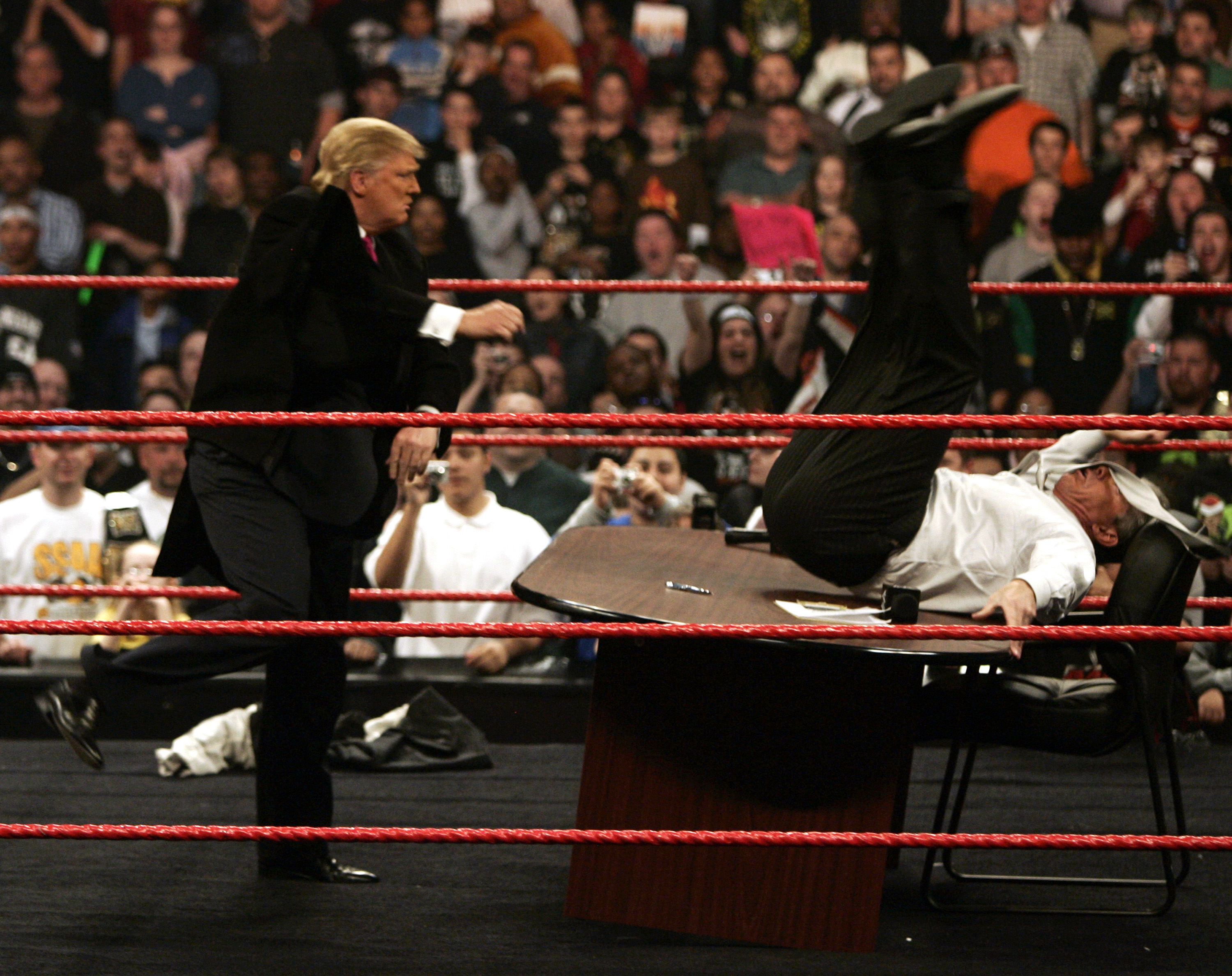
More interestingly, Bartlett makes the case that modern US politics is full of grifters, and traces their success, including that of the current president, back to the fake-reality of 1980s pro wrestling. Bartlett explains that Donald Trump not only hosted WrestleMania matches in the late 80s, he actually took part in a match, going up against the WWE founder Vince McMahon in 2007. It was called the “Battle of the Billionaires”, and each picked a wrestler to fight on their behalf, the winner getting to shave the other’s head! (Trump does the shaving, it’s on YouTube.) The appeal to Trump of pro wrestling’s ridiculous showmanship – its faux outrage, pretend machismo, the adrenalin of a huge crowd – can be seen today. Incidentally, McMahon’s wife, Linda, is now the US secretary of education. Everything Is Fake... has something of Jon Ronson about it, though Bartlett has his own wry style. His delightfully revelatory series starts off well and gets better as it goes along.
Bartlett traces the success of American political grifters back to the fake-reality of 1980s pro wrestling
Bartlett traces the success of American political grifters back to the fake-reality of 1980s pro wrestling
As we’re discussing the unreal warping reality, let’s bring in The Interface, a podcast about tech and how it impacts on our lives. It’s hosted by two very American Americans – the boisterous Thomas Germain and Karen Hao – as well as the more self-effacing British investigative journalist Nicky Woolf, known for his excellent series Finding Q: My Journey into QAnon and Fur and Loathing. All three presenters are hugely well informed.
This week’s episode tackled the White House falling-out with Anthropic, the company contracted to provide the US government and its military with AI systems. Anthropic baulked at the Trump administration’s insistence on removing human oversight for AI involved in “lethal autonomous warfare” and “surveillance of Americans en masse”. (OpenAI immediately hopped into the lucrative vacant contract when Anthropic bailed.) Hao gave an in-depth explanation of what really caused the contract to collapse: let’s just say that Anthropic weren’t as moral as we thought.
Woolf also discussed how the US and Israel’s attack on Iran triggered millions of market bets. Six accounts made bets in the two or three hours before the offensive was launched. They made $1.2m (£900,000) in profit. “This would be people either inside the Pentagon or inside the White House,” Woolf explained. Bleak.
At times, The Interface can be a little too insidery, but the hosts’ knowledge means you come away from this episode far more informed than when you go in. More depressed, too, but that’s the way of things.
The Talented Ms Goldiee, last week’s episode of Question Everything, is another intriguing story about tech fakery. Nicholas Hune-Brown, executive editor at the Local, a Toronto health and social issues publication, likes to give new writers a chance, so was happy when Victoria Goldiee, an up-and-coming freelancer, sent in a pitch for a story on health privatisation. Goldiee had already conducted interviews and gathered excellent quotes.
However, when Hune-Brown gave her email another once-over, he had a bad feeling. Goldiee’s pitch was too good, the phrasing too smooth. He smelled AI, and started investigating her writing. She’d had pieces published in the Guardian, the Cut, the Journal of the Law Society of Scotland. Hune-Brown contacted the people she’d interviewed. None remembered her.
Eventually, he gets Goldiee on the phone, ostensibly to talk through her pitch, and we hear her quick, plausible answers to his questions. Though when Goldiee admits her personal assistant had conducted one of the interviews, we all knew: no freelance journalist has a PA! “She was lying to me and I was pretending not to notice she was lying to me,” says Hune-Brown.
Newsletters
Choose the newsletters you want to receive
View more
For information about how The Observer protects your data, read our Privacy Policy
As the story continues, he points out that $800 (£600), what Goldiee was paid for a piece about interior design, isn’t very much if you have to interview 10 top designers, but it’s “a healthy payday if you only need to enter a few words into ChatGPT”. Later, when he realises other pitches he’s received are also probably AI, he’s “overcome by a brief but genuine moment of deep despair”. Yes, everything might be fake, but some of us do still care.
Photograph by Getty