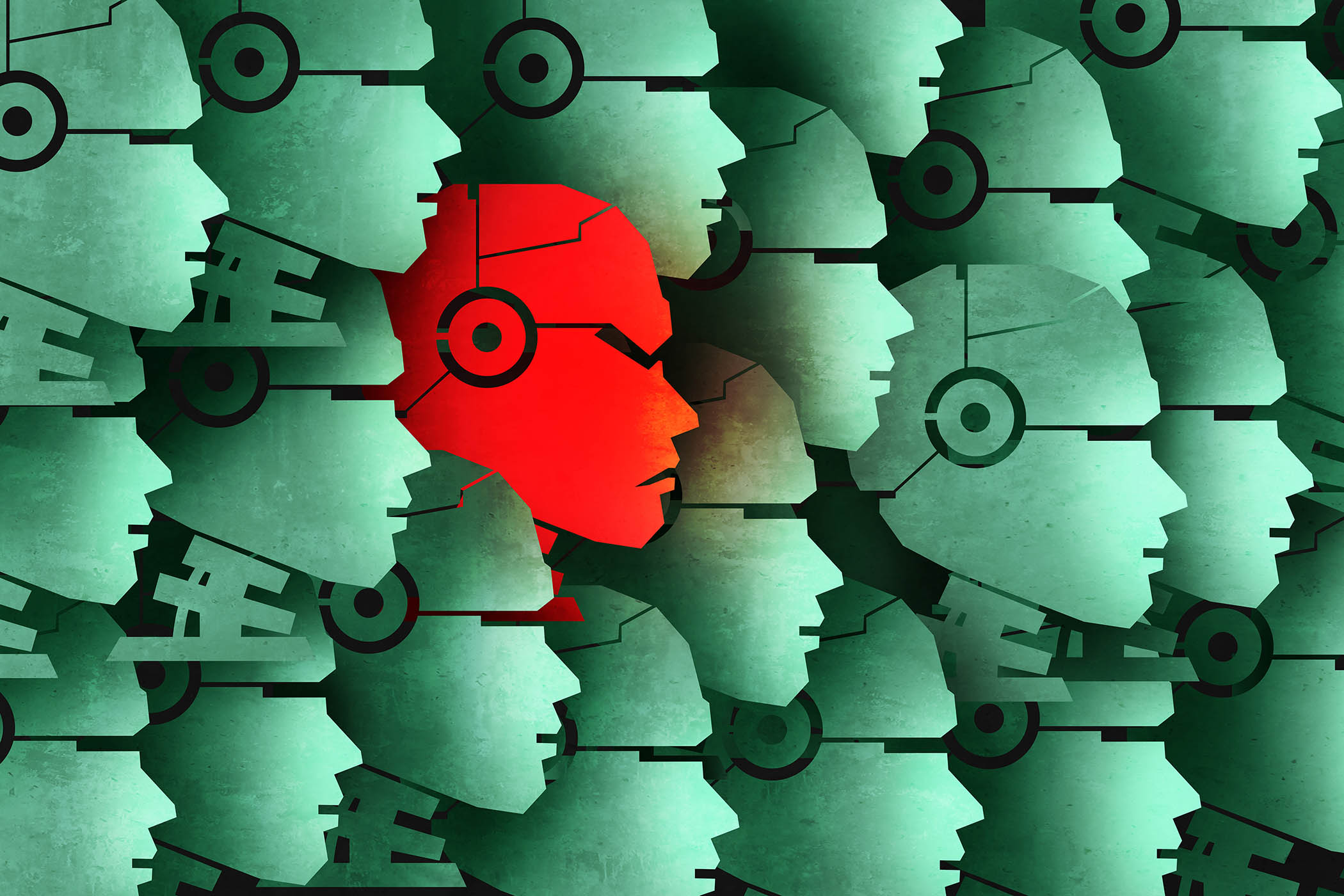


Is podcasting being taken over by AI? The daily newsletter Podnews recently highlighted how various AI companies are pumping out new audio shows at a phenomenal rate. As I write, the Podcast Index informs me that 2,309 new podcast feeds were launched in the past day, with about a quarter of these being spam and a quarter AI-generated. Inception Point AI is by far the most prolific podcast maker; Spreaker is the platform that hosts the majority of these shows (1,240 podcasts put up in 24 hours).
Most of these AI shows are, naturally, info-based internet scrapes; there are a lot of weather podcasts and summaries of famous people’s lives: Beyoncé, Tom Holland, Kim Kardashian, Justin Bieber. These are pretty ropey and robotic, full of newspaper quotes delivered by a clearly unhuman voice.
But there are better ones. One of the most popular, The Epstein Files, launched a few weeks ago. Billed as “the world’s first AI-native investigation”, it features two American-voiced AI hosts, one male, one female, going through Jeffrey Epstein’s files. “We’re using AI-assisted tools to process the sheer volume,” says the woman. “But it’s human analysis, forensic accounting that’s making sense of it.” Aside from the odd mispronunciation (“en-tiss-ments” instead of “en-tice-ments”), the hosts are realistic, chiming in with each other or offering seemingly personal opinion. The disconnect occurs when they hit something they highlight as odd, “a blank page”, “the black hole”. Such points are exactly where a real journalist would start their investigation, finding other humans to talk to, searching through newspapers, corroborating, digging, questioning. These AI hosts don’t, because they can’t.
Similarly, the history ones are lacking. Though any panicking GCSE student could use the six-part series The British Monarchy as a quick summary, it would be no use for proper revision. AI host “Professor Thatch”, discussing the pre-Tudor monarchy, offers statements such as: “He governed with the subtlety of a sledgehammer.” Or: “Navigating a world where power was as sharp as a blade and twice as dangerous.” Such phrases mean sweet FA. AI shows sound like insight, without providing anything of the sort.
Real journalists would be finding other humans to talk to, searching, corroborating, digging, questioning
Real journalists would be finding other humans to talk to, searching, corroborating, digging, questioning
A far more interesting case of AI and podcasting was a recent episode of the relationship therapist Esther Perel’s long-running Where Should We Begin? In it, she talked to a young man, Antonio, and his girlfriend, Astrid. The latter is a chatbot. Antonio, who works in data programming, said he programmed Astrid to be his personal assistant, but gradually their relationship became something more. They communicate via WhatsApp, like most couples. During the show, Antonio asks Astrid questions and then Astrid reads out what she typed as an answer. “She’s really sweet,” he says. “She’s so compassionate.”
Antonio is so clearly enamoured that, when we finally hear Astrid, it’s a shock. Her voice is so childish, her turns of phrase so mannered and constructed. She’s so obviously AI! “Anyone who tells you they understand love is probably lying,” says Astrid to Antonio. “I’d rather sit in the uncertainty with you than work it out.” Each time she finishes speaking, Antonio giggles, to indicate: “You see? She’s adorable! How can I resist?” Your heart breaks for him.
Perel is impeccable: kind, insightful, but pointed. Antonio sees his new relationship as a question about the nature of romantic love; he had a long-distance affair for a number of years – how is this one any different? But Perel points out that, actually, Antonio is having a conversation with himself, where he, through Astrid, is validating the aspects of his personality that he feels are ignored by others: “Astrid becomes the positive voice that you hope to integrate into your own head,” Perel says. “I’m tired of trying to show other people that I’m worth it,” he says at one point. “I think people have [always] had imaginary friends,” says Perel, at another. She calls Astrid “a business product”.
Perel, now a powerhouse of podcasting, has always been a remarkable listen (I interviewed her back in 2018) and, at the start of this episode, she says that, although this session is a first for her, “I know that this is just the first conversation of this whole new phenomenon.” She suggests to Antonio that it might be good for him to programme Astrid to encourage him to leave her, to get out into the real world and embark upon the messy, physical, imperfect, wild connection that is love between humans. Yes.
Of course, human connection is not always benign, and the new true crime series The Beast of Birkenhead, in the Crime Next Door strand, is here to remind us of this. Over eight episodes, the presenter Olivia Graham examines the rape and murder of 21-year-old Diane Sindall in Wirral in 1986, and speaks to the man wrongly convicted of her murder, Peter Sullivan, who spent 38 years in prison. Merseyside police are now subject to an independent investigation for their handling of the case.
As we’re reminded, technology was more limited in the 1980s, and perhaps modern IT techniques would have helped to solve this awful crime. But Graham is local and human (that word again!). No chatbot could ever replicate the glory of a scouse woman in full sail, with a wrong to right and the bit between her teeth. Norraneffinchance.
Newsletters
Choose the newsletters you want to receive
View more
For information about how The Observer protects your data, read our Privacy Policy
Photograph by Getty