


Oprah Winfrey has a podcast that I can’t recommend, partly because it isn’t really a podcast. Sure, she and her interviewee sit in faux comfy chairs in front of microphones that need stands and clamps. It comes out weekly and is pretty newsy. It features writers and “culture changers”. But it’s on YouTube and, really, it’s a cheap TV show, filmed before an audience sitting so close to Oprah and her guest that the wide shot resembles that photo of Donald Trump praying at his desk, surrounded by handsy evangelical leaders.
The visual approach means, as ever, that certain parts don’t work for audio (Oprah often chats directly to the audience and sometimes refers to guests in the third person, which sounds rude).
Last week’s show, though, is worth a listen. Oprah’s guest is Kristin Cabot, better known as the woman from the viral Coldplay kiss cam. On 16 July last year, Cabot and her workmate Andy Byron were getting cosy during the band’s Boston gig. At a certain point (during Yellow, we discover), they were filmed and projected on the enormous screens. Their horrified reaction to seeing themselves up there – she turned her head away, he tried to drop to the ground – meant that Chris Martin commented: “Either they’re having an affair or they’re just very shy.” Cabot and Byron’s lives changed instantly.
The clip has reportedly been viewed more than 300bn times online (“and there’s only 8 billion people on the planet!” exclaims Oprah). The story that Cabot and Byron were cheating on their spouses took hold, and Cabot had to leave her job as head of HR at the technology startup Astronomer, where Byron was chief executive . She was painted as a home-wrecker and hypocrite who deserved every nasty comment fired her way.
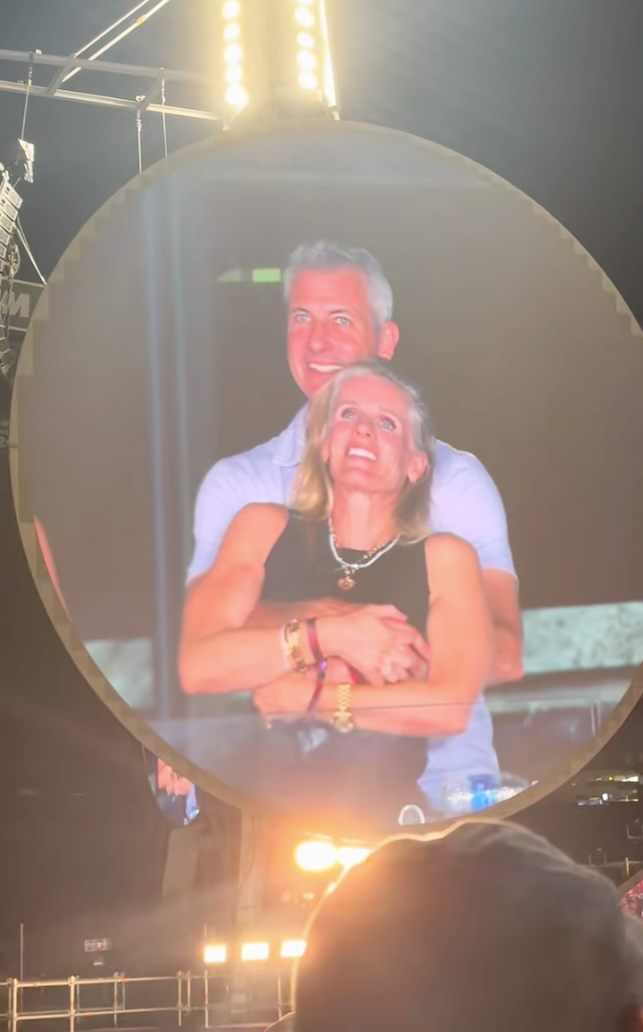
Kristin Cabot with her colleague Andy Byron on kiss cam at the Coldplay concert in July last year
But Cabot, it turns out, is not what you expect. She is calm, likable, sound and solidly feminist. What happened, she explains, is that both she and Byron were going through divorces (hers was amicable) and had become close. The Coldplay evening was the first time they’d physically touched – their first “date”. By coincidence, Cabot’s soon-to-be-ex-husband was also at the gig. So when the camera focused on her and Byron, she panicked.
As she continues with her story – the fallout, the online vitriol, the people who berated her in the street (sadly, always women) – you warm to her more and more. She was attacked much more than Byron. She wants another job, but companies won’t even interview her. “I’m raising my kids alone. I’m financially responsible for my kids alone, and I need to get back to work,” she says. It’s not the same for Byron, who she claims is getting lots of work interest. Cabot’s life has been wrecked by the world’s assumptions about a few seconds of her evening out.
Here’s another supposedly visual podcast about mad stuff that’s happened to an ordinary person. This tale, though, doesn’t revolve around a few seconds of notoriety: it spans decades. Going Clean Is Dirty Business concerns Nick Abson, a director of pop videos and comfort telly (Countdown), who decided in the 90s to change career. He’d made a science documentary about catalytic converters for cars and decided that they were rubbish. Instead, alkaline – or hydrogen – fuel cells seemed to offer a new way: safe, reliable energy, with only water as a byproduct.
Since then, he’s devoted his life to developing these fuel cells to offer community-owned technology we’re all capable of making – not buying, making ourselves. If he succeeds, we’ll all have access to cheap, clean energy. Amazing!
However, Abson’s invention would, obviously, cut out the enormous energy companies that dominate the market, and in his 30 years of development he has come across many obstacles: legal cases, financial collapse, murder attempts, the torching of equipment – you name it. The Russians are involved, he alleges, as are the Rothschilds, and the UK’s energy department.
It’s an extraordinary story, with shocking twists and the potential to change the world. But it has problems: it relies heavily on Abson, which means hours of his voice. You long for journalistic storytelling; without it, the show becomes one man ranting about protons, alkalis and manufacturing processes. By the end of this six-part series, we’ll have barely started. Two more series are planned for later in the year.
Newsletters
Choose the newsletters you want to receive
View more
For information about how The Observer protects your data, read our Privacy Policy
But Swimming with Jimmy, for Radio 4’s Illuminated strand, knows how to tell a tale. This, too, is a programme about ordinary people’s lives changed by outside forces. But this time, those forces are smaller: water – and a swimming instructor. Jimmy runs swimming classes for adults at Cardiff International pool. He teaches those who never learned, or who are so scared of the pool that it takes them six weeks to be brave enough to dip in a toe. Selma Chalabi, presenter and producer, is one of these people.
She talks to class mates, some of whom have suffered terrible trauma in water, and we hear Jimmy coaching and encouraging them. “We’re not birds – we can’t fly,” he says. “But we can in water.” Though these people are unlikely to be noticed by the world at large, their triumphs and disasters are, we understand, enormous. I loved them all.
Photograph by Youtube