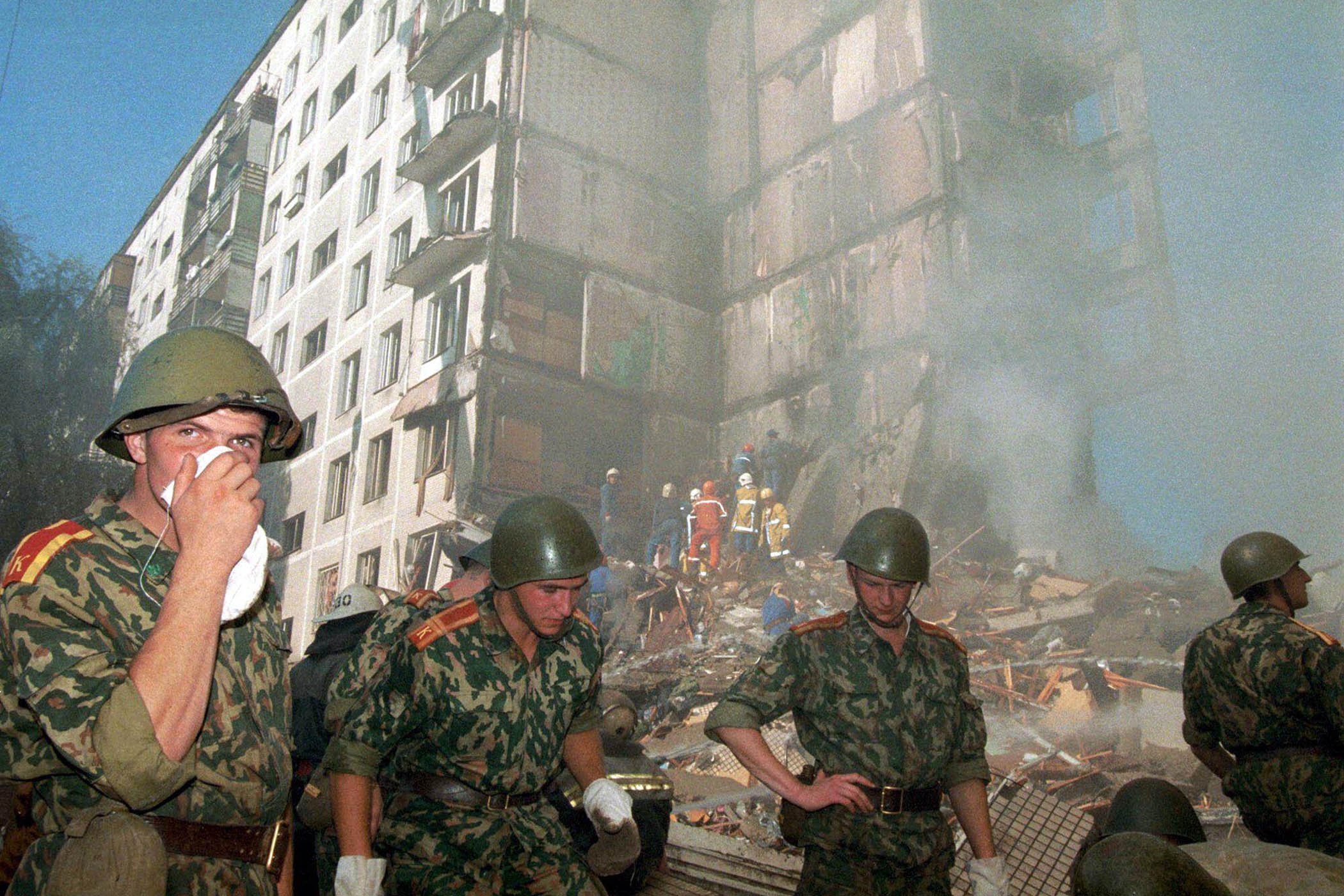
Radio 4’s The History Bureau: Putin and the Apartment Bombs, hosted and scripted by the excellent Helena Merriman (Tunnel 29, Room 5), is a tricky sell. It concerns a long-forgotten bombing campaign in Russia in 1999, when unknown terrorists blew up four apartment blocks in the cities of Buynaksk, Moscow and Volgodonsk, killing more than 300 civilians and injuring at least 1,000. I don’t remember this story from then, and, so far in 2026, we’ve had enough conflict to last the entire year – and we’re not even at the end of January.
The first episode didn’t do much to reel me in, consisting of the somewhat dull reminiscences of Andrew Harding, the BBC foreign correspondent in Russia at the time of the campaign. But then, right at the episode’s end, we were introduced to a figure who becomes central to the tale: one Vladimir Putin. Then prime minister of Russia (Boris Yeltsin was the president), he moves rapidly to become president-elect, then president; and as he tightens his grip on power, this series tightens its grip on the listener.
Putin’s initial rise is in great part due to his strong stance against the Chechen militants who supposedly planted the apartment bombs. Except the bombs, according to this series, have other people behind them. Guess who? The controversial conclusion is arrived at brick by brick; the evidence stacking up as though rebuilding those apartment blocks. Meanwhile, there are some great – and quite mad – details to be enjoyed.
A 50-minute video is played on Russian national telly of the prosecutor general having sex with two women. A satirical TV show hosts a confrontational debate between FSB agents and residents of a tower block where bomb-making equipment was found but not detonated. The FSB says it was conducting a training exercise; the residents are sceptical. By episode four, we’re in the UK, with the Alexander Litvinenko poisoning, and the show continues moving towards the recent past, offering increasingly shocking revelations. Investigative journalists often talk about pulling on a thread to uncover the truth; this series tugs at a huge web that stretches from 1999 to today. An excellent series, well worth your time.
By episode four, we’re in the UK, with the Alexander Litvinenko poisoning, and the show continues moving towards the recent past, offering increasingly shocking revelations
By episode four, we’re in the UK, with the Alexander Litvinenko poisoning, and the show continues moving towards the recent past, offering increasingly shocking revelations
It’s the new year and several radio people have new jobs. First up, the impressive Misha Glenny, journalist and author of McMafia, has become the presenter of Radio 4’s In Our Time, replacing Melvyn Bragg, who had hosted the show since its inception in 1998. I’ve always liked In Our Time, and I enjoyed Bragg’s impatient personality; how quickly he wanted to move through dense information, pushing the guests to make their point so he could hop forward several years.
Glenny is not so twitchy, but there’s still a sense of rapidity. In last week’s episode, the speed was provided by Helen McCabe, professor of political theory at Nottingham University, who spoke throughout with a swift, “Well, we know this already” air. The topic was John Stuart Mill’s 1859 essay On Liberty. Mark Philp, emeritus professor of history and politics at Warwick University, explained that “the tendency for opinion to dominate individuals” was one of Mills’s worries. “Even if it doesn’t stop them thinking things, it stops them saying things,” said Philp – which certainly chimes with today, though none of the guests were crass enough to point this out.
In Our Time assumes intelligence in the listener – a good thing – though this assumption also led to rather a few too many “of courses” from Glenny when referring to other writers and philosophers. It’s a hugely informative programme as ever. It was interesting to discover Mills’s early gloominess, as well as how he was influenced by Jeremy Bentham, a friend of his father’s (Glenny: “Bentham, of course, being the founder of utilitarianism”). But most delightful was Mills’s relationship with his wife, Harriet, who, the episode demonstrated, was the co-writer of On Liberty, though her name was not on the cover.
Here’s another newbie: Emma Willis. A regular stand-in on Radio 2, she has been given the Saturday afternoon slot that Zoe Ball vacated at the end of last year. Big shoes to fill, and Willis’s first show wasn’t perfect, though it wasn’t bad either. Introduced by an over-the-top jingle (imagine a gospel choir having a sugar rush), the presenter sounded upbeat enough, though keen to tell us how nervous she was, which is never a good idea. She banged through her intro with only slight hesitation, before introducing the ice-breaker listener question: Why not, she said, tell her: “What do you do that you think is normal but everyone else thinks is weird?”
The answers were pretty soporific: no gravy on a roast, never switching the boiler on. But then this is Radio 2. Willis herself said she doesn’t like eggs that look like eggs – she only eats scrambled or an omelette (are you asleep yet?).
She had a strange conversation with Sally Traffic, the travel news presenter she forgot to introduce. Sally, a good conversationalist, said her own weird habit was that she peels a banana from the wrong end. This is clearly odd, and could have led to some funny chat – do you try to take your pants off before your trousers etc – but the ever-polite Willis insisted it wasn’t weird at all and instead burbled something nonsensical about seeds maybe making a banana sweeter.
The music choices were jolly (Madonna’s Like a Prayer, Robbie Williams’s new one), and I have no doubt at all that once Willis calms down and relaxes, she will find everything much, much easier. She is likable and warm – just right for the slot.
Photographs by Alamy
Newsletters
Choose the newsletters you want to receive
View more
For information about how The Observer protects your data, read our Privacy Policy