
To some extent, how we divide and therefore understand time is determined by facts of the universe: a day is the amount of time it takes for the Earth to spin on its axis; a year is the duration of the Earth’s orbit around the sun. But, writes Rebecca Tamás, how we understand the progression of the year comes from a different source. The origin of the word “calendar” is derived from the Latin calendarium, meaning “account book” or “interest register”, “where creditors in Ancient Rome entered the names of their debtors and how much money they were owed by them. These debts were due to be paid on the calendae, or first day of every month: the concept of profit becoming baked into our very concept of structured time.”
So our understanding of the passing of the months, once inferred by the days growing long and then short again or when new buds appeared or leaves fell from the trees, was “externalised and divided from us”. Time, Tamás insists, became “not something that we shared in, but something that ruled over us – a mechanism of control that could be wielded to organise workers and colonial subjects into the positions that would yield the most profit and power, all human activity turned towards the accumulation of wealth”.
In The Book of Mysteries, Tamás, a British poet and environmental writer, traces a year in her life as she seeks to resist this man-made notion of time. Suffering from burnout as she commutes to her job in London at the same time all year, no matter whether it’s light or dark outside, she craves more connection to natural time. She looks back longingly on the months she spent on Exmoor during the pandemic, when she was “able to be in a rural space for long enough for something radical to happen – which was a change in my experience of time”. There, she entered a “new rhythm, a wild time”, where “time was born from the rising of the sun, and the shifts of the seasons, and the movements of my own body, and so, there was no ‘just in time’ or ‘out of time’ – there was only a shared chronology that moved with those changes”.
How, out of the pandemic and back into the relentless drive of modern life, might she find a way to discover wild time again? Having enjoyed marking the summer solstice with friends, Tamás turns to ancient seasonal rituals, “where human actions were dictated by and shaped by the natural world, and not the other way around”. She commits to engaging in a ritual for each spoke in the pagan Wheel of the Year. The wheel – which contains the four equinoxes and solstices, as well as the four cross-quarter festivals that mark their halfway points – is a modern invention, but reflects pagan celebrations of seasonal change that were observed in pre-Christian societies. It is these eight spokes that determine the structure of Tamás’s bright and surprising book.
The idea of looking to ancient traditions as an antidote to the tiresomeness of modern (and especially urban) society is not new – indeed it has become something of a cliche, with record-breaking numbers of people gathering at Stonehenge to mark the solstice this June, and the folk revival evident in everything from music to fashion. But the way The Book of Mysteries blends memoir, reportage, research and political thought sets it apart as a singular treatise on just what we might gain if we reset our body clocks to wild time.
Tamás travels to Edinburgh in the depths of winter for the Beltane Fire Society’s Samhain ritual, where body-painted participants drum, do acrobatics and engage in fireplay, and to Padstow in Cornwall for the May Day ’Obby ’Oss festival, where two hobby horses parade through the streets all day before meeting at a maypole at night. All the while she tracks her increasing closeness to the natural world and a more elemental understanding of time.
Her training as a poet is evident in the lyricism of her prose: “I had turned away from the flat, rigid time of capital, and towards the feral, wild time of the Earth; towards the glimmers of light, stretching their frail hands across the sky.” But the book isn’t all dancing around maypoles and odes to nature’s restorative power; it’s darker than that. Partway through the book, Tamás’s father dies, and in the rituals she attends in the period afterwards she finds a means to better understand death and its part in the natural cycle of life, a realisation that can be cruel and upsetting before it is reassuring.
Newsletters
Choose the newsletters you want to receive
View more
For information about how The Observer protects your data, read our Privacy Policy
Tamás is an honest ritual-goer, who shares her preconceptions about traditions (“I wasn’t always a huge fan of morris, and the way that its male-dominated, Victorian cod-romanticism seems to turn up at every ritual event”) and is open about her limitations. In January she hopes to travel to Llangynwyd in Wales to experience the ritual of the Mari Lwyd, but doesn’t have the strength for a long journey during those cold, dark days. Instead she finds a wassailing ceremony held at an orchard local to her in south London, and wanders there.
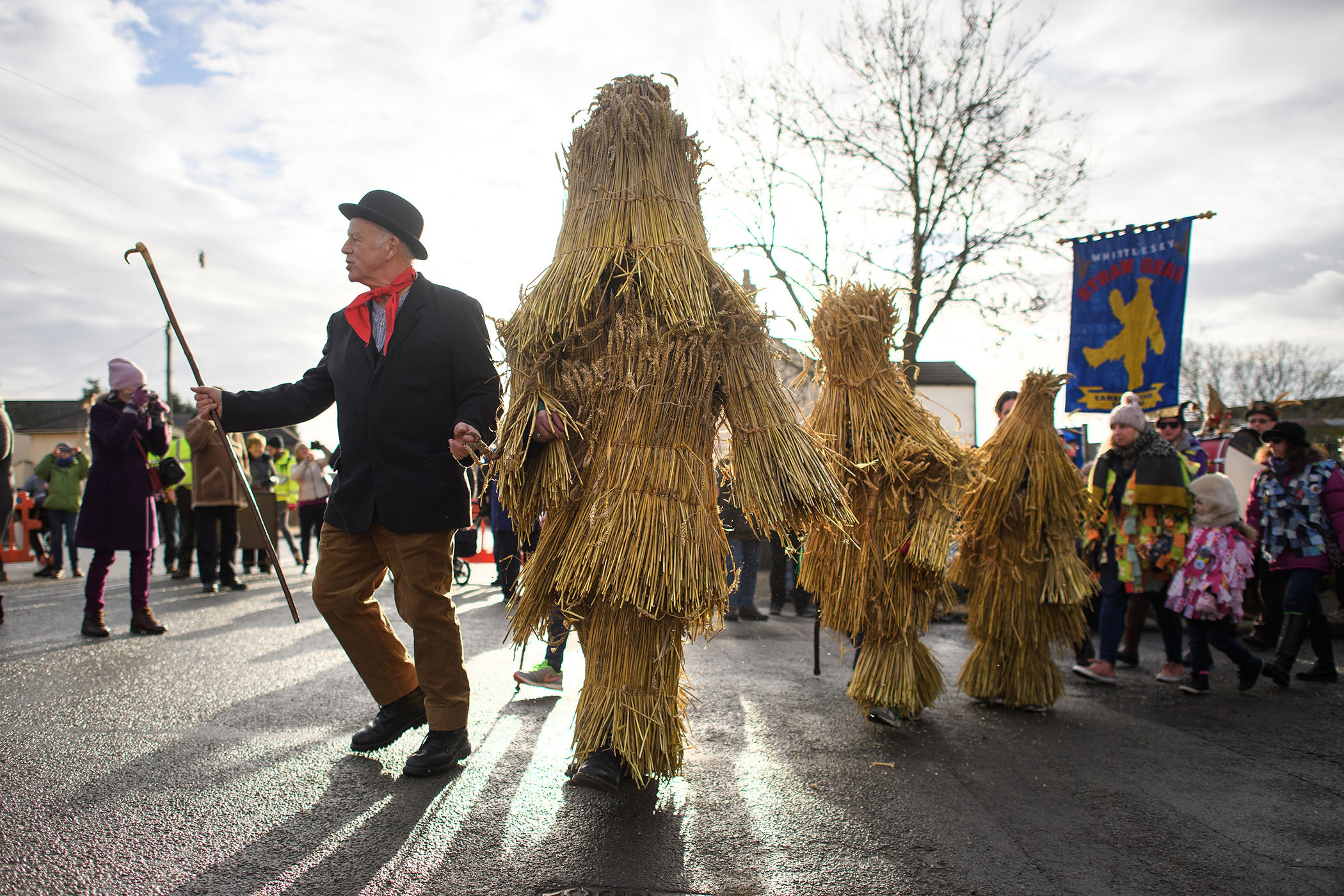
Part of the book’s subtitle, “Wild Time and the Ritual Year”, appears as the name of another new book, The Ritual Year: A New Calendar of Britain’s Feasts, Festivals and Folklore, by Kiera Chapman, Lulah Ellender and Rebecca Warren. While Tamás’s work offers one person’s experience of a deep engagement with a year shaped by rituals, this book acts as a guide, offering brief entries – each written by one of the authors – on 72 events that take place annually in parts of England, Wales and Scotland. It’s a wide-ranging collection that shows the variety of traditions still celebrated in these isles, from the Whittlesea Straw Bear festival held in Cambridgeshire on the first Saturday after Plough Monday (the first Monday after Twelfth Night) to Yorkshire’s Mischief Night, an alternative to Halloween.
The entries by Chapman, a political ecologist and nature writer, are the liveliest. She begins her description of the Pearly Kings and Queens Harvest festival with a reference to Apple founder Steve Jobs’s koumpounophobia, or fear of buttons. Elsewhere she explains the beginnings of Notting Hill Carnival in a powerful passage written in the second person that makes evident the racism experienced by the Windrush generation in London in the 1940s, 50s and 60s and the need for a festival that celebrated multiculturalism.
Each entry offers an origin story for its ritual – if its author can find one. “As with many customs, Crying the Neck’s beginnings are disputed,” writes Ellender about a Cornish harvest ritual that involves participants singing hymns around a patch of barley or wheat before it is cut, gathered and made part of a ceremony. The origins of others are similarly unclear – and, as a note at the book’s beginning states, their dates have sometimes been approximated, while Britain’s 1752 adoption of the Gregorian calendar moved some ritual days out of their intended month entirely.
Tamás’s book suggests these specifics don’t matter. Even the calendar-like framing of The Ritual Year is at odds with these wild, uncanny events that serve no purpose in terms of productivity or financial gain – which the calendar was designed to track. As Tamás writes after forging her own Lughnasadh ritual to mark the beginning of the harvest season, she is seeking “to work myself into the capaciousness of the living world, and to learn a temporality that contains more than just my individual position as a tool of capital”. The modern workplace might insist that we input into an HR system the annual leave we plan to take in order to engage in seasonal rituals. But our ancestors would have known it was time by the state of the harvest, or the shape of the moon.
What’s more, there is a joy in not knowing quite why or when we do certain things. “Capitalism’s greatest trick,” Tamás writes, “has been convincing many of us that there is no mystery left in the world, that everything can be explained, understood and utilised, as if the earth and everything on it was a reliable, inert machine.” By involving herself in rituals that insist she take notice of the passing of time as the seasons, not clocks or calendars, make evident, Tamás rekindles some wonder in the world – both in what we do know, and in what we never will.
The Book of Mysteries: Wild Time and the Ritual Year by Rebecca Tamás is published by Pushkin Press (£16.99). The Ritual Year: A New Calendar of Britain’s Feasts, Festivals and Folklore by Kiera Chapman, Lulah Ellender and Rebecca Warren is published by Granta (£14.99). Order a copy of either book at The Observer Shop for 10% off RRP. Delivery charges may apply.
Photographs by Leon Neal, Paul Ellis/AFP via Getty Images