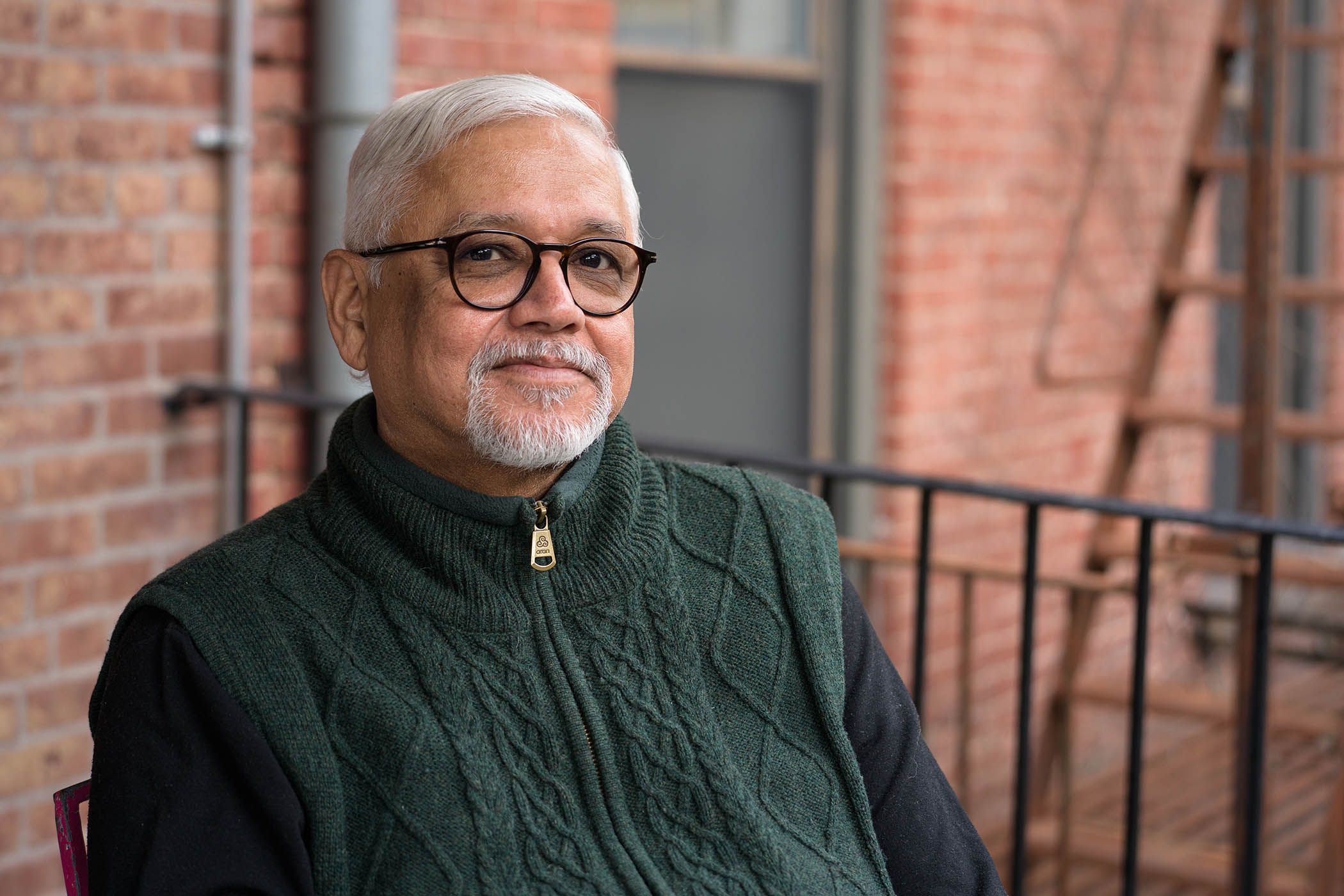



Photograph by Maria Spann
Amitav Ghosh, 69, was born in Calcutta, the son of a diplomat, and spent some of his childhood in Bangladesh and Sri Lanka. He was educated at the Doon School, a boarding school for boys in the foothills of the Himalayas, where Vikram Seth was also a pupil at the time. Ghosh studied history at St Stephen’s College, Delhi, and social anthropology at Oxford.
His first novel, The Circle of Reason, was published in 1986. He has won the Jnanpith award, India’s highest literary prize, and been shortlisted for the Booker. His new novel, Ghost-Eye, explores the environmental crisis through a character who recalls a past life. A collection of essays, Wild Fictions, is now also out in paperback.
Do you believe in ghosts?
I think all kinds of bizarre phenomena exist in this world. Yes.
Why does reincarnation appeal to you as a subject for fiction?
I don’t like to use the term reincarnation, you know, because reincarnation is a metaphysical term. It implies there’s a certain kind of mechanism that leads from one life to another. I don’t know if that happens. I’m agnostic. What I do know, because there’s abundant evidence, is that a very large number of children are born with past-life memories. There’s so much evidence of this, and I know people who were born with past-life memories. And since writing this book I’ve come to know many more because they come and tell me.
Are you aware of any of your own past lives?
No, not at all. But one of the strangest things that’s happened since I wrote this book is that people have been telling me about things that happen in their lives. They meet a child they have never met before and the child recognises them from their past life and tells them about that life, what their name was. That is actually the most disturbing thing to me. Can you imagine someone you just don’t know at all suddenly recognising you?
In Ghost-Eye, three-year-old Varsha Gupta is being raised in a strictly vegetarian household but craves fish, which she remembers vividly from a past life. Do you think that part of our connection to the environment comes through our stomach?
Oh, absolutely. Food is the primary form of engagement with the environment. There couldn’t be anything more important. One of the strangest things about these past-life memories is that, for the children who were born with these memories, there are two things they tend to focus on. One is language: they have memories of languages in completely inexplicable ways – they suddenly start speaking a language their birth family cannot understand. And the second thing is food: they have a very powerful attachment to [specific] food. Just think about it, what makes us human – it’s language and food.
Agriculture was transformed in the 20th century by the Green Revolution, the significant increase in the production of wheat and rice brought about by the introduction of high-yielding plant varieties. One of your characters refers to it disparagingly. What has its legacy been?
The Green Revolution was one of those major cold war initiatives. The American establishment felt it had to score a big win for American science. But in the long run the Green Revolution has proved to be a disaster. It’s very input-intensive in terms of fertilisers. You see what’s happening now with fertiliser essentially off the market… farmers have now become so dependent on massive inputs of fertilisers that many of them just don’t know how they are going to manage.
It’s also very water-intensive. A large part of the Green Revolution consisted of encouraging people to grow crops that shouldn’t be growing in those particular environments, like rice in Punjab. In the past, Punjabis didn’t grow rice in any significant quantities. And now they are, large parts of the Punjab are essentially running out of water.
Climate change denial is increasingly reaching government levels in western countries. As a writer concerned with the environmental crisis, does it make you feel like giving up?
It doesn’t surprise me at all because the Anglo-American empire was built on fossil fuels and will do anything at all to preserve the fossil fuel economy. This is also an element of their culture, their identity. This current war [in the Middle East] has really shaken up the whole equation. After this war, people will start switching to renewables at double the pace.
Do you think there’s a connection between the politics of climate change, in particular denialism, and colonialism?
Climate denialism is something that exists mainly in English-speaking countries: Australia, America, Canada.. a little less in England. It has flourished over the years. And, especially in the United States, a lot of the most influential billionaires have been building themselves doomsday bunkers. They are planning for an event that will wipe out a large part of the world’s population. There is no secret about it. The Silicon Valley so-called thinkers confidently predict that the people who will die will be black and brown.
You can buy a doomsday retreat for as little as $35,000… What’s behind it is this apocalyptic imaginary [scenario] where they see people in the global south perishing in their billions. That was the thinking behind many of the colonial exterminations.
You are involved in the Future Library project, where writers are invited to produce a book that will be published a century from now, timed for when a Norwegian forest matures. How has it changed your thoughts about writing?
When you are writing something like that, the temptation is to try to be futuristic. [But] you very quickly realise the future is not going to be anything like you might imagine. Even science fiction written in the 1950s and 60s, [such as] JG Ballard’s The Drowned World, is completely rooted in its own time. It just tells you it’s a fool’s errand to imagine the future.
Ghost-Eye (£22) and Wild Fictions (£14.99) by Amitav Ghosh are published by John Murray. Order either title from The Observer Shop to receive a 10% discount. Delivery charges may apply
Newsletters
Choose the newsletters you want to receive
View more
For information about how The Observer protects your data, read our Privacy Policy