
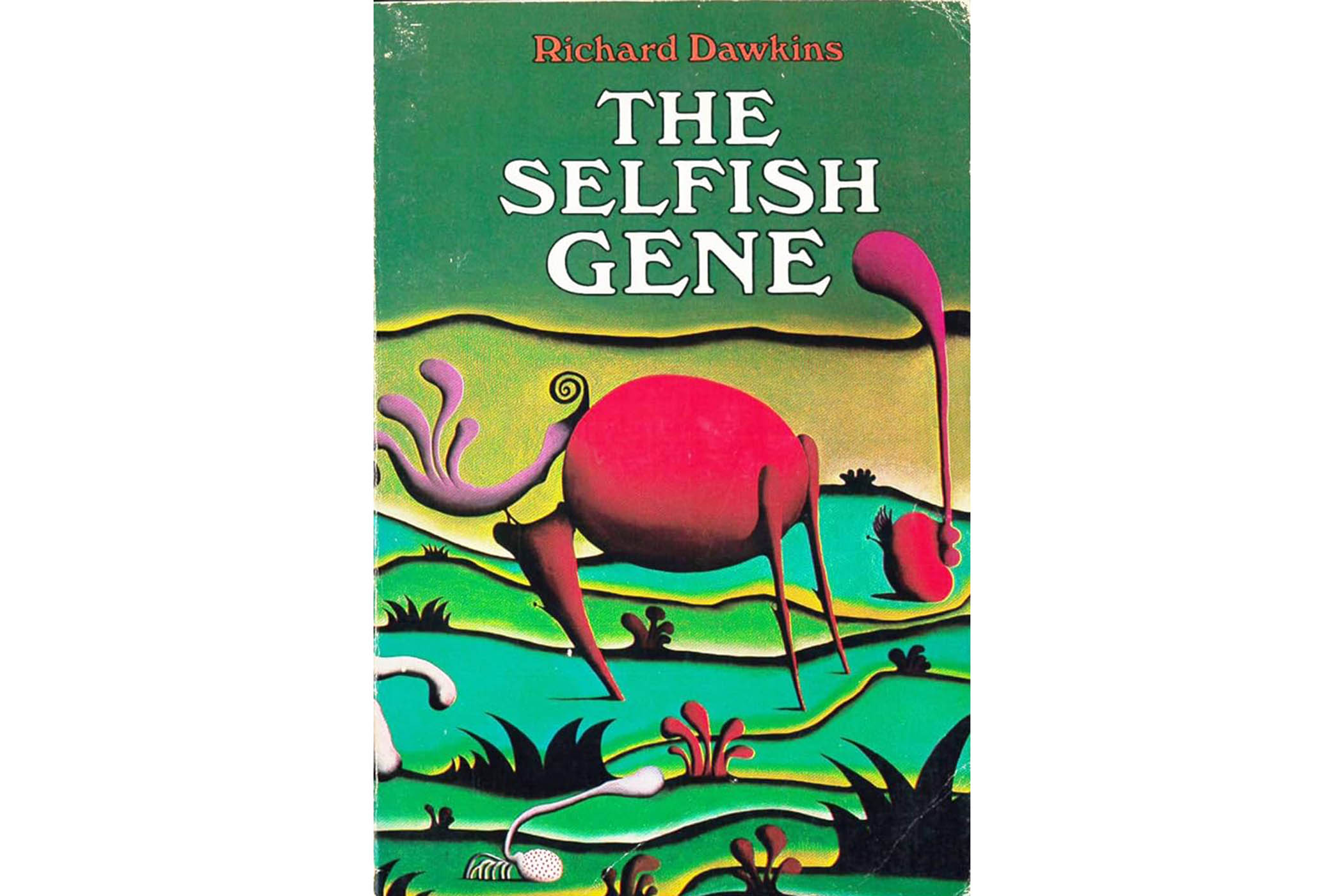
How often is the author of a book still around to mark its 50th anniversary? It’s a disturbing question, not least for the author. But then, how many science books even have a 50th anniversary edition? Such is the pace of scientific progress, after only 20 years a book with “gene” in its title might expect to find itself out of date, out of mind and out of print.
Yet, somewhat to my bewilderment, The Selfish Gene is still going strong in more than 40 languages, and is being read – in annually sustained numbers – by successive cohorts of new young readers.
The flourishing field of genomics grows apace and might be thought to have overtaken and eclipsed a 50-year-old book. In 1976, the word “genomics” had not yet been coined, the human genome’s completion was a quarter century in the future, and the two winners of the Nobel prize for discovering the gene-editing technology Crispr were still young girls in elementary school.
Genomics is not genetics. It’s the study of what genes actually are, DNA, and how it does what it does in the genome and in embryology. Genetics is the study of heredity, of how inherited traits reassort and pass down the generations. A century ago and in complete ignorance of DNA, it was a triumph of genetics to pinpoint the positions of genes along chromosomes, not by directly observing them but by statistical analysis of inheritance patterns. You can study genomics in a single individual; genetics in a single individual would be meaningless. Genomics is an exciting field, one that I’d encourage an ambitious young scientist to enter. But, strange to relate, its detailed findings make no difference to the central thesis of The Selfish Gene.
The Selfish Gene could have been written not 50 but 100 years ago. Then RA Fisher was girding up to write The Genetical Theory of Natural Selection (1930). Close behind followed JBS Haldane’s The Causes of Evolution (1932), in which he wrote: “For in so far as it makes for the survival of one’s descendants and near relations, altruistic behaviour is a kind of Darwinian fitness, and may be expected to spread as the result of natural selection.”
Newsletters
Choose the newsletters you want to receive
View more
For information about how The Observer protects your data, read our Privacy Policy
I began my 1976 preface by saying: “This book should be read almost as though it were science fiction. It is designed to appeal to the imagination.” At the other end of the book, I said that the arguments I had put forward should apply to any evolved being, meaning any living creature, anywhere in the universe. Not only could it have been written 100 years ago: The Selfish Gene, or at least its main message shorn of detail, could be published on any planet in the universe where life exists. That’s going to need a modicum of justification!
By “life” in this universal context, I mean functional complexity. “Functional” means carrying an overwhelming illusion of having been designed for a purpose (for example, the human eye functions as if painstakingly designed to focus a sharp image on an orderly array of light detectors). “Complexity” means statistically improbable in a functional direction (if you shuffle the parts of an eye at random, it won’t see). “Illusion” means not really designed but only looks designed (a camera, but not an eye, really was designed by engineers). “Overwhelming” means that the illusion is powerful enough to require a strong explanation other than chance (a raindrop may function as a magnifying lens but the illusion of design would not be overwhelming).
According to Darwinism, the illusion of design is overwhelming in the case of the eye (and all of biology) because, although random accidents were involved (mutations), they accumulated in a cascade of successive generations, leading to statistical improbability in the functional direction. The water drop’s illusion of design is weak (non-overwhelming) because it was shaped in only a single “generation”. Raindrops don’t reproduce, and don’t survive by virtue of behaving like a lens. Genuinely designed objects such as cameras become possible only because of the prior existence of illusorily designed objects – engineers – which themselves, along with all animals and plants, are the product of many sequential generations of genetic selection.
At the 1982 Darwin centenary conference in Cambridge, and also in my book The Blind Watchmaker, I argued for what I called “Universal Darwinism”. If life is defined as functional complexity, Darwinian natural selection, in its most general form, is the only theory in principle capable of explaining it. Not just the particular form of life that we see on this planet, but life in general, life wherever it might be found. I stick my neck out and prophesy that, if we ever discover life elsewhere in the universe, however strange and alien its details may be, it will be Darwinian.
The only alternative theory ever proposed, at least the only alternative that takes functional complexity seriously, is that of the 18th-century French biologist Lamarck: “striving” followed by the principle of “use and disuse” coupled with the inheritance of acquired characteristics. Francis Crick said of the Lamarckian theory: “As far as I know, no one has given general theoretical reasons why such a mechanism must be less efficient than natural selection.” And Ernst Mayr, another pre-eminent biologist of the 20th century, said much the same.
I gave reasons to show that Mayr and Crick were wrong. Even if acquired characteristics were inherited – and there may be planets where they are – the Lamarckian theory is not in principle capable of generating adaptive evolution. And “in principle” means anywhere in the universe.
I began my 1976 preface by saying: ‘This book should be read almost as though it were science fiction. It is designed to appeal to the imagination’
I began my 1976 preface by saying: ‘This book should be read almost as though it were science fiction. It is designed to appeal to the imagination’
There has to be a Darwinian underpinning to decide which acquired characteristics are beneficial (muscles grow if they are used) and which deleterious (scars, broken limbs, etc.) And although “use and disuse” works for a few things (muscles when exercised, toughened skin on soles of feet) there’s no general reason to expect usage to generate improvements. Lenses don’t become clearer as photons wash through them. Unlike Lamarckism, Darwinism knows no limit to the fine details of improvement that it can midwife, no matter how deeply, how obscurely, how inaccessibly buried they may be in the interior of any part of the organism. In Darwin’s own words:
It may be said that natural selection is daily and hourly scrutinising, throughout the world, every variation, even the slightest; rejecting that which is bad, preserving and adding up all that is good; silently and insensibly working, whenever and wherever opportunity offers, at the improvement of each organic being in relation to its organic and inorganic conditions of life. We see nothing of these slow changes in progress, until the hand of time has marked the long lapse of ages, and then so imperfect is our view into long past geological ages, that we only see that the forms of life are now different from what they formerly were.
Mayr helpfully lists other alleged alternatives to Darwinism. All may be similarly dismissed in principle, not just as a matter of fact. Hugo de Vries, William Bateson and the other “mutationists” of the early 20th century thought that mutation on its own was enough. Bateson went so far as to say:
We go to Darwin for his incomparable collection of facts [but] … to us he speaks no more with philosophical authority … The transformation of masses of populations by imperceptible steps guided by selection is, as most of us now see, so inapplicable to the fact that we can only marvel both at the want of penetration displayed by the advocates of such a proposition…
I find this amazing. It should be obvious that mutation alone cannot account for adaptive improvement, because it has no non-magical way to “know” in which direction improvement lies. Given the stunning detail of biological design, as a many-toothed key fits its lock, and given the obvious impossibility that mutation alone could achieve it, one is tempted to turn against Bateson his own attack on Darwin and “marvel” at his own “want of penetration” in espousing “mutationism”.
In The Selfish Gene I had defined a “replicator” as an entity capable of creating copies of itself: in practice this refers to genes. I illustrated Universal Darwinism by asking: “Do we have to go to distant worlds to find other kinds of replicator?” And the answer I gave was the meme, the cultural replicator, “still in its infancy, still drifting clumsily about in its primeval soup”. I compared the meme to a virus, developing the analogy further in “Viruses of the Mind”, a tribute paper to Dan Dennett, who has been one of the leaders in applying the meme concept, along with Susan Blackmore.
Of course the details of alien life are likely to be stranger than anything a science fiction author can imagine or even hallucinate. Even if, as can be plausibly argued, life in the universe must use carbon chemistry and must rely for its executive functioning on the catalytic genius of proteins, there is no reason to assume a limitation to our Earthly list of 20 amino acids. DNA, too, is probably local to this planet. And even if another planet has DNA, it is highly unlikely to share the same triplet code. But if I am right that some form of Darwinism is general and universal, there must always be a replicator of some kind, and it will evolve tricks and devices to serve its own selfish interests in a population of such entities competing against variants of their kind.
Martin Rees, until last year the astronomer royal, has made the interesting point that, if we ever receive a message from another planet, it will probably be sent by machines whose original designers were already extinct when the message was sent. This is different from the more obvious point that, because of the light years that separate us, the senders will likely be dead by the time the message arrives. And we’ll be dead by the time our reply reaches them. Rees’s quite different point is that life, having originally evolved biologically, is likely to be superseded by its own artefacts, and the artefacts are likely to persist long after their engendering biology has gone extinct.
We have not yet reached that stage, but scary (or exciting, according to taste) futurological works such as Max Tegmark’s Life 3.0 render it all too plausible. This means that I must temper my definition of life as functional complexity. Artefacts such as cars and computers exhibit functional complexity in spades. Even if they are not themselves living, their presence on a planet is diagnostic of the sometime presence of life – and therefore the sometime action of Darwinian natural selection in the most general version of the theory.
Complex artefacts, even if they don’t evolve by natural selection themselves, are made by things that do. But it’s also possible that they could actually evolve. A Von Neumann machine is a machine that reproduces itself, hypothetical in our world at present, but perhaps real on other planets and in our planet’s future. A population of Von Neumann machines could therefore be subject to a form of Darwinian natural selection. Already, computers provide an environment in which a virtual form of natural selection can occur.
If there’s one passage that distils that central message of The Selfish Gene, it is the final paragraph of chapter two, concluding: “Now they go by the name of genes. And we are their survival machines.” In 2025, I invited ChatGPT, one of the artificial intelligences recently available, to write a poem inspired by that paragraph. It took about two seconds to compose the following sonnet:
No end in sight to nature’s sly design,
As genes refine their hold through shifting days.
Each trait they sculpt, each molecule align,
To better serve their deep, enduring ways.
From RNA’s first stir in primal ooze,
To complex strands that dwell in blood and bone,
They learned to twist the rules they could not choose,
To build the hosts they never call their own.
No longer free within the salt-swept tide,
They dwell in cells, in chromosomes confined,
Commanding life from deep and silent pride,
Their code the script by which all forms are signed.
We are their vessels, shaped by blind decree –
Their past preserved in our biology.
I was struck dumb with admiration. This is no mere paraphrase, not a straightforward verse translation of my words. The creature shows more than just intelligence. It manifests true, insightful understanding. It gets it! The last line goes further, seeming to anticipate the thesis of my most recent book, The Genetic Book of the Dead (2024), which begins: “You are a book, an unfinished work of literature, an archive of descriptive history. Your body and your genome can be read as a comprehensive dossier on a succession of colourful worlds long vanished, worlds that surrounded your ancestors long gone: a genetic book of the dead.”
In its own digital language, DNA has programmed, to aid its own survival, a vast array of machines. Among these survival machines, one highly complex variety known as Homo sapiens evolved a second-order form of language, capable of horizontal propagation, as well as vertical transmission down the generations. This jump-started a new, accelerated mode of evolution: non-genetic evolution. One of the fruits of this second-order evolution was an ability to comprehend and reconstruct the original first-order process. A later manifestation took the form of silicon-based artefacts capable of the same level of understanding – or at least the poem is a remarkably convincing simulation of true understanding. A third product, we have reason to expect, will be a third-order evolutionary process, in which the machines themselves partake. Will we, the soft, wet products of first-order biological evolution, then fall away, like the expendable stage one booster rocket that hurls a spacecraft towards escape velocity?
A version of this essay appears as the epilogue to the 50th anniversary edition of The Selfish Gene (OUP, £25). Order a copy of the book from The Observer Shop for £22.50 (10% off RRP). Delivery charges may apply
Photograph by Greg White/Fairfax Media via Getty Images