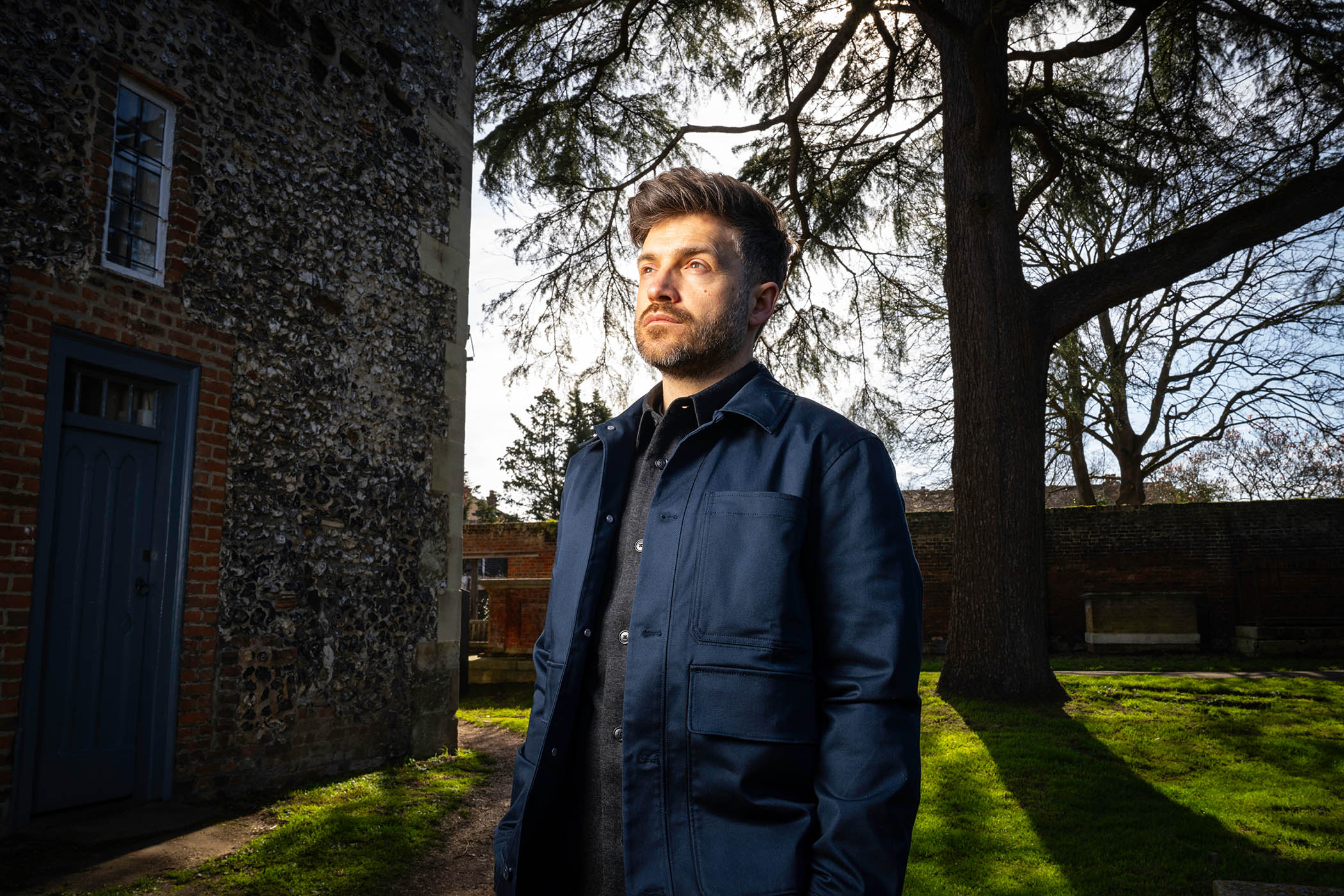

Portrait by Antonio Olmos for The Observer
Benjamin Wood was born in 1981 and lives in Thames Ditton, Surrey, with his wife and children. He is the author of five novels and teaches creative writing at King’s College London. His most recent book, Seascraper, was longlisted for the 2025 Booker prize. It follows a young man named Thomas Flett living in Longferry – a fictionalised version of Southport, where Woods grew up – who works as a shrimper but hopes to become a folk singer. The novel has just come out in paperback.
How did the idea for Seascraper come about?
I guess you could say it was an existential crisis where I just didn’t know if I would ever write another book. So the best way I can put it is to say I tried to write the book that I felt only I could write. That if you prompted ChatGPT to produce a novel set in 1960s Southport, it would generate a story that had the feeling and the details and the facts right, but it wouldn’t have what I think is the glue of this novel, which is the lived experience I put into it. I wanted to write something that, if in the future I handed somebody a book – handed my children a book – and they asked: “What have you written that truly represents you?”, this would be it.
Have you ever needed to do that – hand over a book like that?
Yes, actually. One of the best things that ever happened to me was while I was walking over Waterloo Bridge about this time last year. I had just got the proof copies of Seascraper – I would never usually cart my book around anywhere! Walking towards me was Thom Yorke [of Radiohead], who is my absolute hero. OK Computer kept me from the brink quite a bit in my younger days. I remembered I had a copy of a book in my bag. I’m sure I came across like an absolute lunatic, but I gave it to him. He went off with a copy of Seascaper. He probably put it straight in the bin. But it doesn’t matter. It felt like one of those experiences that was redeeming somehow of everything I put into writing over the last 20 years.
You wrote most of the book outside. How did that work?
There was building work happening next to my house that made it impossible to work inside. So, I started walking down to the local church near where I live, and sat down outside with a pencil and paper, because I was frustrated that I hadn’t written anything for ages. As soon as I started writing, the words came. I ended up writing for hours and nearly forgot to pick my son up from school.
After that, I went back every day for months. When the weather got worse, I bought a huge golf umbrella and waterproof trousers so I could keep writing, even in the rain. I refused to type it into a laptop until I was too terrified I was going to lose it. The exploratory part of writing is so fun that I hate when it’s over. I like to keep it alive as long as I can. There are moments in the book where the rain is drumming down on the character’s oil skins; I was in the rain under an umbrella in very different conditions.
Your books are full of music, and the audiobook of Seascraper includes a recording of your own original song. What does music mean to you?
I don’t know where music came from for me. I can’t read a note of music. I just play, and I play by feel. It diverted me away from where I think people expected me to be because I ended up dropping out of my A-levels and pursuing it more or less full time. I was on the dole for a bit while doing it. There were times in my younger days when I was really close to something happening. One time in particular I was really close and it didn’t quite happen. I had to pick myself up from that. That’s how I got back into writing fiction. I ended up going to another local college to do a BTec in art and design, just to do something creative.
One section of the book is set in a dreamscape, but the whole book carries the texture of dreaming. Do you ever write from your dreams?
I had three or four extremely vivid dreams during writing, which I think of all the time. They were dreams in which I felt like I was being visited by somebody who’s no longer with me. That’s what I captured in the book. I have a very strong sense of their presence in that dream, as if they’re communicating with me. And I thought about how Paul McCartney and Paul Simon wrote [respectively] Yesterday and Seven Psalms from dreams. It absolutely staggers me that the human imagination can be a lightning rod for such things.
Where else do you go for inspiration?
Whenever I’ve lacked inspiration I’ve either picked up my copy of In Cold Blood, or even better, watched the film of it: Capote. I also love The Assassination of Jesse James by the Coward Robert Ford. They are two films that feel as close to the experience of reading fiction as film can get without being the original text itself.
I think the reason I was drawn to writing fiction from a very young age is the idea that I could effectively make a film without any money. I could control every single aspect and build the reader’s impression of it, line by line. Great directors are in charge of every aspect of what’s on screen at all times: every sensory moment of it; how it feels. I feel really proud to have produced something like that. I don’t know what the future holds, but at the moment I feel gratified.
Seascraper is published by Penguin (£9.99). Order a copy from The Observer Shop for £8.99. Delivery charges may apply
Newsletters
Choose the newsletters you want to receive
View more
For information about how The Observer protects your data, read our Privacy Policy
Related articles: