

Speaking during Nasa’s recent Artemis II mission around the moon, pilot Victor Glover was struck not by Earth’s immensity from space but by its insignificance: “In all of this emptiness – this is a whole bunch of nothing, this thing we call the universe – you have this oasis, this beautiful place that we get to exist together.”
It’s an insight as old as the first human voyage beyond our mother planet: the spaceship isn’t the aluminium can the astronauts are floating in, but the Earth itself. The damage humanity has inflicted on this spaceship – at first unwittingly and now with increasing awareness – is a story that has its roots in deep time, and one that has sparked a political fight in the present.
Bill McGuire, a volcanologist and climate scientist, weaves both of these strands together in The Fate of the World: A History and Future of the Climate Crisis. Earth has experienced ice ages and hothouse eras, when there were no permanent ice caps and crocodile-like beasts roamed lush Arctic swamps. Now, our planet should be in a cooling cycle, related to changes in the Earth’s orbit around the sun. But that isn’t what is happening. Instead, the planet is going through a process of rapid warming due to carbon dioxide and other greenhouse gases being pumped into the atmosphere, which has been going on since the dawn of the industrial era.
McGuire’s book tells the story of the slow shifts in Earth’s climate that preceded our species, as great ice sheets advanced across the planet and then retreated, while continents came together and then danced apart. Along the way, there are descriptions of the fantastical animals that accompanied each era, from the woolly rhinoceros of the late Pleistocene to the giant scorpions and monstrously large snakes that slithered through very warm epochs. This is a book that is both instructive to the general reader and corrective to those who would use junk science in an attempt to deny climate change.
It ought to read like a tale of wonder, but the prose is frequently clogged with acronyms and unhelpful adjectives. A waterfall is described as “stupendous”, while an iceberg collision is described as “titanic”, and it’s hard to tell whether the ghost of the ocean liner is being summoned by accident or intention. The attempt to meld the sweeping chronology of McGuire’s book with rebuttals to climate sceptics is frequently jarring. It’s strange to read a planetary narrative that spans billions of years and then to come across mention of Nigel Farage, even if he is of some relevance in early-21st-century Britain. The deep knowledge on display in this book could have been marshalled better, and at times the reader may wish they were listening to McGuire in conversation on a podcast rather than trudging through these pages.
Books about climate change and those about AI tend to share a similar plot: that of overcoming the monster. The key difference between the two is that in AI stories we perceive the monster as an outsider – the big bad wolf come to steal our jobs and our agency – even though we are responsible for creating it. In climate stories, the dragon is us. Since we’re raised to sympathise with ourselves, this prompts a bit of a narrative dilemma.
McGuire describes humanity as an ‘external and invidious agency acting against the interests of all life’
McGuire describes humanity as an ‘external and invidious agency acting against the interests of all life’
David Shukman, a former BBC News science editor, resolves this paradox by putting the reader in the shoes of ordinary people confronting the threat on their own doorstep. His book, The Response: A Story of Fire and Flood in Britain’s New World of Extremes, considers the impact a heating planet will have on Britain, and asks whether the country is prepared to deal with the challenge. The answer to this question will not be a surprise, but Shukman tells his story with verve.
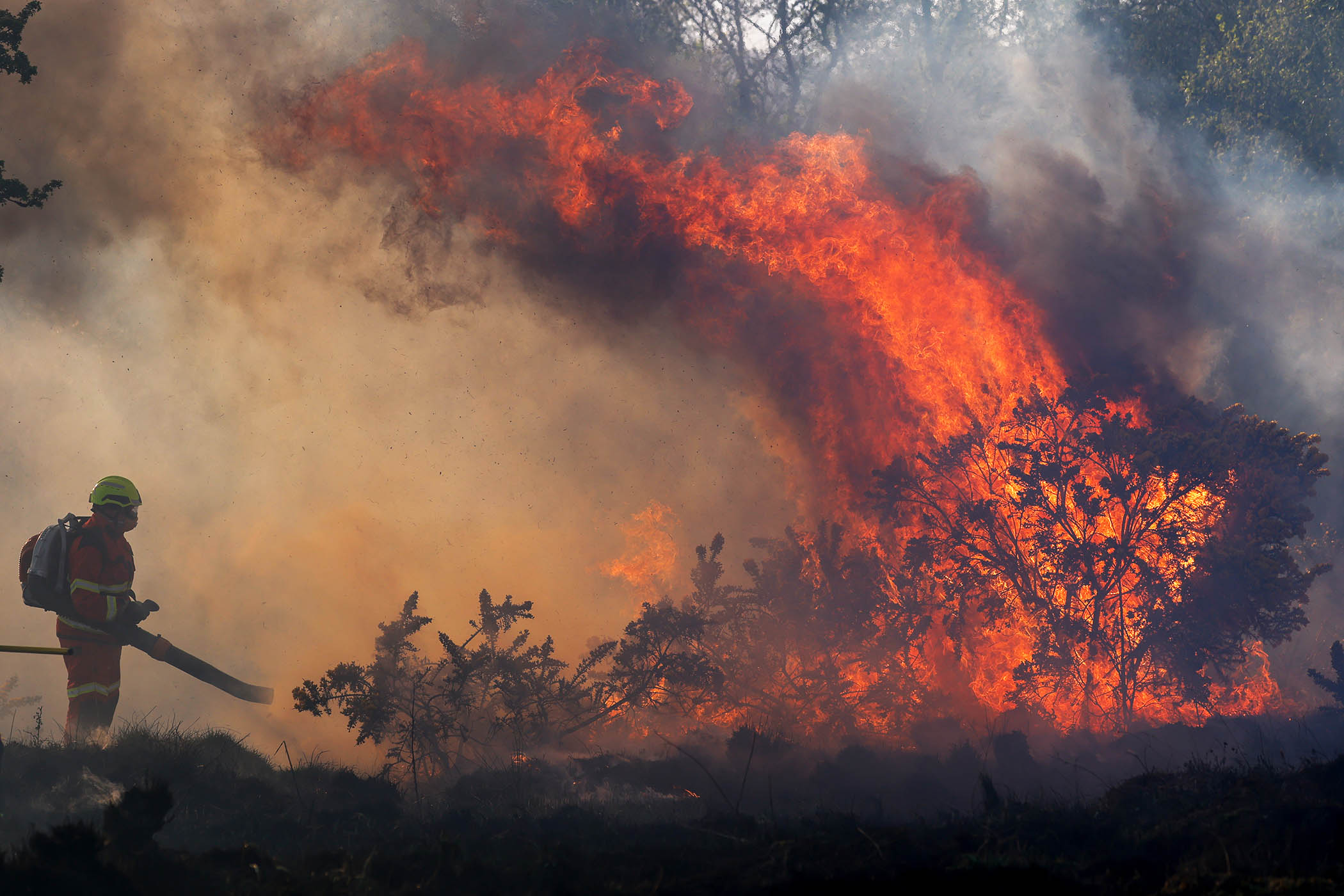
The book opens by recounting the wildfire that broke out in Wennington, on the eastern periphery of London, in 2022. No one was killed but several houses burned down and the incident strained the capacity of the emergency services – the mayor of London described it as the fire brigade’s busiest day since the second world war.
Wennington is similar to the nondescript London suburbia where I grew up, but Shukman’s flash of insight is that this is the kind of neighbourhood that is especially vulnerable to fire. The rural-urban interface, where town bleeds into countryside, has an abundance of flammable grass and other vegetation interspersed among the housing – think of southern California’s settlements that sprawl into fire-prone grasslands or Greek holiday towns where buildings creep over pine-covered hillsides. As British summers grow hotter and drier, such areas will come under increased threat.
Shukman vividly describes the speed at which wildfires can travel as well as their terrifying agility – including the ability to leap across distances, as embers are carried on the wind. This section of the book owes an obvious debt to John Vaillant’s Fire Weather (which Shukman acknowledges) and its account of a wildfire in a Canadian oil town in 2016. From fires, Shukman turns to rising temperatures, floods, air pollution and food security, and on each count identifies a failure of imagination about the scale of the crisis and the preparation needed.
Newsletters
Choose the newsletters you want to receive
View more
For information about how The Observer protects your data, read our Privacy Policy
Shukman suggests several reasons why this might be the case: a lack of coherence at government level about who’s in charge of implementing measures; a problem of timescales, which makes it easier to focus on a sudden disaster like a plane crash than a slowly evolving one; and the relatively small and local scale of some measures that places them outside of Whitehall’s view.
For these reasons, a common response to a natural disaster is to slam the stable door after the horse has bolted. Two decades after Hurricane Katrina, New Orleans now has one of the most robust flood-protection systems in the world. A storm surge that ravaged the North Sea coast in 1953 led – after some delay – to the construction of the Thames Barrier, which shelters London from rising sea levels.
Shukman’s book is a lively read, especially when he interviews the general public about the impact of fires and floods on their lives. His jargon-free approach is refreshing, though he is slightly too fond of the staccato sentence that works better in a TV news script than it does in a book.
Inevitably, both books have a sombre tone. Humanity has developed the technology to allow us to stop using traditional hydrocarbons, at least for the bulk of our energy consumption: solar and wind power, batteries, and perhaps a bit of nuclear energy (if we can learn to build nuclear power stations on schedule). But a combination of short-term economic incentives and increasingly malign politics in many western countries are conspiring against our best interests.
The trickiest part of books dealing with climate issues is grasping what the future may hold. Climate shocks might cause large-scale deaths and prompt mass migrations, but the interplay of natural and social factors is hard to predict. Humans have demonstrated an ability to endure in bleak environmental conditions, and the decisive factor is usually the resilience and adaptability of nations and cultures. The past is a poor guide to a climate-altered future, though, as going beyond certain tipping points may lead to significant and irreversible changes, such as the death of coral reefs and accelerating ice melt.
It’s understandable that McGuire lands in a gloomy place, describing humanity as an “external and invidious agency acting against the interests of all life”. We are the dragon. There may be a grain of truth in this statement but it seems unfair to pin the blame for this mess on all humankind, lumping together the occupants of oil company C-suites and vegetable sellers on the streets of Ahmedabad.
Fittingly, given his BBC background, Shukman looks for common ground and finds it in the idea of adaptation. The far right may scoff at climate change but there’s acceptance across the political spectrum of the need to prepare for meteorological extremes.
His final chapter is titled “Protect what you love”, starting with ourselves and our families and scaling up to the local community and then the country. Like the astronauts moved by Earth’s beauty in the desert of space, love offers a way to overcome the monstrous greed that is doing such harm. But, in truth, it seems a frail defence against the scale of risk he and McGuire have outlined.
The Fate of the World: A History and Future of the Climate Crisis by Bill McGuire is published by HarperNorth (£20). Order a copy from The Observer Shop for £18 (10% off RRP).
The Response: A Story of Fire and Flood in Britain’s New World of Extremes by David Shukman is published by Witness Books (£25). Order a copy from The Observer Shop for £21.25 (15% off RRP).
Delivery charges may apply
Photography by Jeff J Mitchell/Getty Images