
Related articles:
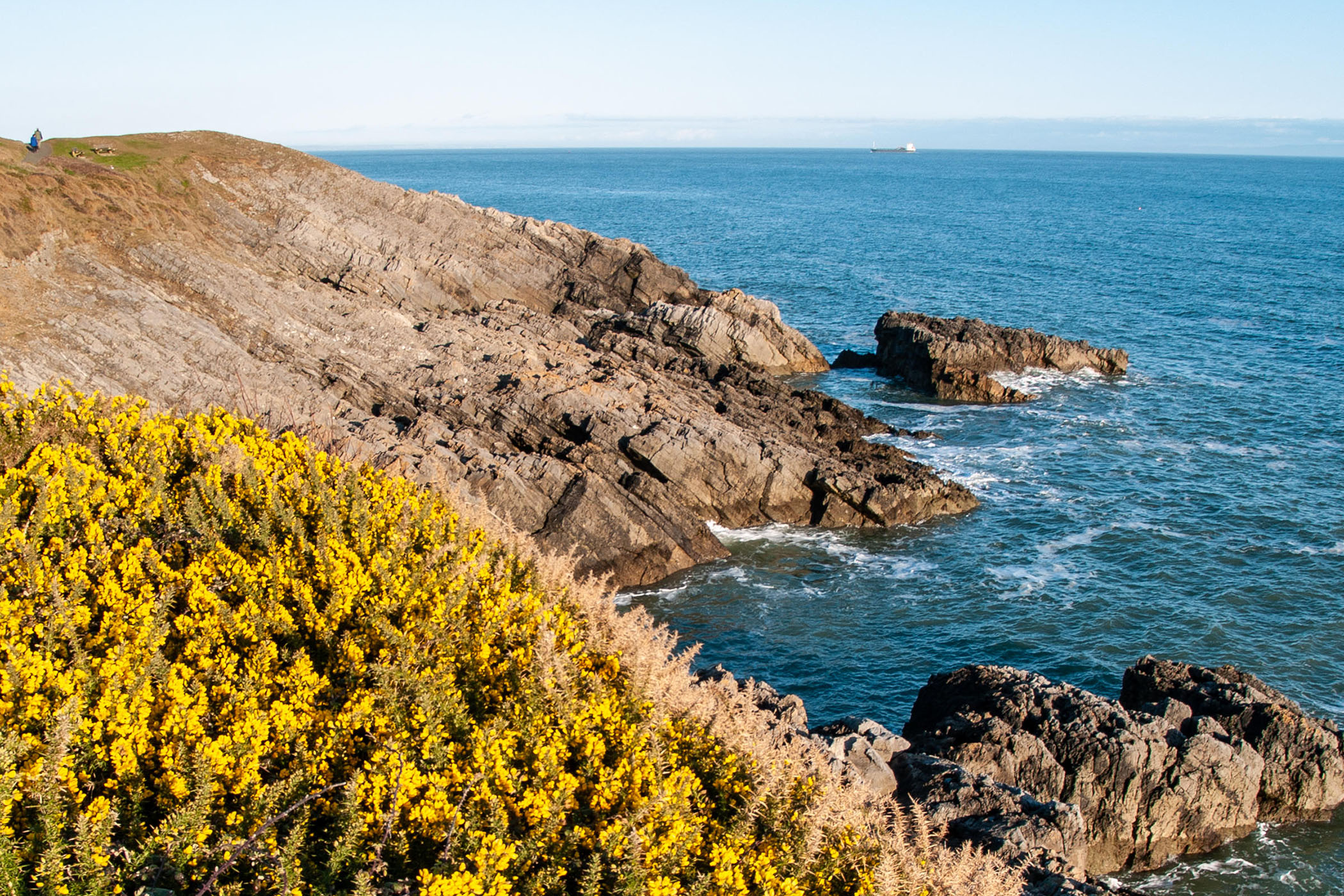
William Blake’s poem Auguries of Innocence begins: “To see a world in a grain of sand”; Francis Gooding’s The Script of the Stones does exactly this, at times literally. Here, microscopic particles of rock and soil expand into vistas of shifting continents, reaching back through millennia. Subtitled A Short Walk at the End of the World, the book takes as its starting point a section of coastline – “half a mile of scrubby, unremarkable clifftop” – along the southern edge of the Gower peninsula in Wales, a place deeply embedded in the strata of the author’s memory since childhood. It is not memoir, though it contains elements of personal history, folded into an intimate exploration of the landscape and the ways in which it embodies broader historical, geological and political themes: “I hoped that it would be a way of showing that each microcosm can teach us to think about the macrocosm.”
An early chapter poses the question: “What sort of book is this?” Gooding, who is a contributing editor at the London Review of Books and head of research at the Derek Jarman Lab at Birkbeck, University of London, appears to be working out the answer as he goes along; the result is a colourful collage of genres of the kind that delights curious readers (and makes marketing departments despair). Its obvious antecedents are the likes of Olivia Laing’s To the River or WG Sebald’s The Rings of Saturn: narratives constructed around a walk through a particular place whose specific features and history prompt associations in the narrator’s mind that spin off into unforeseen tangents and digressions. “For me, this stretch of cliffs always seemed the axis around which the living world itself turned, though I suppose that this is merely a way of saying that it was the axis around which my idea and my experience of the living world turned, and around which I myself turned,” Gooding writes.
Though he was born and raised in London, his maternal grandparents were local and owned a house on the Gower coast, where he spent childhood holidays and now takes his own children; this generational continuity is, in part, an inspiration for the book. “To revisit the scene of childhood as a parent, and know that our children are the fourth generation to have walked the same muddy pathways is a strange sensation,” he writes: “if I think about it too much, it becomes as vertiginous as the cliff itself.”
Time is a constant preoccupation, particularly the dizzying scale of geological time, embodied in the contrast between the enduring limestone cliffs and the transience of the human lives that come into contact with them. Gooding traces this preoccupation to a moment of epiphany he experienced in his early 20s, after the murder of a close friend. (As with most of the more personal episodes in the book, he keeps the detail scant.) Escaping London for Gower, he recalls: “As I sat thinking and grieving and desolate, a sudden feeling of the deep permanence of the landscape, of the eternal presence of the world, had overtaken me like a kind of brief green gnosis … I felt that I had seen time revealed, for one moment, as an infinite presence in living things. The sense of it has never really left me.”
But in recounting this experience, he is immediately forced to acknowledge that the comforting notion of an enduring landscape already feels out of date. So much in the natural world that for centuries or millennia seemed permanent – even something as apparently solid as a cliff – is now subject to rapid and catastrophic change as a result of the climate crisis: “Where once the world was largely reliable, it is now violently unpredictable.” It is impossible, then, to write about landscape without also discussing the human capacity for destruction; what begins as the story of the author’s relationship with one beloved place must also encompass the often violent ways in which people have treated the natural world and one another. It leads him to stories of Auschwitz, to British nuclear testing in the 1950s, to Tudor Acts of Parliament for the destruction of birds.
The easy fluency of Gooding’s descriptions of landscape, his confident familiarity with the names of plants and geological features, would seem to place the book in a tradition of nature writing that he identifies disparagingly as “man walking”. But he is wary even of the idea of “so-called nature writing”: “Sometimes I feel the genre has unacknowledged colonial bones – that it springs from a line which reaches back towards the exotic travelogue, the intrepid explorer’s diary, the witty reports penned by the scions of Empire as they went out collecting, numbering, naming…” He mocks the “male, bold, solitary” writer who “moves through the landscape in an ecstasy of natural communion, engaged in a display of exploration”, wryly adding in parentheses: “(I am quite aware that I have just done exactly this).”
How, then, should we relate to the landscape? The question occasions a glance backward, as he traces the entangled histories of the organic farming movement with fascist politics, and a more optimistic look forward, to recent cases where indigenous peoples have successfully argued for elements of the landscape – rocks, rivers – to be granted legal rights as living entities.
The book’s title is taken from a poem by the Welsh poet Vernon Watkins, born in 1906, who was a friend of Gooding’s grandfather and who is commemorated with a granite stone set into the cliff face. Watkins wrote a series of poems featuring the mythical Welsh bard Taliesin and set firmly on the Gower cliffs; his Taliesin declares: “I have been taught the script of the stones, and I know the tongue of the wave.” It is this visionary understanding of the living landscape’s language that Gooding has tried to capture in his close reading of its elements, though there are moments when his search for overarching meaning comes to sound grandiose: “The spoil of our labours is pushed up into the unknown future as a new molehill in the morning of tomorrow, glittering with fragments of today and yesterday. Everything is everywhere.”
Related articles:
The reader might wish for more glimpses of the personal, or for those that occur to be a little more fleshed out. The book is dedicated to the memory of his father, whose death from cancer is briefly referred to in one chapter, and it often feels as if the writing is a way of addressing death obliquely. He returns repeatedly to the theme of nature renewing or transmuting itself out of decay. In a fascinating aside towards the end, Gooding relates a letter that his Welsh grandfather, an artist, received from Carl Jung, who had been given one of his paintings as a gift (casually, Gooding notes, “it used to be in a brown manila envelope in a drawer in the house where I grew up, but now it is in the National Museum of Wales”). The painting was of a black mandala, entitled The Black Apple of Gower, a symbol of eternal renewal. “I understand your picture as a confession of the secret of our time,” Jung wrote.
The Script of the Stones is impossible to categorise; to immerse yourself in it is like a conversation with an erudite friend eager to share his wide-ranging knowledge, or the analogue equivalent of going down an internet rabbit hole, but infinitely more satisfying. Gooding’s writing is richly textured, full of fine-grained detail, allowing the reader to feel they have walked the same paths and tasted the same soil. The book will stand as a tribute not only to the place it commemorates, but to the myriad influences that formed the writer through it. It’s a pleasing coincidence that, in geological terminology, “The rock underneath the soil, from which the soil acquires its character, is called the parent.”
Newsletters
Choose the newsletters you want to receive
View more
For information about how The Observer protects your data, read our Privacy Policy
The Script of the Stones: A Short Walk at the End of the World by Francis Gooding is published by Atlantic (£18.99). Order a copy at The Observer Shop for £17.09 (10% off RRP). Delivery charges may apply
Photograph by KM Lucas/Alamy