


Mining is a dirty business. Carving up mountains, digging out their entrails, polluting soil and rivers… the environmental impact is nearly as dismal as the trail of death and disease it inflicts on the men, women and children who descend into the pits. And yet there is also something romantic about it.
The modern world is conjured, like sorcery, from the matter buried underground: the steel in buildings, the copper in wires, the quartz in semiconductors and the cobalt and nickel in batteries. Each age of human progress is marked by extraction: bronze, iron, coal, oil, and now the elements of a renewable age. For decades, oil was the only commodity that really drew attention from the wider public, because it was both the energy base of our society and a prime source of the carbon emissions heating the planet. But in recent years, a succession of books has shone a spotlight on the other materials that have built our societies, notably Javier Blas and Jack Farchy’s The World for Sale and Ed Conway’s Material World.
Attitudes to trade and the flow of goods around the world have altered. Dial back a decade or two and it seemed perfectly acceptable to import gas from Russia and rare earth elements from China, and to trade oil on global markets. Now, China is threatening to cut off supplies of rare earths – used in everything from wind turbines to electric cars – while the US is seizing control of Venezuela’s oil exports. The world has become a chess board with great powers competing to control the squares.
Nicolas Niarchos’s The Elements of Power is the latest to turn its scrutiny to the matter that makes modern life. He focuses on batteries, and the raw materials that go into them, and the trade-off this implies: cleaner power in developed countries in exchange for “pollution and suffering elsewhere”. Niarchos, grandson of the Greek shipping magnate Stavros Niarchos and a journalist whose reporting has been published in the New Yorker, tells the story of the scientific advances that created lithium-ion batteries and the human consequences of extracting their components. The book skips around the world like a spy movie: from the Sahara to Indonesia and Tokyo to Uganda, but its fulcrum is the Democratic Republic of the Congo, which is the place where Niarchos’s twin narratives of technological progress and human suffering intersect.
If the world is now a chessboard, Congo has become a contested square at its centre
If the world is now a chessboard, Congo has become a contested square at its centre
Niarchos goes deep into Congo’s past, digging up the history of mineral extraction before the Europeans arrived, with vivid images of master smiths passing secrets through generations and sorcerers invoking ancestral spirits before mines were excavated. There is a conflict between a Red King and a Black King in the legends of Congo’s past, which sounds like something from a fairytale, or perhaps a foreshadowing of the new global struggle between Beijing and Washington that we are all living through. The book’s subtitle speaks of “the dirtiest supply chain on Earth”, but it would more accurately be subtitled: the tragedy of Congo, for that is where the writer’s heart is. Early on, he poses the question: “Why is a country so rich in minerals still so poor?”
The era of renewables is, more than ever in the world’s history, an era of materials. It requires six times the quantities of minerals to manufacture an electric vehicle (EV) compared with a car with an internal combustion engine: from lithium and nickel to cobalt and manganese. The green shift also requires the electrification of everything, from domestic heating to shipping, and this is a good thing as these technologies are more efficient and will reduce emissions. But electrification is a monster that eats copper: needing the metal for solar panels, wind turbines, batteries and EVs. Valuable metals are scattered through the Earth’s crust but there are places where it is especially straightforward and profitable to extract them. Indonesia is the Saudi Arabia of nickel and Congo dominates the global supply when it comes to cobalt, an essential ingredient in lithium-ion batteries, employed in the smartphones and laptops we use every day.
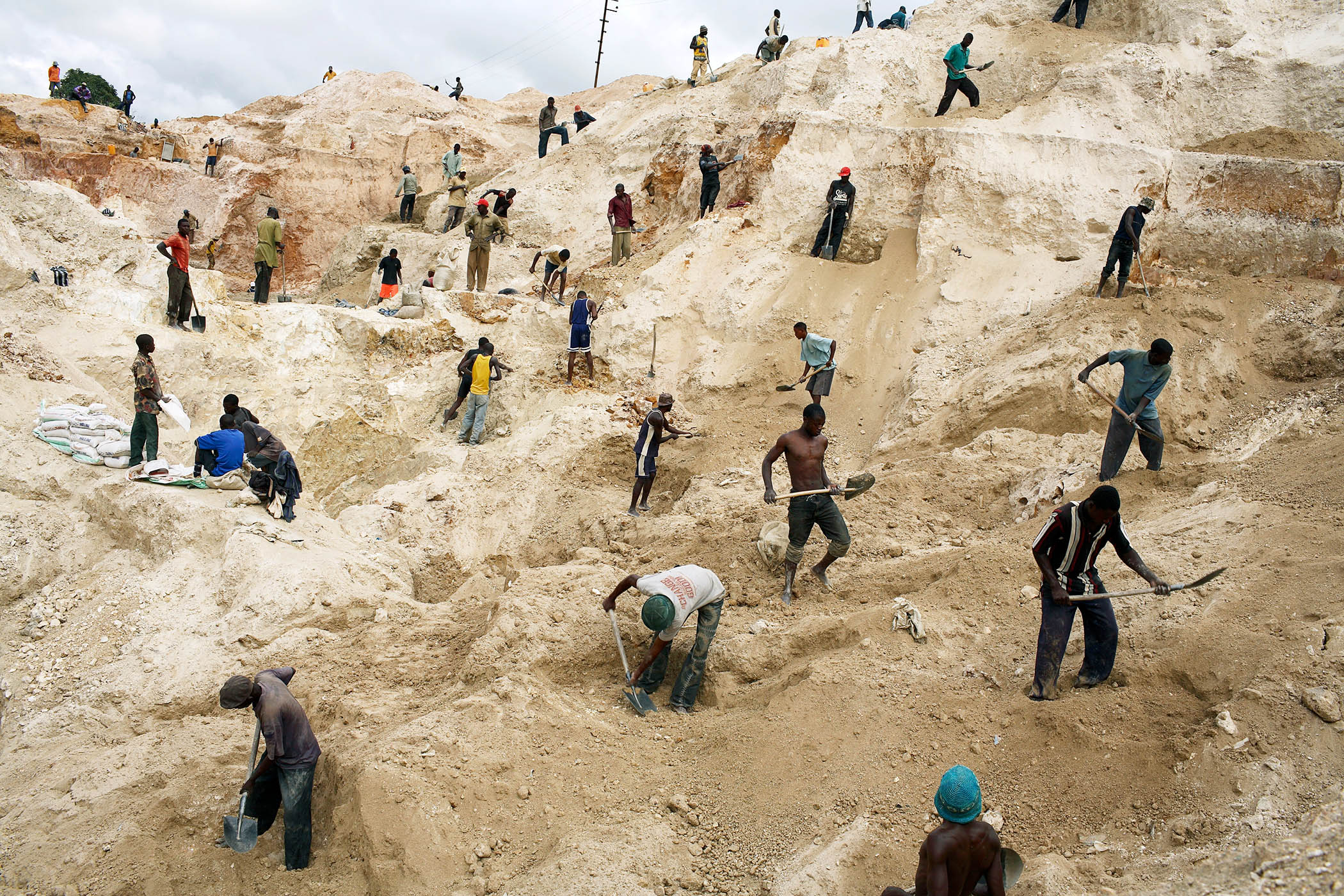
Most of Congo’s cobalt is produced in industrial mines, where there are meant to be safety standards and labour conditions are subject to scrutiny by campaigners and businesses that buy the raw materials. But a chunk of Congo’s mineral wealth is extracted by people known as “artisanal miners”, which has nothing in common with artisanal bread or craft beer, but is the exceptionally dangerous work of informal mining, tunnelling underground by hand along veins of cobalt. Accidents are commonplace in this unregulated sector, with dozens of deaths every year when makeshift pits collapse. The consequences are described in heart-wrenching detail in the chapter “Buried Underground”. (The scholar Siddharth Kara also covered this ground in his 2023 book Cobalt Red.)
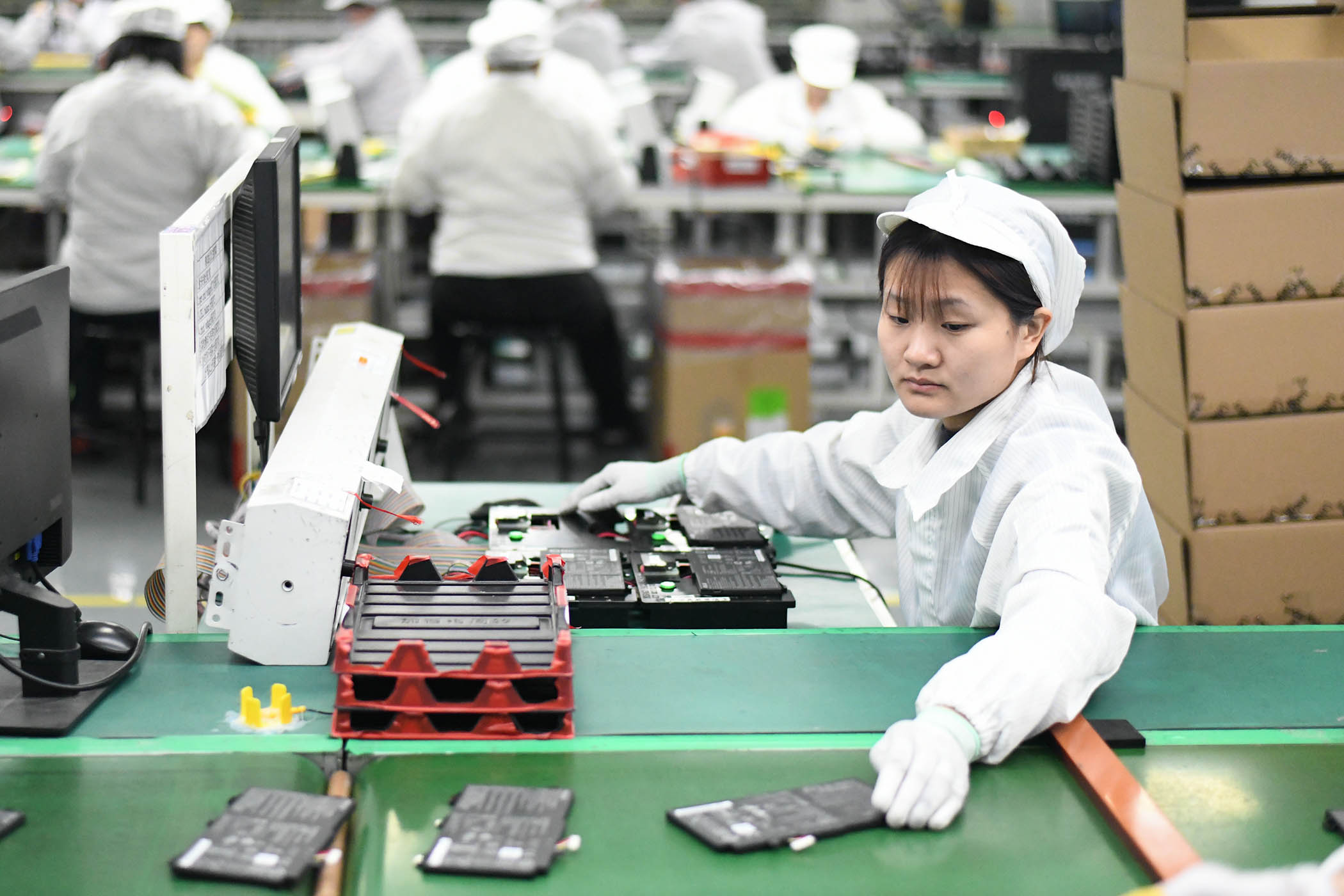
Above: lithium battery products being assembled on a production line in Nantong, Jiangsu province, China. Main picture: artisanal miners dig for copper in the Ruashi mine in the Democratic Republic of Congo.
If the world is now a chessboard, Congo has become a contested square at its centre. Niarchos follows this part of the story closely, suggesting that the US, a country “still run on hydrocarbons – it was even fighting a losing war for them in Iraq” had slumbered through the growth of China’s influence in the Congo. America has clearly woken from that nap now. The quest for control of resources provides one of the animating impulses of the Trump administration’s global ambition, from Greenland to the depths of the Pacific, where the US is expediting plans to plunder the seabed for mineral-rich nodules.
Donald Trump has taken credit for a peace deal between the Democratic Republic of the Congo and Rwanda (the president’s claims to have ended the war may be mildly exaggerated, as fighting in the region continues). At the signing of the peace agreement in Washington, Trump declared: “There’s tremendous wealth… in that beautiful earth.” Congo and the US have signed a partnership giving US investors preferential access to the African country’s treasure. The US is helping to fund a 1,300km rail line linking the mining regions of the Congo with Angola’s Atlantic coast.
A few of the bigger questions end up dangling in Niarchos’s storytelling (in fairness, he emphasises at the outset that this is a journalistic book rather than one with grand solutions). It won’t be entirely clear to readers why the Congo has failed to profit from its resource riches when a number of petrostates (Norway, and, to some extent, the UAE) have spread oil wealth across their populations and sought to diversify their economies. Part of the answer in Congo’s case must be the frankly diabolical meddling by foreign powers, from King Leopold II of Belgium to the CIA to Rwanda.
Newsletters
Choose the newsletters you want to receive
View more
For information about how The Observer protects your data, read our Privacy Policy
Niarchos acknowledges the urgency of bringing down emissions and transitioning away from oil and gas. The world is currently on track for a 2.6C temperature increase – that is, 2.6C above the average preindustrial temperature – by the end of this century. Continuing to burn oil, gas and coal will, in the absence of any technology to capture the carbon, lead to a world of extreme weather and increasingly difficult living conditions for much of the Earth’s population. From the perspective of people living above the world’s biggest oil resources, the fossil fuel era hasn’t been pretty, as decades of coups and wars to protect the free flow of hydrocarbons have illustrated.
As this book shows, in pages of evocative reporting, the age of renewable energy may be better for the planet but humanity will not become any less ruthless in its quest for buried treasure. The Red King and the Black King will keep on battling for control of the board.
The Elements of Power: A Story of War, Breakthrough Technology and the Dirtiest Supply Chain on Earth by Nicolas Niarchos is published by William Collins (£25). Order a copy from The Observer Shop for £22.50. Delivery charges may apply