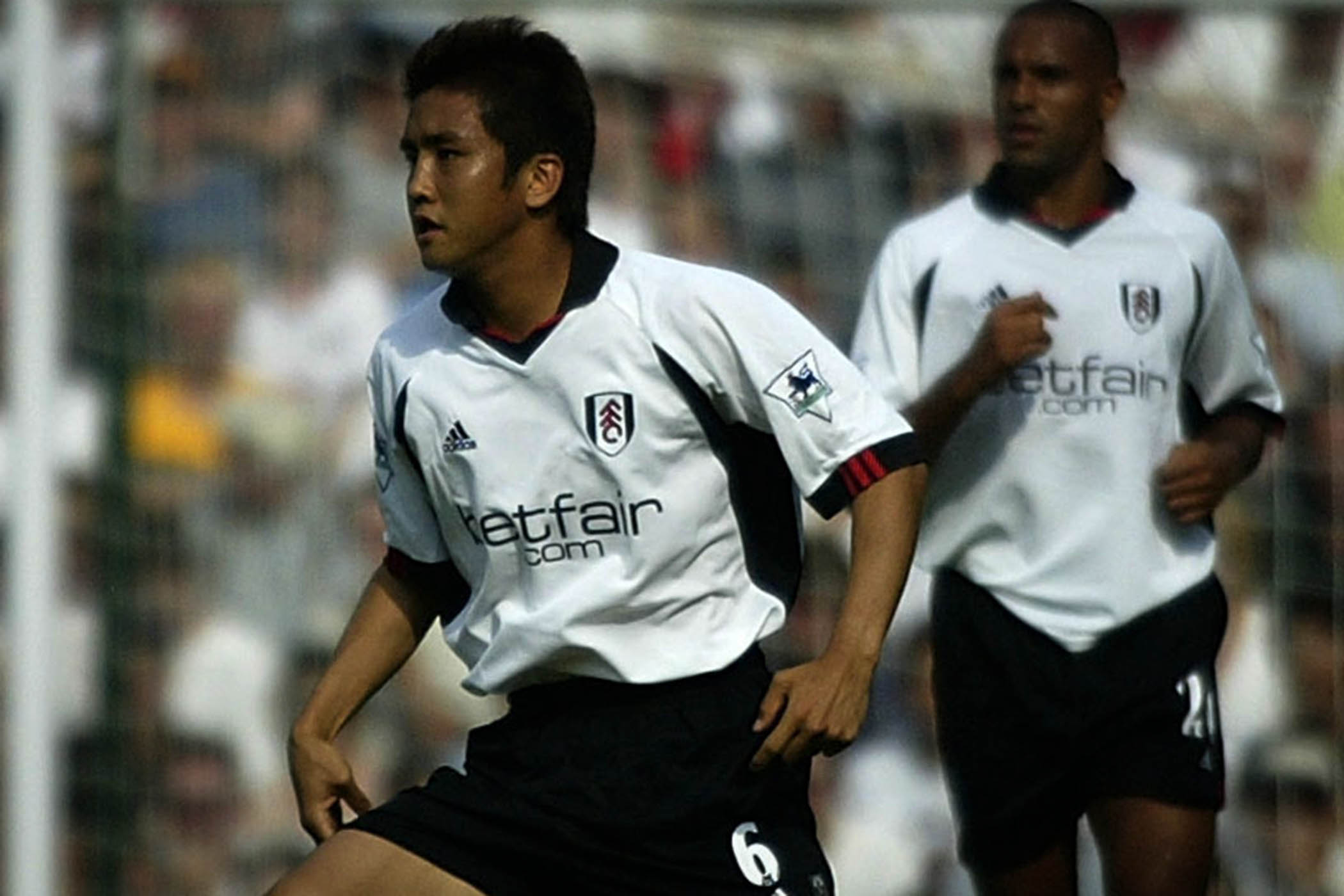



Last month, the Premier League side Crystal Palace announced that next season’s shirts would be sponsored by the software platform Temporal. It is not, on the face of it, an era-defining change. But it is part of a shift that means for the first time since 17 August 2002, when Fulham walked out on to the pitch with Betfair emblazoned on their kits, no Premier League team next season will have a gambling sponsor on the front of their match shirt. The agreement was made in 2023, as part of a voluntary scheme to reduce gambling advertising within football.
The journey from the first Betfair shirt to today is the focus of Darragh McGee’s book Imitation Games: How Gambling Hijacked Sport. McGee, a lecturer at the University of Bath, has spent the past decade researching the growth in sports gambling, which has moved a long way from its origins in horse racing and boxing. Imitation Games focuses predominantly on gambling within football – and, as McGee admits, it was less a case of a hijacking than being welcomed with open arms.
The story of how gambling became so ubiquitous within football involves a perfect storm of deregulation by Tony Blair’s New Labour government, the arrival of the digital age and the explosion in popularity of the Premier League. The Gambling Act 2005 lifted restrictions on advertising by gambling firms: citizens were deemed responsible for their own decisions, rather than needing to be protected by the state. Within a couple of years, people would have their own handheld – and highly addictive – personal bookmakers (though it was another half a decade until mobile gambling technology really began to take off). By 2016, it was estimated that British gamblers were losing £12.6bn a year. (That figure now stands at £16.8bn.)
Meanwhile, football clubs were enjoying the huge influx of new money into their coffers, with scant regard to where it was coming from. No inch of football has been untouched by gambling sponsorship over the past two decades, whether clubs, players or the media.
The huge amount of information pumped out around football gives gamblers the increased sense that they might actually have an edge over the house. McGee demonstrates how this is a mirage, with gambling companies regularly banning anyone who starts winning good money, often in the name of tackling corrupt behaviours such as match-fixing.
The kind of data that is now available within football tends to be presented as an unalloyed good. The concept of “expected goals”, or xG – a statistical measure of how likely a player or team is to score – is firmly integrated into sports media. Yet measures such as these, which can help explain a team’s performances versus their results, also power large-scale betting models.
To see how complicated this has become one need only look at Brentford FC and Brighton & Hove Albion, the much-feted “data-savvy” clubs within the Premier League. In an era when teams are often owned by petro-states or US private equity, the feelgood story of two clubs bought by their fans and taken from the lower leagues to the elite of English football – and, in Brighton’s case, European football – is hard to resist. Yet the team’s owners, Matthew Benham and Tony Bloom, made their fortunes running betting syndicates. The bespoke data models used to power their business success are now also powering the data-driven recruitment and analysis operation that has supercharged the two football teams.
Betting companies pump out messages such as ‘gamble responsibly’ or ‘when the fun stops, stop’ to free themselves from any duty of care
Betting companies pump out messages such as ‘gamble responsibly’ or ‘when the fun stops, stop’ to free themselves from any duty of care
There is an even darker side to data within sports betting. Betting companies can track every element of what its users are doing: not only the amount of money they are spending but also every single click on an app or website. Instead of this data being used to create a robust system of checks and balances, it is regularly exploited to encourage people who are already gambling excessively and making significant losses to continue doing so. A coroner investigating the suicide of Luke Ashton in 2021 found this to be the case when he criticised Betfair for not intervening to protect Ashton based on his gambling pattern. Ashton was gambling up to 100 times a day and had accumulated debts of £18,000.
As the philosopher Hanna Pickard argues in her book What Would You Do Alone in a Cage With Nothing But Cocaine?, the “broken brain model” of addiction – which describes it as an uncontrollable personality flaw – affects our expectations of responsibility and recovery. Pickard’s focus is on drugs, but it is easy to see how this thinking applies to the world of gambling, where companies pump out messages such as “gamble responsibly” or “when the fun stops, stop”, freeing themselves from any duty of care to their users. Meanwhile, they have a unique insight into what is pushing people into gambling addiction, hidden within their own proprietary analytics and away from academics and researchers.
At times, McGee seems a bit torn between gonzo-style journalism and his more formal academic background, particularly when it comes to fast-changing situations such as in the US, where the 2018 supreme court decision to overturn a federal ban on sports gambling has led to a rapidly growing new market. The ensuing rise of Kalshi and Polymarket, self-styled prediction markets, have increased the range of topics people can bet on.
Newsletters
Choose the newsletters you want to receive
View more
For information about how The Observer protects your data, read our Privacy Policy
Kalshi was forced to remove a market that allowed bets on whether Iran’s supreme leader, Ayatollah Ali Khamenei, would be “out” by a certain date, but not until it had drawn $54m in trades. Polymarket had also offered odds on the possibility of nuclear detonation in relation to the Iran war. Understandably, McGee can only skim the surface of these kinds of rapidly emerging developments.
As Premier League clubs began to announce their fresh front-of-shirt sponsors, free from any mention of betting companies, Manchester United were reported to be in advanced talks to sign a deal with Betway to sponsor their training kit. Meanwhile, Americans are expected to bet more than $3bn on the World Cup, which begins there next week. And although the use of sports stars to promote gambling companies was banned in 2022, the former footballer Peter Crouch makes a cameo in Paddy Power’s World Cup ad and Danny Dyer (who is West Ham star Jarrod Bowen’s father-in-law) is the face of it.
The decision to no longer allow betting advertising on the front of Premier League shirts is admirable. But in the context of the harm caused by gambling – there were 1.4 million British adults with a betting problem in 2024 – it is the equivalent of rearranging deckchairs on the Titanic.
Imitation Games: How Gambling Hijacked Sport by Darragh McGee is published by Bodley Head (£22). Order a copy from The Observer Shop for £18.70 (15% off RRP). Delivery charges may apply
Photo of Junichi Inamoto, debuting the Betfair shirt during Fulham’s match against Bolton Wanderers on 17 August 2002, courtesy of Getty Images