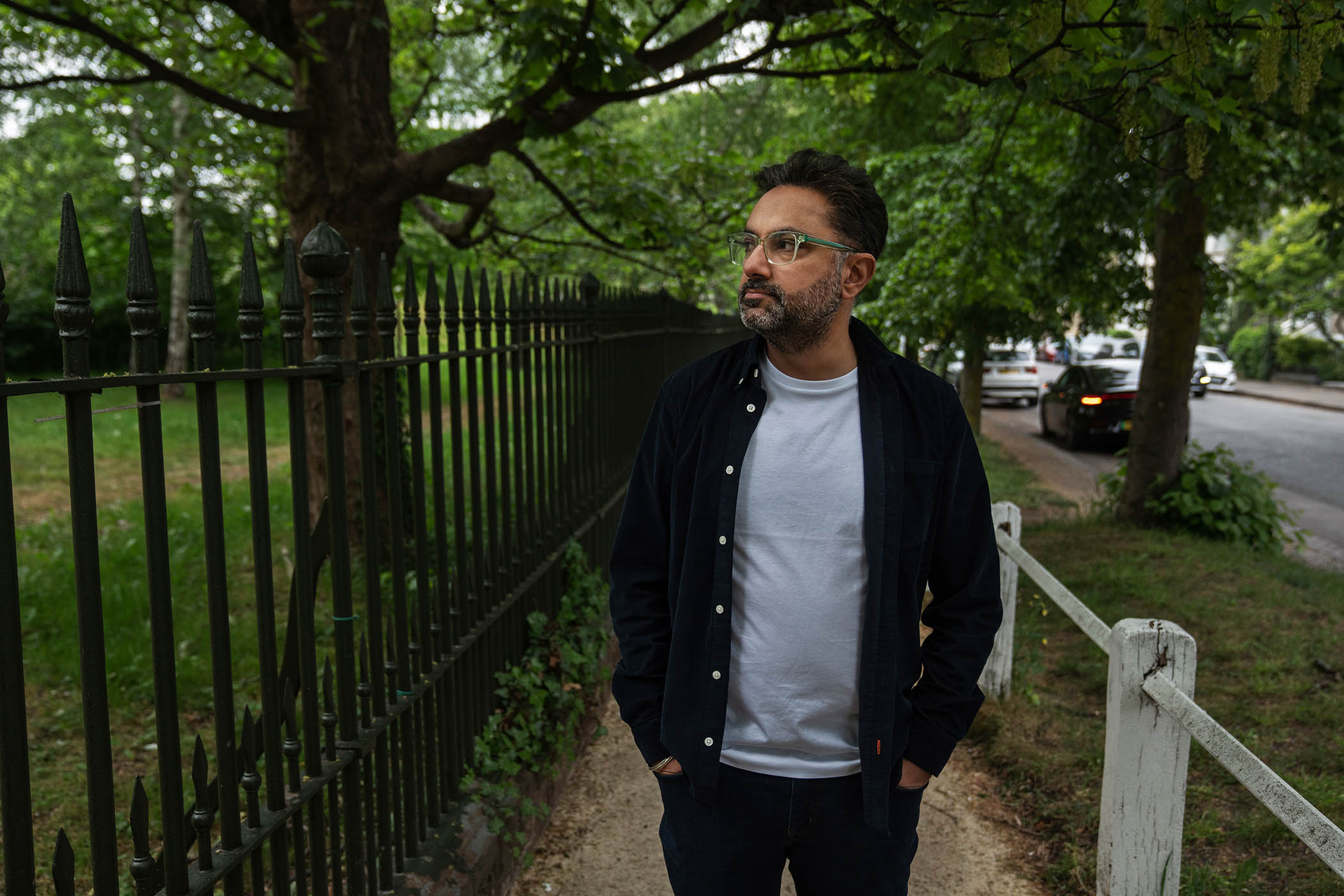


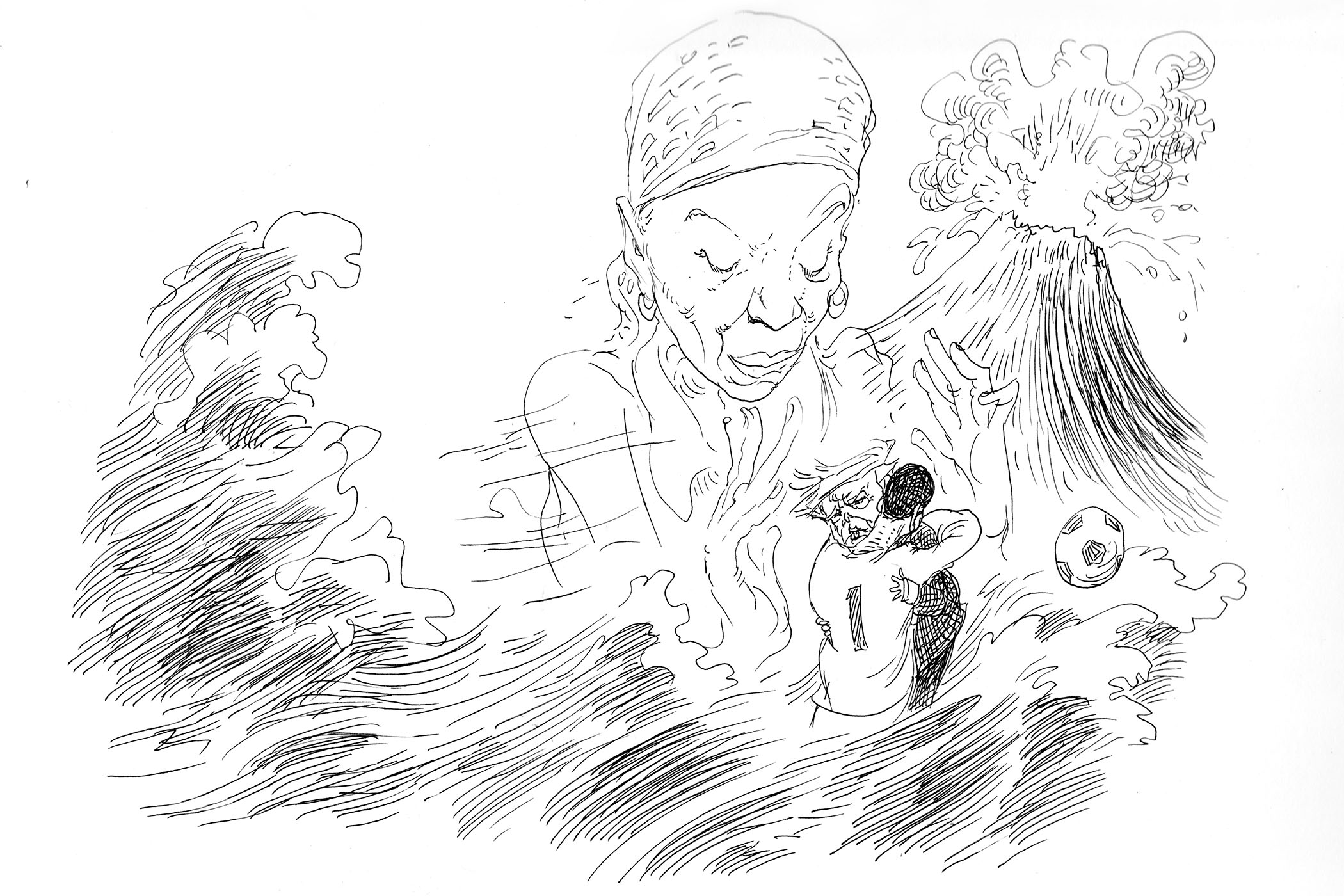
Portraits by Tom Pilston for The Observer
On a hot early summer lunchtime, Sathnam Sanghera and I are lost in the woods. We’re on a George Michael-inspired trail across Hampstead Heath – Sanghera has written a compulsive new fan’s-eye life of the singer – and we are looking for a particular spot in the gay cruising area that George helped to make famous. It’s the place he would head to for night-time adventure when the mood took him, as it frequently did. He called it the fuck tree.
The tree has a Wikipedia page, and Sanghera has dropped a pin on his Google Map to help us find it, but the signal comes and goes. We press on gamely through the bushes, retracing our steps, talking slightly loudly to advertise our presence. “There may be a trail of condoms to follow,” he suggests.
I can’t help thinking that George would have been mightily amused by the sight of two journalists Stanley-and-Livingstoning it through the undergrowth in search of traces of his past, 10 years after his death; he could never quite understand the heterosexual obsession with his private life. The tree in question is an oak that is half uprooted and grows parallel to the ground. (It was described in Armistead Maupin’s 2024 novel Mona of the Manor as “a chaise against which you could lean for wanking or bend over”.) We eventually find it, and stand side by side a little awkwardly in front of it for a long moment, admiring its girth, wondering if there should be a blue plaque, before heading back to the road.
Sanghera’s book could seem a curious kind of departure for him, though in fact it is a kind of sequel to his beautifully drawn memoir The Boy with the Topknot, about growing up in the Punjabi Sikh community in Wolverhampton in the 1980s. (For example, when he went to the barbers aged 13 to have that topknot cut off, against his parents’ wishes, he took George’s blowdried cover image from Freedom! on a cassette for courage.) In between those books he has written two bestselling histories of Britain’s colonial past and present – Empireland and Empireworld – which won him high critical praise and social media flak in about equal measure. The flak came from rightwing commentators and trolls who didn’t want to hear his meticulous, nuanced portrait of the continuing denial and consequences of 300 years of British global conquest. That trolling was one reason for the shift into pop culture, he suggests.
“I was planning, unbelievably, to write a book about another British colonial legacy, Israel and Palestine, a couple of years ago – not long before 7 October,” he says. A friend, the writer Elizabeth Day, told him that was an insane idea and advised him to do something different. “She was right,” he says. “I hadn’t fully accepted how traumatising it has been becoming a sort of spokesperson in that colonialism debate. It was like every two weeks I’d get invited on the Today programme or something and people would start mischaracterising [what I said] again. It was just weird. I think it was David Baddiel who said the definition of intellectual celebrity is everyone having the wrong idea of what you think. It became a bit like that.”
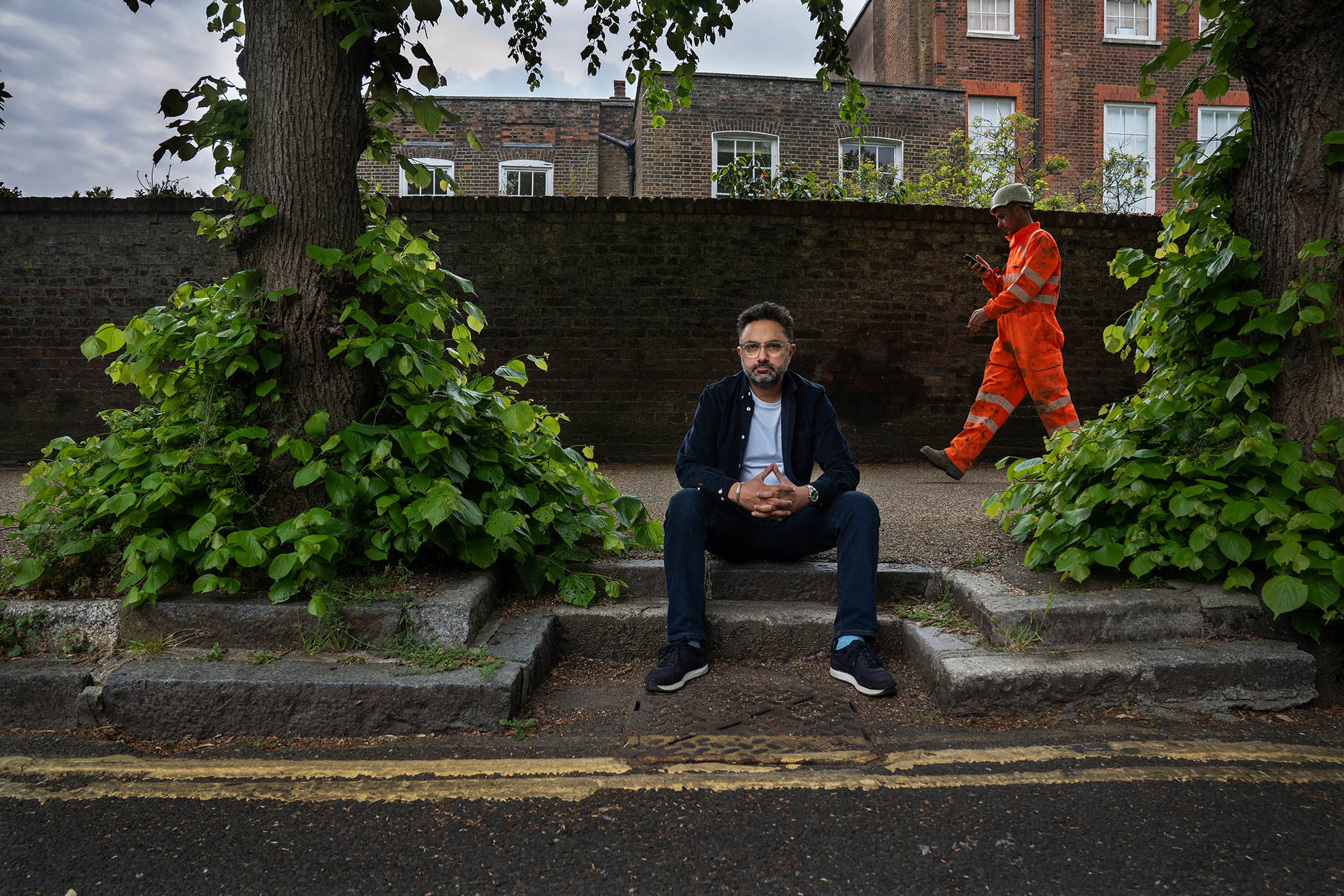
Sanghera, who writes features and a column for the Times, says he has given up 95% of his social media, which became a wearying addiction in those culture-war years. He has welcomed the liberation, but admits: “You can probably take opting out of those arguments too far. I feel like a lot of liberal people are not even consuming news any more, and just going to their allotments. And I understand that temptation. In a way, George Michael was my version of the allotment.”
Sanghera is 49 and last year got married to the BBC culture correspondent Noor Nanji. He may have given up many of the trappings of the religion he was born into, but, as he lays out in the book, his faith in George has been a lifelong commitment. It began at school in Wolverhampton, where he would defend the singer against indie-loving all-comers and continued through university at Cambridge, and into adult life. “I was worried that spending two years thinking about him for the book, I would hate him by the end,” he says. “But it’s the opposite. I actually admire him even more, because I think he faced so much shit.”
Newsletters
Choose the newsletters you want to receive
View more
For information about how The Observer protects your data, read our Privacy Policy
The book is a fabulous account of the various expressions of George’s precocious and polymathic talent, from writing Careless Whisper aged 17 on the top deck of the No 32 bus to the great soul-revival of Faith. It is also a horrific reminder of just how monstrously homophobic mainstream and tabloid culture in this country was right through the 1980s and into the 1990s. Sanghera went to a boys’ grammar school where, in the time of Aids panic, no one admitted to being gay (“one of my closest friends came out subsequently,” he says). “But it was also like there were no gay people. I remember people asking whether you thought Boy George was gay. Or Freddie Mercury. I was 16 before I realised Elton John was gay. What were we thinking?”
In this context, George Michael becomes a kind of reluctant – and then fabulously defiant – truth-teller. “There was all this kind of retro condemnation of him for not coming out earlier,” Sanghera says (the singer was first outed by the Los Angeles police department when he was caught cottaging in 1998; university friends pasted the Sun front page “Zip me up before you go go” to Sanghera’s door). “But then he came out and divulged every possible detail of his sex life.”
Our walk has been planned as something of a stations of the cross of George’s north London odysseys. We begin at the Flask pub in Highgate, opposite George’s big old house on the Grove, a leafy set-back lane of Georgian mansions where Sting and Kate Moss and Jude Law and Jamie Oliver were once neighbours. All have now moved on, to be replaced by city types. (George Michael’s house was bought for £19m by a couple who had made a fortune from a medical PR company; they proclaimed themselves superfans and then spent five years gutting it).
Sanghera and I both live not far away on the cheaper lower slopes of Dick Whittington’s turn-again hill. Like all locals, I know the folklore of George’s random acts of generosity: how he funded the Christmas lights each year and gave many generous anonymous donations to local people in need.
After the singer’s untimely death, the little green opposite his house became a madly tacky shrine where fans kept vigil for months. Sanghera stayed away. “When George was alive I would jog past here every week,” he says, “and there were always fans, always paparazzi parked here.” He couldn’t face the shrine. “I’m not much of a joiner and it all made me feel a bit queasy.”
Georgios Panayiotou, as he was christened, was born a couple of miles up the road in East Finchley, where his Greek Cypriot father, a restaurateur, settled after emigrating in the 1950s. One root of Sanghera’s obsession with the singer is the sense of kindred spirit he felt not only for George but also for his Wham! bandmate Andrew Ridgeley, another son of a first-generation immigrant (Ridgeley’s father was born in Alexandria to a Jewish Egyptian father and Italian mother). “George’s family in particular was quite repressive, very much like my Asian one in some ways,” Sanghera says. “Like me he had sisters who weren’t allowed to have boyfriends, and he was always chaperoning them. That also gave him something to kick against.” George triumphantly modelled liberty. “For me [as a teenager],” Sanghera says, “George was like the ultimate in glamour, the opposite of everything about my life.”
We’ve decided that the ultimate destination in our brief pilgrimage will be the Snappy Snaps near Hampstead High Street into which George famously crashed his Range Rover in the early hours of one morning in 2010. (On the demolished shopfront wall the following day someone scrawled: Wham!)
We set off along Hampstead Lane, which runs along the edge of the Heath past the oligarch’s row of Bishops Avenue. “It’s funny,” Sanghera says, “one thing I noticed when I was looking at George’s life is how often cars were involved. He was always driving between his houses – this one and the one in Oxfordshire. And all the sexual shenanigans or drug deals also involved his car; but also he wrote in his car. And then, of course he became famous for crashing his cars and falling out of them.” In those years, Sanghera says, “I’d be jogging along here and often see a Range Rover on these roads and think, ‘Oh my god, I better be careful’.” This road was also where George was frequently stopped by police in the last 10 years of his life – “he was caught with crack, marijuana, obviously GHB. He was in a pretty dark place, though he was so good at hiding it.”
When the singer died – in still somewhat unexplained circumstances – in December 2016, Sanghera stayed up all night over Christmas writing his obituary for the Times. His distress was the beginning of the end of a relationship he was in, he recalls: “She couldn’t believe I was taking it so seriously.” His book doesn’t dwell too much on the coroner’s report, but instead imagines an alternative ending. “George never played any of his Wham! songs after the band split,” Sanghera says. “Had he lived, I like to think he would have eventually been playing Club Tropicana at Glastonbury. Those songs used to make him cringe, but still if you hear them now at weddings or on Friday night, they’re really so joyful.”
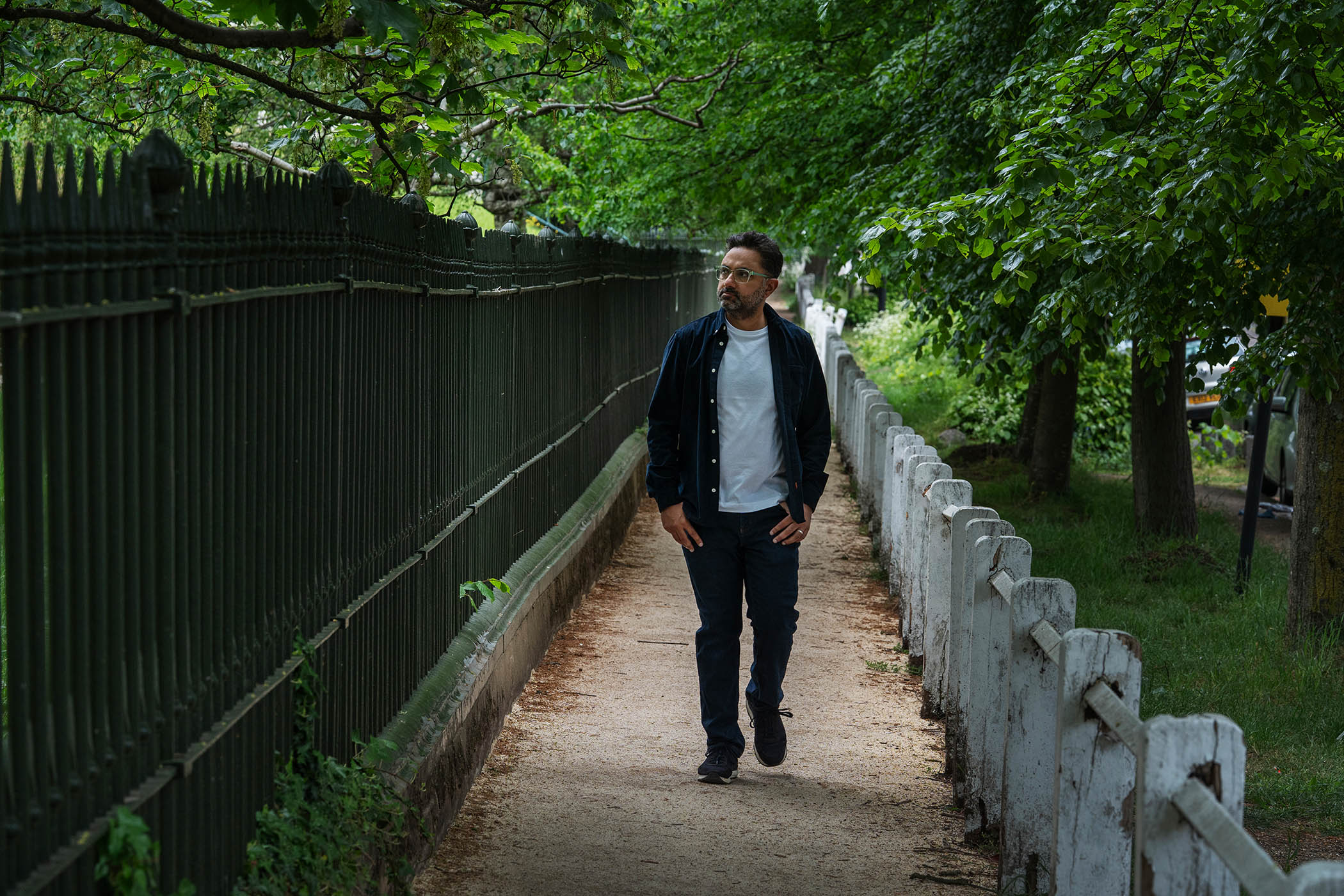
As we walk down the hill from the Heath toward the high street he laments the fact that George has not been afforded quite the posthumous reverence received by David Bowie or Prince, both of whom died in the same year. “I don’t know if I’m going to singlehandedly put that right,” he says. “But a 10th anniversary is a good excuse, isn’t it?
Looking back, does he find it curious that he was quite so loyal to George in his school days, when he could hardly have seemed less cool?
“It’s true I didn’t know any other George Michael fans,” Sanghera admits. “I think it was a weird form of rebellion against everything. But I’d say my fandom has aged better than, say, for the Wonder Stuff, which is what everyone else was in to. There is no British artist in our lifetime who could write such sensitive lyrics. He was like a soft boi, right? He was like Drake, and that sensitivity really struck a chord with me.”
You could argue that same contrarian spirit led Sanghera to be a journalist and a clear-eyed historian of empire. Will he go back to that territory?
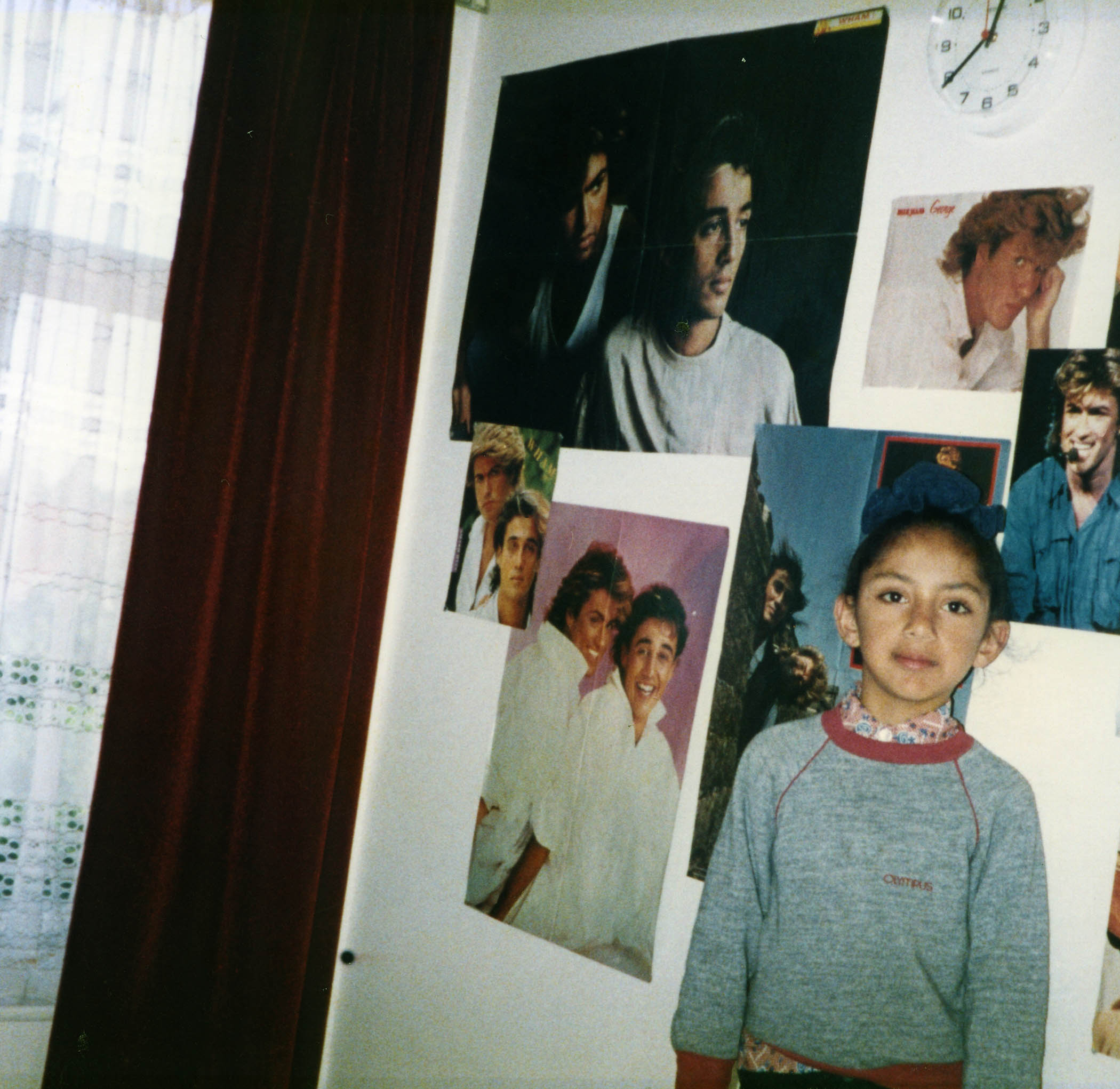
Sathnam Sanghera as a nine-year-old in front of his George Michael and Wham posters.
“I’m not going to write about the British empire ever again!” he says, with a smile. “It’s like, almost everyone in this country had family who were colonised or colonisers. But when a brown person comes along and says, ‘Actually it wasn’t always great,’ they come back with: ‘You’re saying my grandpa was racist!’ And you are literally not saying that.”
As we reach Snappy Snaps, he does concede, however, that he may not have escaped culture wars for ever. “What you realise when you write any book now is that there is nothing that people can’t argue about,” he says. He may have written this one as a way to escape trolling, but he’s getting some of that already. Fans on websites want to idealise George, and don’t want that undermined by any complexity and contradiction. “I’ve had comments like, ‘I hope you’re just focusing on his achievements’ and ‘Why are you making money from him?’ I once wrote that George was very slow at writing songs, and people were like, ‘Oh, you can’t say that. He was a genius! He was a perfectionist!’” It’s like, come on, he was also a human being. And that’s why I love him.”
Sathnam Sanghera will be discussing his new book about George Michael, Tonight the Music Seems So Loud, at the Observer Book Club on Thursday, 11 June 2026, 6.30-7.30pm, 22 Berners Street. Book your tickets here.
Thank you for reading. Tell us what you think by writing to letters@observer.co.uk