

WH Auden once expressed the wistful hope that he might be remembered as “a minor Atlantic Goethe”. Presumably, what he meant was that he longed to be a poet who could be taken seriously as a creative thinker, as someone with his finger on the cultural and intellectual pulse of a whole civilisation.
Johann Wolfgang von Goethe’s formidably distinctive position is just this. He was a great lyric poet, a poetic dramatist of bewildering versatility and an epoch-defining writer of fiction; but also a recklessly bold amateur scientist, willing to take on no less an authority than Isaac Newton, anticipating Charles Darwin and even Sigmund Freud; and an essayist deeply engaged in the philosophical and political debates of his day – a very long day, spanning what is, for us, the age of Dr Johnson and the beginning of the age of Charles Dickens.
For most of that long life (1749-1832), Goethe, whose father was a lawyer and administrator of modest standing in Frankfurt, worked as a kind of grand vizier to the duke of the tiny German principality of Weimar, organising everything from theatrical entertainments to the management of a silver mining concern, and was increasingly involved in the intricate diplomatic contortions necessitated by Napoleon’s violent and decisive redrawing of the political map of western Europe.
There is no figure quite like him in post-medieval Europe. With due respect to Auden, a 20th-century Goethe would have been impossible: no one could straddle the worlds of science and the arts in the way Goethe did, and there were no equivalents to the political stage on which he operated and the princely patronage that sustained him.
In intellectual terms, the nearest we get in Britain is probably Samuel Taylor Coleridge – as a poet of real substance and stature, battling to articulate a position within the philosophical discussions of his time and making a lasting contribution to how we think about imagination. But Coleridge lacked Goethe’s granular interest in scientific inquiry and stood nowhere near any kind of political influence.
So writing about Goethe is a daunting enterprise, but there have been some distinguished takers. Nicholas Boyle’s biography (two volumes so far, taking us up to 1803) is already a classic treatment: comprehensive, stylish, sympathetic and completely engaging. Recently, AN Wilson has produced a warm and lively study entitled Goethe: His Faustian Life.
Matthew Bell’s new book steps back from a straightforwardly biographical emphasis to deliver exactly what his subtitle promises: A Life in Ideas. Although there is a fair bit of detail early on about the family background, most of the book consists of close summaries and discussions of Goethe’s literary productions, from his early, blazingly successful and controversial novel The Sorrows of Young Werther to Faust, the endlessly revised and extended tragic play that most would see as his greatest lasting legacy in European literature.
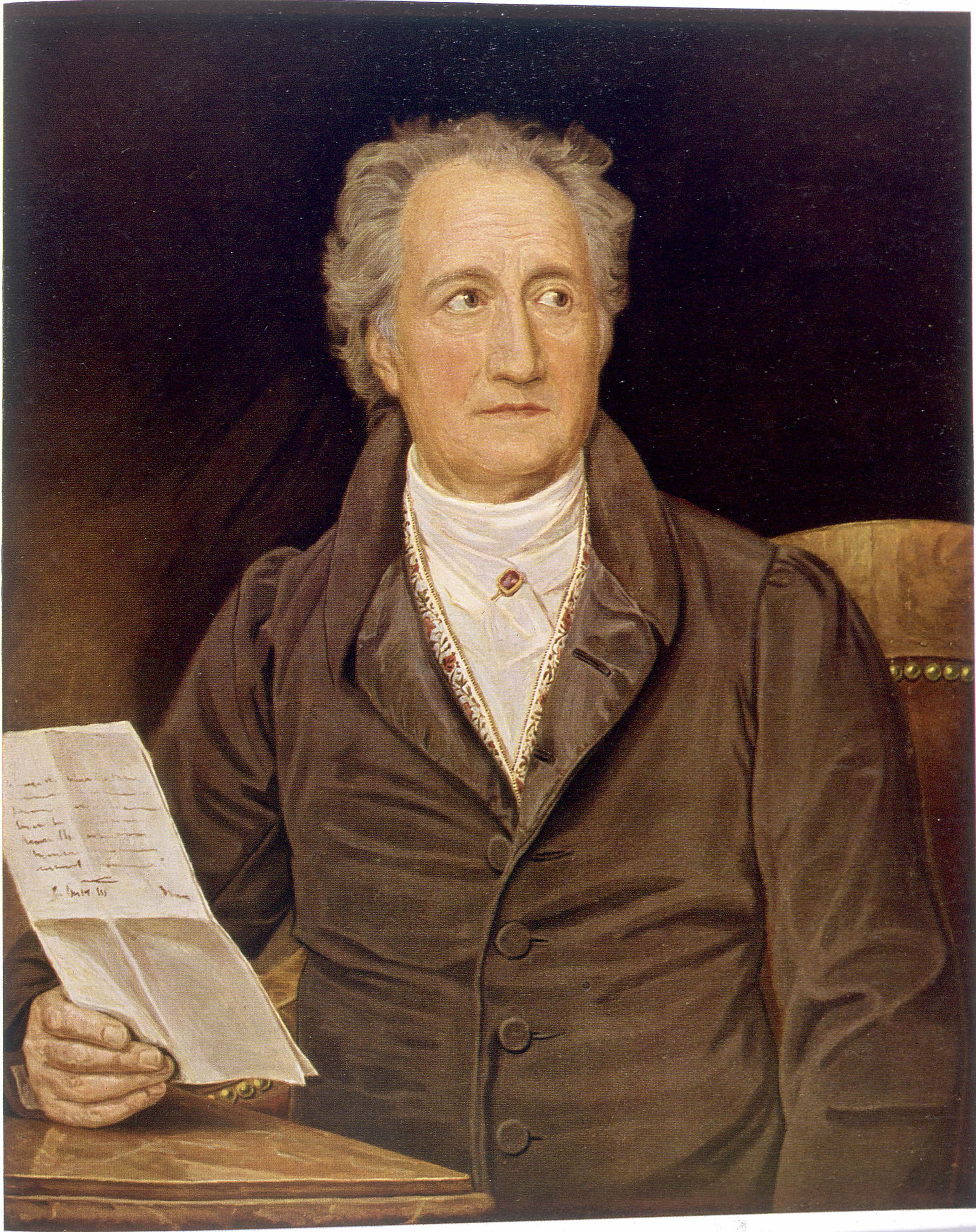
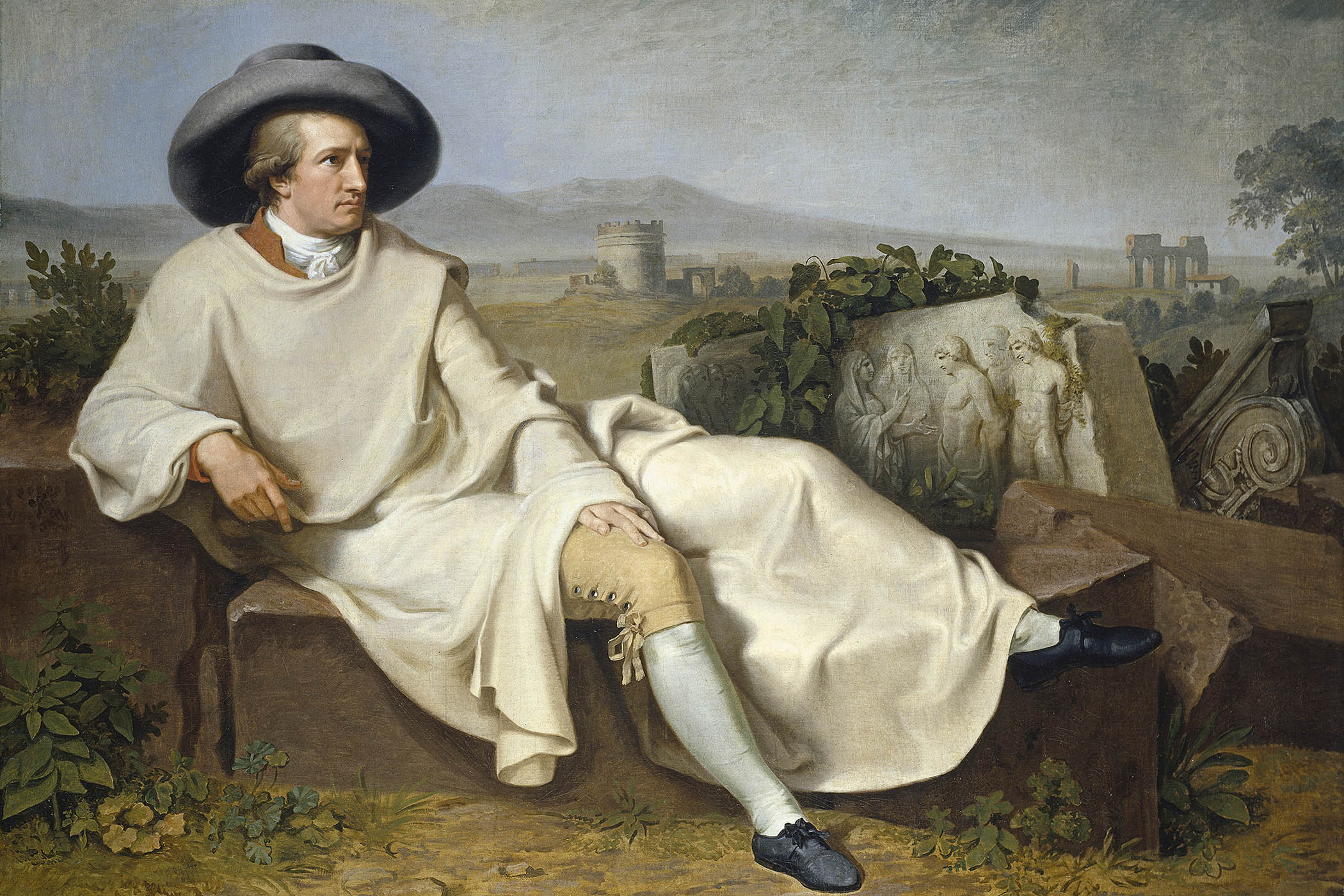
Above: Karl Joseph von Stieler’s 1828 portrait of Goethe; main image: Goethe in the Roman Campagna (1787) by Johann HW Tischbein
Bell does a very successful job of repeatedly bringing us back to the themes that connect the wildly diverse ensemble of Goethe’s writings. Somewhere near the heart of the entire enterprise is the notion of homo mensura: “man is the measure of all things”. If it is true that the human organism is the most finely calibrated vehicle for absorbing and articulating the inner pattern of things, Goethe argued, we must be wary of any claims to be able to give a full, objective account of “external” reality. In terms more familiar in modern philosophy, there is no “view from nowhere”.
As Bell says, this is given its most vivid embodiment in the character of the wise old aunt Makarie in the late and diffuse novel Wilhelm Meister’s Journeyman Years (designed as the last episode of a series of fictions about a young man’s spiritual and intellectual development). Its final revision appeared three years before Goethe died. Makarie knows intuitively what scientific observers strive to discover and prove: she understands the basic dialectical pattern of attraction and repulsion that animates the phenomena of the world.
Thus, she also knows the world in ways that go beyond science; she understands the Earth is not an emporium for our human projects. She knows more than the scientist but less than the entire truth. Attuning herself to the world, she accepts the limitation that goes with this.
Newsletters
Choose the newsletters you want to receive
View more
For information about how The Observer protects your data, read our Privacy Policy
This was the foundation on which Goethe built up his attacks on a number of scientific orthodoxies of the day. Goethe’s best-known skirmish with received wisdom was his critique of Newton’s theory of colour, which established the visible spectrum. Goethe insisted that the conductor of experiments is always, unavoidably, looking for answers to questions they have themselves defined – in this case, at the expense of what a human eye actually perceives in seeing colour in its gradations and interconnections. This leads, Goethe believed, to the construction of artificial schemata; mathematically coherent but radically inadequate to our lived, organic and timebound experience of the world.
Bell characterises Goethe’s campaign against Newton as “quixotic” and “wrongheaded”, although it did identify some genuine problems with Newton’s theories. But the really important thing is that Goethe is diagnosing a central flaw in the experimental method: you have to screen out a range of phenomena in order to find an answer to a specific question; but that screening out means that your final picture is partial and conditioned by your agenda.
As Bell rightly notes, this opens the door to a new approach to science. Goethe’s own attempt to clarify why Newtonian analyses prevailed so rapidly and universally produces the first real essay in the history and sociology of science: why, he asks, are people grappling with these questions at this moment? But this book also helps us to grasp a more ambiguous element in Goethe’s legacy.
Bell does not gloss over Goethe’s lack of interest in democratic liberties – the freedom that matters is always interior
Bell does not gloss over Goethe’s lack of interest in democratic liberties – the freedom that matters is always interior
For Goethe, the ideal form of knowledge is a state of receptivity in body and mind and an attentiveness to the specific effects of external reality upon us. This should make us wary of any appeal to an objective rationality that we can discern or operate without reference to our own situation. What Goethe deduces from this is that we should also be sceptical of any systematic critique of the social order. Bell does not gloss over Goethe’s frank lack of interest in anything resembling democratic liberties.
The freedom that matters is always interior. Goethe’s social vision is (as Bell puts it) of “a German nation free in spirit but not in politics”. There can be no rational – or theological – foundation for any scheme of government; so effective executive power is what matters. Ultimately, all authority rests on naked power, and the best we can do is make it work efficiently and fairly.
Goethe admired Napoleon, and there is no shortage of passages where he affirms his preference for what we would now call “strongman” leadership. In Weimar, he encouraged a policy of quiet repressiveness on the part of the ducal administration. In this, as in many ways, he is a strange and troubling presence in the western canon – both an Enlightenment figure and a powerful force in the formation of post-Napoleonic conservatism in Europe. One of the things that Bell’s treatment suggests is how much we need to beware of glibly defining the legacy of western civilisation in terms of its promotion of rational democracy.
Goethe’s implacable hostility to institutional Christianity (for all his willingness in Faust to use Christian symbolism of a sort) is another dimension in this. Goethe’s lodestar for aesthetics and politics was the classical world – not unusual at the time, but not always connected, as in his case, with so strong a resistance to Christianity (especially Catholicism).
For him, the church represented, paradoxically, another variant of “rationalism”; in the sense that it was yet another refusal to engage with what was in front of your eyes in favour of abstraction. Such a refusal would mean that there was something to appeal to over and above the status quo of political power – an appeal that Goethe considered fundamentally wrong and destructive of social order.
In this respect, Boyle’s characterisation of Goethe’s political ideals as “pagan” sounds about right. The ideal of benign and intelligent autocracy that he defended had no place for religious loyalties that outbid the claims of existing power. Of course there could be political debate, and of course things could always be done better. But there could be no room for principled challenge to structures of governance and social hierarchy that were the product of long, complex development, processes of slow adjustment to local conditions, temperament, custom and so on. Goethe was no friend of the new pan-German nationalist spirit of the post-Napoleonic period, but he was as committed to the sacredness of place and custom as he was against a universalist idea of human rights or dignity.
In addition to providing invaluable assistance in navigating Goethe’s vast output, Bell’s book raises some large questions about the diversity of strands woven together in our ideas of western and “modern” identity. Goethe is a figure both rebarbative and fascinating for the modern reader: an unforgettable poet, a feverishly restless thinker, a monumental ego; whatever you make of him, no one in recent centuries in Europe is in quite the same category of deeply shadowed greatness.
Apologies to Auden; but the role has been filled once and for all.
Goethe: A Life in Ideas by Matthew Bell is published by Princeton University Press (£35). Order a copy from The Observer Shop for £31.50. Delivery charges may apply
Photographs by Corbis, Dominic Turner, Roger Viollet via Getty Images