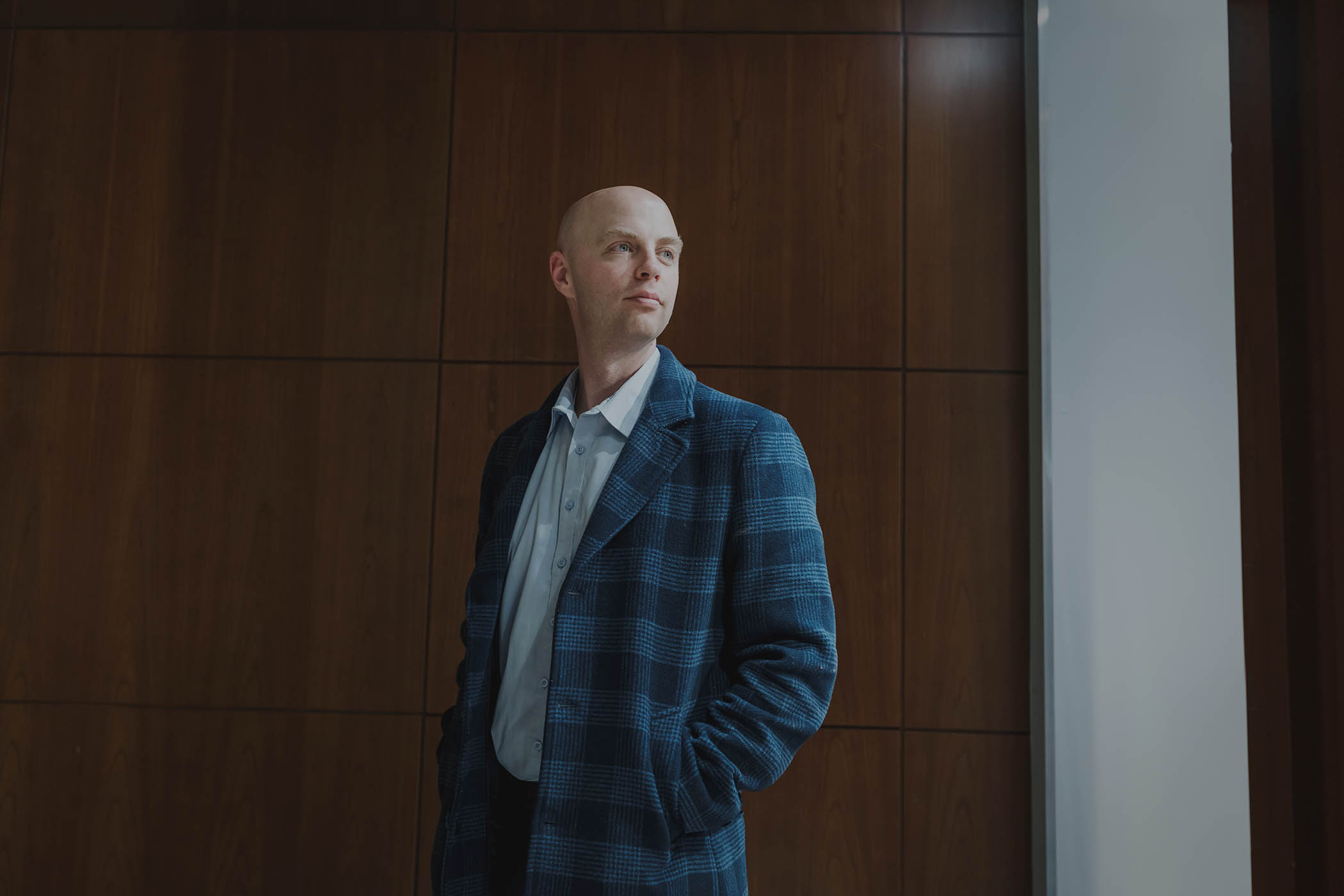


Portrait by Ofir Berman
Amir Tibon writes of arriving at Mishmar Ha’emek, a kibbutz 100 miles (160km) north of Gaza, not far from Haifa. It is the morning of 8 October 2023, 24 hours after Hamas’s devastating attack on Israel. “When the first busload of survivors disembarked shortly before 6.00am, they looked to their hosts like living ghosts. Many were still wearing the same pyjamas in which they had rushed to their safe rooms a day earlier; some arrived barefoot.” They had been evacuated under mortar fire, without clothes, nappies for children, or any supplies at all. The residents of Mishmar Ha’emek rallied round instantly to take care of the survivors of the deadliest attack in Israel’s history; as far as any of them could judge, support from the Israeli government was nowhere to be found.
Tibon’s book, The Gates of Gaza, is the winner of this year’s Wingate prize. Run in association with the Jewish Literary Foundation, the prize – now in its 49th year – is awarded to the best book, fiction or nonfiction, to convey the idea of Jewishness to the general reader. Previous winners include Amos Oz, Zadie Smith, Oliver Sacks, David Grossman and, most recently, Manya Wilkinson. I was the chair of judges this year: my fellow judges were novelists Kate Weinberg and Xiaolu Guo, along with Rabbi Adam Zagoria-Moffet of the St Albans Masorti synagogue. It was a strong field of submissions, in both fiction and nonfiction, but Tibon’s book stood clearly above the rest. It is gripping, frightening and deeply researched, reckoning bluntly with Israel’s history and the harsh price its citizens, and the Palestinian people, have paid for failures in politics decade after decade.
On the morning of 7 October, Tibon was asleep in the Nahal Oz kibbutz, just across the border from the Gaza Strip, where he was living with his wife, Miri, and their two young daughters. An award-winning journalist for Haaretz, Tibon had first visited Nahal Oz in the summer of 2014 during a previous bloody conflict between Israel and Hamas, which had taken control of Gaza seven years earlier. He was struck by the communal spirit of the kibbutz, which had been founded in the 1950s; by its residents’ desire for peace with their Palestinian neighbours. He and Miri moved there from Tel Aviv at the end of 2015.
Tibon, his wife and daughters hid in their safe room, unaware at first of the scale of the attack; unaware that the Israeli military was apparently totally unprepared; unaware that, not far from their home, nearly 400 young Israelis were being slaughtered at a music festival and others taken hostage. With the little mobile phone battery he had, and erratic reception, Tibon was able to call his father, Noam Tibon, a retired Israel Defense Forces (IDF) general, who was having his morning swim in Tel Aviv when his phone rang. Along with his wife, Gali, Noam Tibon set off immediately on an extraordinary freelance rescue mission that is the heart of his son’s book. Noam and Gali Tibon would find themselves driving through a landscape littered with bodies and burned-out cars; they came to the aid of a young couple who had escaped the carnage at the Nova festival, before continuing on their way, and would eventually arrive in Nahal Oz with a reconnaissance unit of the IDF, which they met on the road.
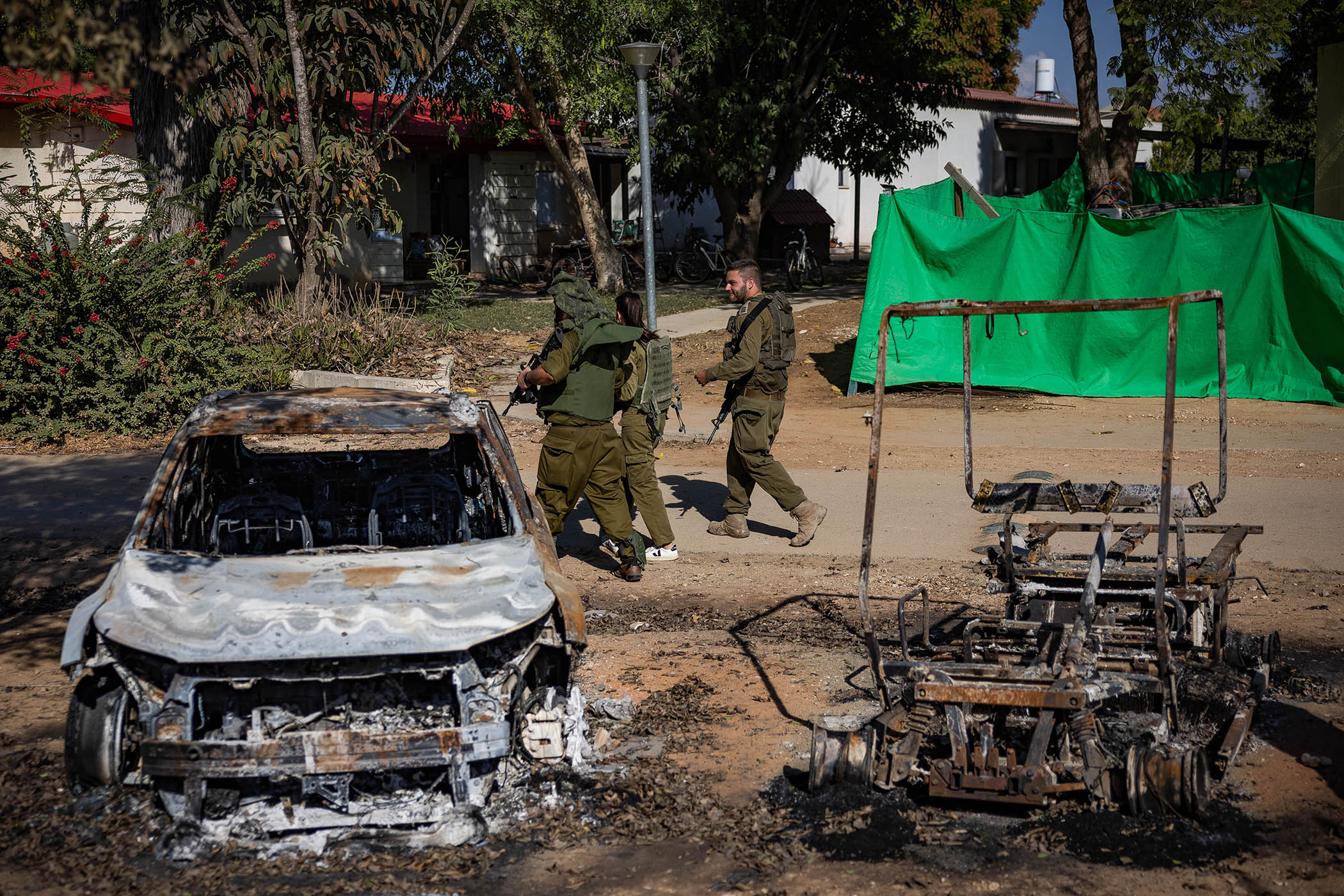
The aftermath of Hamas’s attack on the Nahal Oz kibbutz where Tibon lived with his wife and two daughters
To say that it reads “like a thriller” sounds trivialising, but it is not meant to be. The reader is put into the heart of extraordinary and terrible events. And, yes, it’s intensely cinematic: a documentary about their escape, The Road Between Us: The Ultimate Rescue, directed by Barry Avrich, had its premiere last year at the Toronto international film festival.
When Amir Tibon and I spoke last month he was still in Mishmar Ha’emek. “We are planning to be here until July,” he tells me. “And then our plan is to go back to our home.” A photograph in Tibon’s book shows bullet holes in the glass of the living room window of their home; bullets pierced the furniture, broken glass littered the floor. Now it has all been repaired, ready for the family’s return when his daughters, four and six, finish the school year. “It’s important to have continuity,” he says, with more calm than I can imagine.
Continuity in his text comes from the way he deftly alternates his family’s story with chapters that take the reader back into the history of the kibbutz, the history of Israel, the history of violence. Nahal Oz began to grow in the early 1950s, in the wake of Israel’s founding and the displacement of hundreds of thousands of Palestinians from their homes: the nakba – Arabic for “catastrophe”. Tibon’s careful account shows the lives of idealists trying to create a peaceful community amid war and displacement. “Like the young idealists who founded the kibbutz, Miri and I were Zionists in the most basic sense. For us, two liberal, left-leaning Israeli Jews, Zionism meant only one thing: securing Israel’s existence as a Jewish and democratic state.”
These days, the word “Zionist” itself is a powerful trigger. “I deliberately used it because I’m trying to reclaim that word,” Tibon says. “I know that, today, a lot of Jews are hesitating whether or not to define themselves as Zionists, even if they are supporters of Israel, to some degree, because if you think Zionism is Bezalel Smotrich and Itamar Ben-Gvir [Israel’s finance minister and national security minister respectively, both on the extreme right of the government], who wants to be affiliated with that? God forbid, right? These are awful people, but the real Zionism is the people of kibbutz Nahal Oz, and most of them are people who, even today, still believe and hope for peace.”
Yet that peace seems a distant prospect, and the present is appalling. Hamas killed more than 1,100 people on 7 October; at least 250 were taken hostage. Israel’s retaliation has flattened the Gaza Strip. In an interview with The Observer, Tom Fletcher, UN under-secretary general for humanitarian affairs and emergency relief coordinator, described the scenes in Gaza as “apocalyptic”; his staff must use GPS to find their homes because every landmark has been destroyed. A report lin February in the Lancet found that that more than 75,000 people were killed in the first 16 months of the two-year war in Gaza, at least 25,000 more than the death toll announced by local authorities at the time.
‘My focus is on how we create a better life for people; and that must include a better life for everybody in this land’
‘My focus is on how we create a better life for people; and that must include a better life for everybody in this land’
At the beginning of his book, Tibon looks out from Nahal Oz and sees Gaza City in the distance; at the end of the book, he writes: “The last time I was up here, I saw hundreds of buildings on the other side of the fence; now, there is nothing where they once stood but piles of rubble.” He goes on: “As an Israeli citizen, I supported the war effort, at least in the early months of the fighting. I was angry over what Hamas had done and scared of how Israeli weakness in the face of that attack would be perceived by our other adversaries in the region.
“But as a human being, I find it extremely difficult to countenance the level of destruction caused by my own country inside Gaza. And as a resident of Nahal Oz who still holds out hope that my family will one day be able to return here, I have to ask myself what will result from all this violence – peace and quiet or more violence?”
The book does not enter Gaza, and I offer that some readers would see that as a failing – as a refusal to engage with the devastation Israel’s government has wrought.
“This is an Israeli book written by an Israeli author,” he replies. “I am a Jewish Israeli Zionist and it describes the events and the history from a liberal Israeli, humanist, Zionist perspective. I think if you choose to read the book with that in mind, you will find it interesting and helpful and illuminating. It does not pretend to be a book about the Palestinians, although I also go into internal Palestinian politics, and I don’t ignore the fact that Gaza is home to, today, more than 2 million people. I bring the two perspectives, but I also don’t pretend to be something I’m not.”
The most important question for him, Tibon says, is what happens in the future? He is no fan of Donald Trump; “but the only plan is this Trump document” – the 20-point peace plan that came into effect on 10 October last year. “Everyone is hoping it will work. If it does, you get to a point where you have a new Palestinian government in control of Gaza. Hamas gives up some of their weapons. They are never going to give up everything. Israel withdraws to some kind of border, and there are no more bombardments. Then you can start the reconstruction of Gaza, which is years of work. You have to build new houses for people, institutions, schools, hospitals. I try to cling to hope, because so many powerful people have an interest, so many countries are involved.”
Yet, in truth, it is hard to hear hope in his voice. Not least because he knows the ceasefire is no ceasefire. “It is so hard to convey what it is like there now,” he says. “You hear the artillery, the airstrikes, and later you’ll hear: ‘Four dead in Gaza, including two children,’ and you think: ‘How can this still be happening? What’s going on here?’ Yes, it’s better than it was four months ago, but it is still far, far from where it needs to be.”
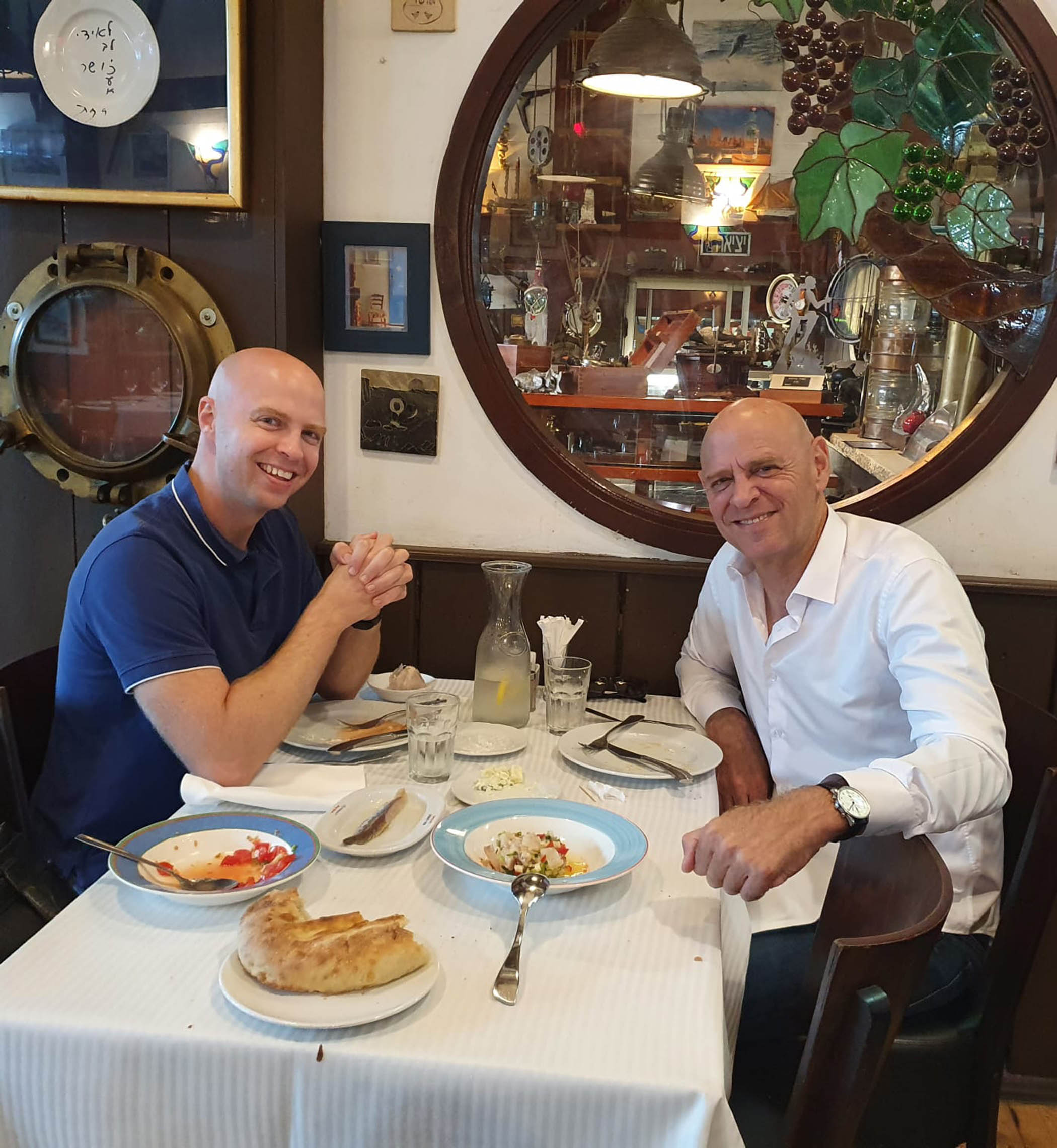
Tibon with his father, Noam
It is clear that Tibon wishes to look ahead. “For me, as a writer, as a person who lives here – and chooses to live here, because I probably could have gone somewhere else – the more important question is: how do we prevent more war and more suffering and create a better future? I understand why the definitions of what happened in the past are important. I respect my friends – historians who deal with this. I have a master’s degree in history, but I don't consider myself more than a student; I understand the discussion of what is a genocide and what is ethnic cleansing, and what was morally justified at every point in history. But my focus is on how we create a better life for people; and that must include a better life for everybody in this land. It cannot work if it’s only limited to one population.”
The word “genocide” does not appear in Tibon’s book.
“I think the events that happened from 7 October onwards are bad enough as they stand,” he says. “We don’t need to use loaded vocabulary in order to make it worse than what it already is. I have read all the relevant reports that were put out – by the UN or by other agencies, human rights organisations that insist on this definition – and I did not find them convincing. I don’t think the word ‘genocide’ is accurate. But I also think that some of this campaign to use this word is based on stupid, irresponsible, racist, abhorrent statements made by members of my own government.”
Tibon also refuses to use the word “holocaust” for what happened to Israeli communities on 7 October.
I ask him how his relationship with his father has changed.
“We are the same family we were in terms of how we relate as a family. But we have all changed as human beings. I don’t think there is a family in this country that has not changed over the last few years,” he says.
“I did not want to write this book,” Tibon writes in his epilogue, which has a bleaker tone than the rest of his text. “There are no leaders in this land these days – not on the Israeli side or on the Palestinian one. In their place are psychopaths and egomaniacs, some of whom dream of endless war and of annihilating the other side, whatever the cost; others are simply too weak and feckless to stand up to those who have dragged all of us into this nightmare.”
It is impossible, in present circumstances, to connect the hopes of one individual to the possibility of repair after such destruction. Tibon’s story is his own; it is his family’s. The best writing can show the reader what it is like for another person to live inside themselves. This is what The Gates of Gaza does: it is a striking achievement.
The Gates of Gaza: A Story of Betrayal, Survival, and Hope in Israel’s Borderlands by Amir Tibon is published by Scribe. Order from The Observer Shop. Delivery charges may apply
Photographs by Yonatan Sindel/Flash90 and courtesy of Amir Tibon
Newsletters
Choose the newsletters you want to receive
View more
For information about how The Observer protects your data, read our Privacy Policy