
Herta Müller, who won the Nobel prize in literature in 2009, is the daughter of an SS veteran from Romania’s German-speaking Banat region. Müller grew up in Banat in the 1950s when Nazi misrule had been replaced by communist misrule. In her 1994 semi-autobiographical novel The Land of Green Plums she portrayed her Führer-doting father as a survivor of the Ceauşescu regime who lamented a lost Saxon idyll of Nazi beer hall songs, strudel and plum brandy pudding. He and his drinking comrades were unapologetically antisemitic, anti-Slav and anti-Romani.
The Village on the Edge of the World is the first nonfiction work by Müller to appear in English translation for more than a decade. This time, among other things, Müller reflects on her mother’s wretched fate under the Soviet occupation of Romania when, in January 1945, thousands of ethnic German Romanians were deported to slave labour camps in Soviet Ukraine and further afield to Siberia. Born to a well-off Catholic farming family, Müller’s mother was sentenced as a young woman to five years’ hard labour. Communism continued to inflict damage on the family. In 1979 Müller, a casualty of Nicolae Ceauşescu’s brutal Securitate secret police, lost her job as a translator at an engineering factory for refusing to spy on her colleagues. Subjected to relentless psychological violence, she saw similarities between communist Romania and Nazi-occupied Romania.
The book unfolds as a series of interviews conducted a decade ago in Berlin between Müller and her longtime German editor, Angelika Klammer, with Klammer’s occasional questions and prompts styled in italics. Müller speaks of subjects such as Securitate torture methods, flyblown socialist shop window displays and the rationed food that left Romania an “immiserated” society.
Müller has been here before. Her essay collection Cristina and Her Double, published in the UK in 2013, anatomised the totalitarian darkness of her homeland under Ceauşescu with its atmosphere of shadowy fear. The interviews serve as a gloss to the rest of Müller’s work, which was first smuggled out to the West in the early 1980s. Even in the decade before then, as an aspirant writer, she was subject to the Securitate’s own special terror, when she was charged with subversive activities and parasitism. Once she became known as a published author, she was simultaneously harassed by the Securitate as a political dissident and, she tells Klammer, ostracised by her Swabian community for “fouling [her] own nest”. Her novel The Passport, first published in German in 1986, portrayed the inhabitants of Banat as a bigoted, narrow-minded community hidebound by their Hitlerite past.
Newsletters
Choose the newsletters you want to receive
View more
For information about how The Observer protects your data, read our Privacy Policy
Now aged 72, Müller writes in German and knows almost no Romanian. She has lived in Germany for 40 years. Burdened by her Romanian German heredity, she speaks at length here of her father’s early death from liver disease and her subsequent teetotalism. Müller’s mother, “doglike” in her obedience to the Ceauşescu state, beat Herta at every opportunity and set her to work in the fields as a child. Memories of this embittered, “spiteful” woman darken the interviews. “Misery makes you ugly,” Müller says; her mother, having lost all her teeth in the Gulag, had dentures fitted when she returned to Banat at the age of 25.
Divided into 10 chapters with sarcastic titles such as The Wonders of My Fatherland and The Regime Buries Its Crimes, the book radiates a black humour and is relentlessly grim in tone. Müller opens a window on to Ceauşescu’s 24-year-long cruel misrule and the “colossal Fear Station” operated by his Securitate. Only the most thuggish, unlettered countryfolk were recruited to hunt down and humiliate opponents of the regime. In a dictatorship that eroded all humanity, resistance was hopeless. Müller says she was subjected to about 50 interrogations; her vigilant intelligence provided a bastion against mental disintegration.
In the book’s most discomfiting chapter, My Friend Oskar, taken from a 2009 interview, Müller considers the sad case of the Romanian poet Oskar Pastior, who defected to the West in 1968. Müller had no idea that Pastior was a Securitate informer when, in 2004, she began to research her novel The Hunger Angel, based on Pastior’s ordeal as a Gulag prisoner. Pastior’s fictional alter ego, Leo Auberg, refuses to be cowed by the camp’s inhuman labour. His fellow inmates, with their individual kindnesses and strategies of survival, are emblematic of the sorrows of Romanian “counter-revolutionaries” at their darkest hour.
The revelation that Pastior collaborated with the Securitate therefore deeply shocked Müller, even though it seems he was forced to comply by threats of violence and blackmail (he was homosexual). In a note found after his death in 2006, Pastior described his forced collaboration as his secret “revulsion complex”. The Village on the Edge of the World, a powerful indictment of life under dictatorship, chronicles the lies, surveillance and intimate betrayals of a totalitarian bureaucracy that killed its own citizens in the name of a misguided revolutionary nationalism.
The Village on the Edge of the World: Writing and Surviving Ceauşescu’s Romania by Herta Müller, translated by Kate McNaughton, is published by Granta (£16.99). Order a copy from The Observer Shop for £15.29 (10% off RRP). Delivery charges may apply.
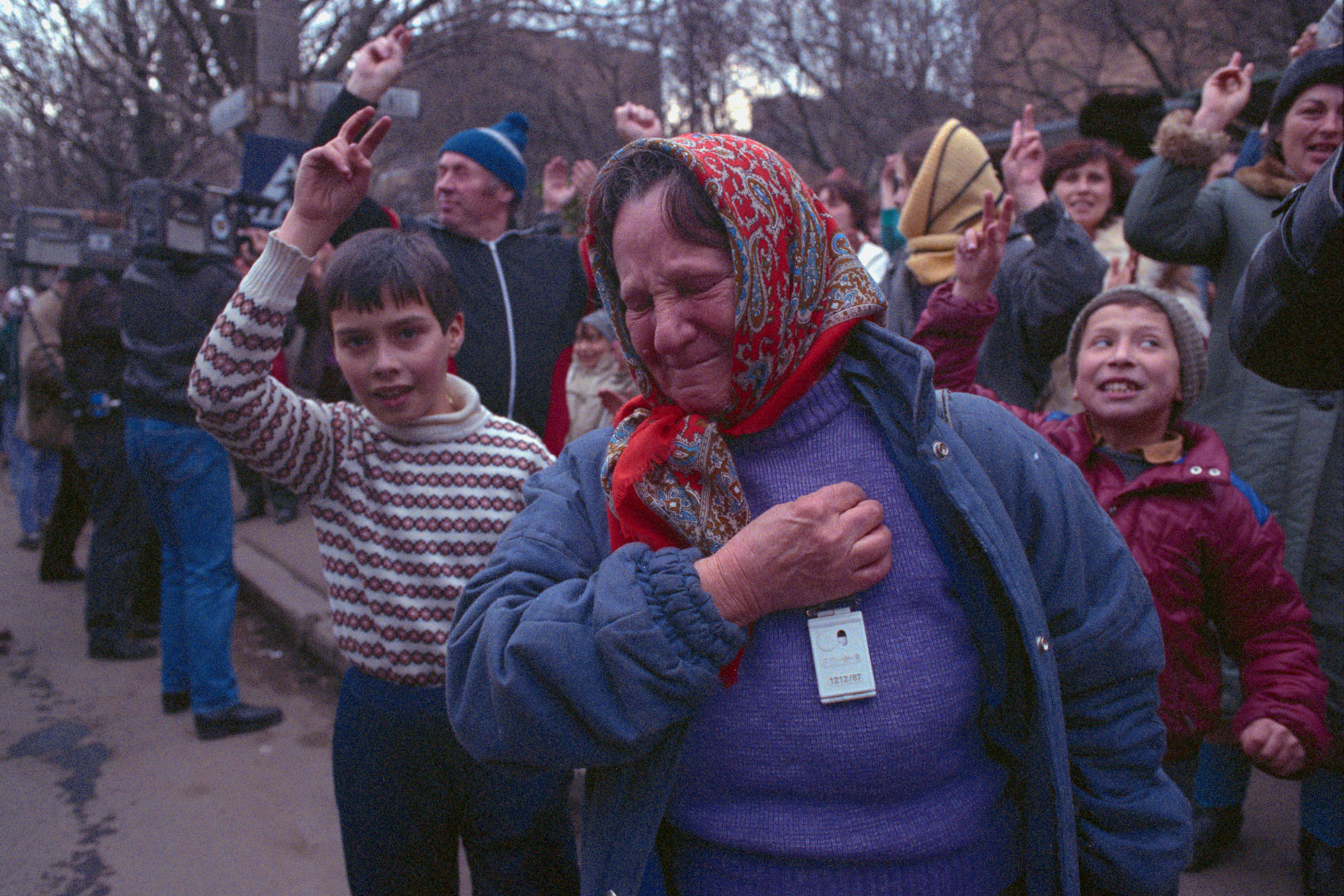
Photograph by David Turnley/Corbis via Getty Images