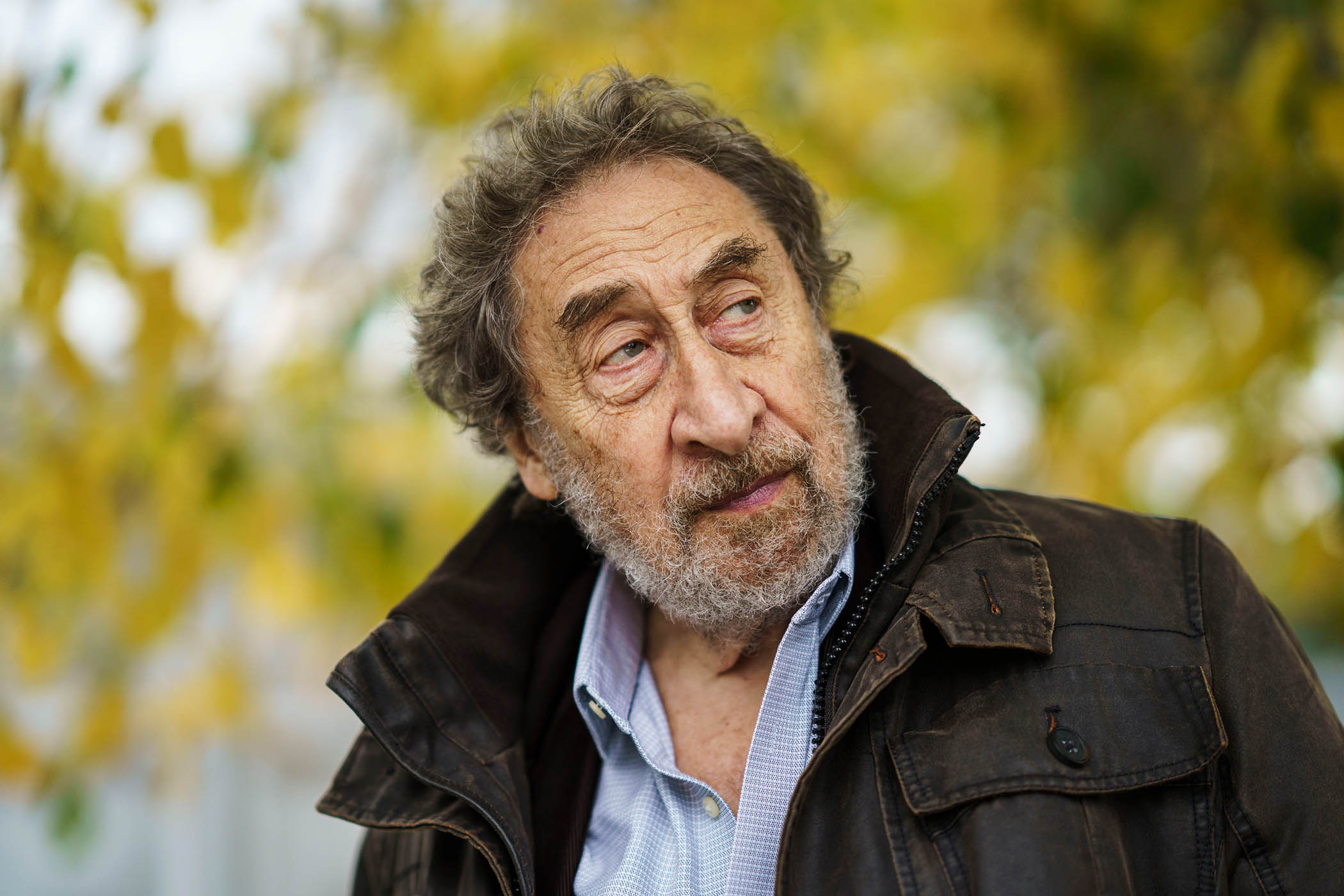
Howard Jacobson wrote three columns for The Observer in the wake of the 7 October attacks. His first argued that progressives downplayed the mass murder perpetrated by Hamas (“How many lecturers in human rights partied through the night after being shown the footage of Israelis denied their right to live?”). His second argued that those same people exaggerated Benjamin Netanyahu’s retaliation (“Genocides don’t leaflet the populations they want to destroy with warnings to stay out of harm’s way”). His third column, by his own account, was the one that caused more upset than anything he’d ever written. It said that, by reporting on Palestinian children bombed in the assault on Gaza, the media (“as much like propaganda as news”) was “stirring race-memory of the child-killing Jew of the middle ages”, fuelling “hostility and fear” by corroborating “stories of their insatiable lust for blood”.
“I was in such a confusion of fear and stress and upset and then rage,” said Jacobson, when quizzed by the New Yorker about what he wrote. “I have been so thrown by the topsy-turvyness of people’s response to the massacre [of 7 October]. When people denied that children were killed and women were raped... I think the attitude towards that has made me a different kind of person.”
Jacobson’s new novel, Howl, is perhaps best understood as an exercise in stress-testing the views he expressed in that period, this time not via an interviewer’s grilling, but in the slippery medium that has always afforded him most latitude, the comic novel, his safe space. Unfolding over six months, it’s narrated by Ferdie, the Jewish head of a south London primary school. On the night of 7 October, his neighbours toast the atrocities with prosecco, dancing on their lawn, to his horror. He turns on the radio to hear a student call it “the best day of her life”. His daughter Zoe, studying at Oxford, celebrates 7 October as an uprising, defacing a hostage poster on television and screaming “Colonialist Zio pig!” in Ferdie’s face while marching in London, unaware she’s just bumped into her dad. When he visits his mother, a Belsen survivor, he finds “Death to Jews – Jenoside” daubed on her door –which leaves him wondering what’s worse, “not knowing what the word meant or not being able to spell it”.
No gag is too low (“There were no innocents. Only Jews, Israelis, Zionists. JIZ – a new mnemomic of hate”) and the taste for comedy is silly, which, in a Jacobson novel, might be like complaining that water is wet. Ferdie tells us about his school’s janitor, Hasheen, “waving his mop in celebration” after 7 October, later redrawing a map of Israel and Palestine in swept-up dust with his broom handle, “radicalising toddlers”. But the more strenuous elements are largely kept in check by the constant undermining of the narrator. Ferdie, it’s implied, not least by his wife, rather revels in his righteousness, conferred by the febrile atmosphere of prejudice and paranoia. This produces a wicked feedback loop that invites us to question how far Ferdie is seeing what he wants to see – not least because the source of the antisemitic graffiti ends up being rather closer to home than his envisioned “gang of Oxford professors of Settler-Colonial Studies going round on motorbikes”.
A delicately handled subplot, about whether his mother is telling the truth about her past, further fuels a sense of looming breakdown for Ferdie, whose colleagues raise eyebrows after he tells a Muslim parent at the school: “You’ve done what even Christianity couldn’t do. You’ve mounted a relentlessly sentimental propaganda campaign that’s convinced half the world... that the Blood Libel was no libel after all. Not every citizen of the medieval world believed the Jews were in league with the devil. Today everybody does.”
The taste for comedy is silly, which, in a Jacobson novel, is like complaining that water is wet
The taste for comedy is silly, which, in a Jacobson novel, is like complaining that water is wet
By this time he’s shouting at children in the playground. As the action becomes more frantic, he’s plagued simultaneously by apocalyptic visions from what he imagines is in the Qur’an (which he hasn’t read) and “ancestral longing” for the Jewish girlfriend of his estranged brother, recently returned from Jerusalem. A scuffle breaks out over the yarmulke worn by a colleague who annoys Ferdie by converting to Judaism. Ferdie says that the one place he feels comfortable in central London is Chinatown: “Chinese waiters didn’t notice my existence. Eating with chopsticks slowed my heart rate.”
During a stint as a standup, busking at the Edinburgh fringe festival, he gets into a barrel in order to slam the hypocrisy of westerners, who, fat from historical conquest, line up to condemn Israel as the “cruellest imperialists of all”. “And if you think this is self-pity,” he adds, “understand I am speaking from the bottom of a bleeding barrel and would appreciate it if someone lent a hand to get me out of here.”
Jacobson’s yen for outrageousness is tempered with the plausible deniability, and the off-colour riffing and dodgy gags that have been a staple of his work are studded with caveats. There’s something magnetic about his line-by-line yo-yoing between conviction and doubt. But for all the calculated multiplicity of perspectives, and the artful framings, Howl is notably wary of allowing that protesters against the bombing of Gaza might be sincere. Zoe, we’re told – tattooed in “portraits of Islamic terrorists” with the phrase “Kill all Zionists” around her navel – doesn’t even believe a massacre took place on 7 October: “Zionist propaganda, the lot of it.”
While our view of her comes filtered through Ferdie’s unreliable lens, Jacobson’s taste for overstatement grinds against the novel’s reality. “I don’t wish the death of anyone, least of all a child,” Ferdie writes to Zoe, in a tentative stab at detente. “And I am not implicated in the harvesting of organs.” That reflexive ramping-up of rhetoric, from a character – and let’s be honest, an author – hardly shy to indict others of melodrama, can’t help but leave us feeling that the most important thing about the mass killing of Palestinian children might not after all be the echo Ferdie detects of “ancient calumnies and defamations”.
At one point, Ferdie takes time out to look at Johann Liss’s painting of Judith and the beheaded Holofernes in the National Gallery. “Some called for the death of their enemies in the street, others went to study a painting.” It’s another dig at what the novel calls “the peace marches”, but the key line is the one that comes next: “The advantage of art, I thought, was that it gave one the chance to meddle in blood and come away with one’s hands clean.”
Howl by Howard Jacobson is published by Jonathan Cape (£20). Order a copy from The Observer Shop for £17. Delivery charges may apply
Photography by David Levenson/Getty Images
Newsletters
Choose the newsletters you want to receive
View more
For information about how The Observer protects your data, read our Privacy Policy